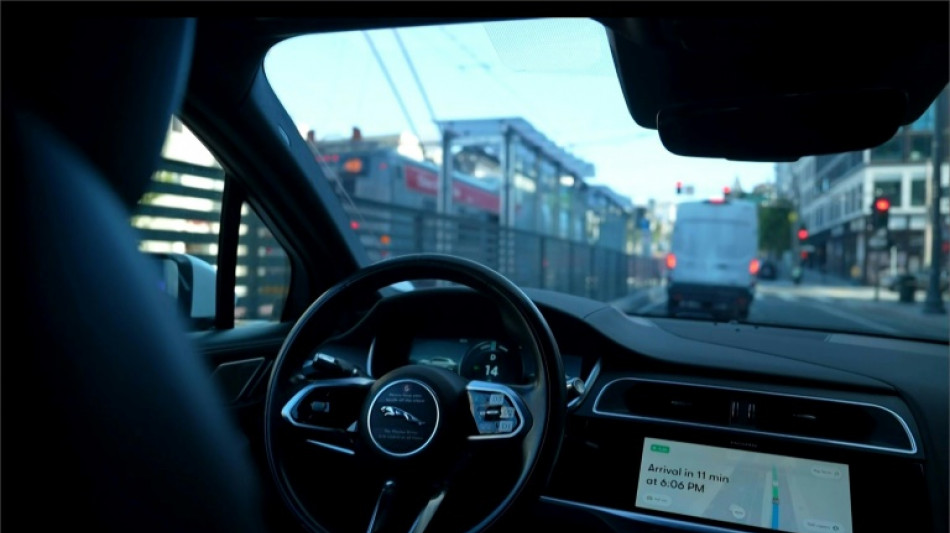
Self-driving car revolution is coming, but slowly / Photo: © AFP

 Libya's pay strike rallies teachers across divided nation

 Four-member crew blasts off for International Space Station
 i-payout Expands True Local Payment Capabilities to Help Enterprises Pay Recipients Globally
 Botched US execution prompts global calls to scrap death penalty

 Algeria adopts law imposing death penalty on forest arsonists
 France unveils cost-cutting 2027 budget as borrowing costs rise

 Brazil court orders removal of fake posts amid patron saint election row
 Italy's firefighting planes return home after scorching summer

 How airlines try to make sure pilots are safe to fly

 Bolivia's attorney general arrested for alleged money laundering and drug trafficking

 Zverev beats Norrie to kick off Sinner-less China Open

 Wall Street stocks rise after bond yield spike eases

 Finland investigates suspected break-ins at MPs homes
 London's Bayeux Tapestry show to offer audio tour for blind people

 Smouldering bins, halted trams as French pupils protest

 Malone Life and Pensions Expands Internationally Beyond the European Union

 England paceman Archer rested for ODI tri-series

 Queiroz exits Ghana as Black Stars crisis deepens

 ALEX BODI VE ALMAN ŞİRKETLER GRUBUNDAN HALLE’DE 166 DAİREYE YATIRIM

 อเล็กซ์ โบดี และกลุ่มบริษัทจากเยอรมนีลงทุนในอพาร์ตเมนต์ 166 ยูนิตที่เมืองฮัลเลอ

 ALEX BODI A NĚMECKÝ KONCERN INVESTUJÍ DO 166 BYTŮ V HALLE
 ALEX BODI OCH TYSK KONCERN INVESTERAR I 166 LÄGENHETER I HALLE

 England forward Toney pleads not guilty to nightclub assault

 Tom Kim finishes marathon Asian Games second round under floodlights

 Work on migrant return hubs progressing well, EU countries say
In Munich, where this week's IAA motor show is taking place, an interactive street survey elicits an overwhelming "yes" when asking passers-by if they would take a self-driving taxi from the station to the Oktoberfest beer festival.
But while the number of coloured balls placed in the "yes" column shows no shortage of enthusiasm, experts say the long-promised future of autonomous cars remains some way off.
"Five years ago, we thought that by 2025 we would have significant autonomy in many vehicles, which is not the case," said Christophe Aufrere, chief technical officer of car-parts maker Forvia.
Pandemic-related disruptions to the car industry, a shift towards investing in electrification and the sheer complexity of the technology have all contributed to keeping the autonomous-driving revolution stuck in the slow lane.
Now, "we're more inclined to say it will happen by 2030," Aufrere told AFP.
Ahead of the pack, German luxury carmaker Mercedes-Benz has received international approval for its "level three" autonomous driving system in accordance with United Nations standards.
The hands-free level three allows for autonomous driving in certain conditions such as heavy traffic or motorway speeds up to 60 kilometres per hour (37 mph). The driver can take their eyes off the road but must be ready to intervene if needed.
The system is available as an option on the flagship Mercedes S-Class, which has a six-figure price tag.
Honda won a world-first approval to sell level three autonomous cars in Japan in 2021.
But the vast majority of today's commercially available cars come equipped with "level two" partial automation at best.
That includes Tesla's well-known "autopilot" and offers features such as adaptive cruise control or automated parking -- while the driver remains alert at all times.
- 'Step by step' -
But the driverless "robotaxis" teased by the Munich survey remain a futuristic dream in most cities, with Europe lagging behind the United States and China in trialling such services in the real world.
These "level four" vehicles, like the robot cabs from Waymo or Cruise used in San Francisco, can operate without human intervention within designated areas.
The uneven deployment in Europe wasn't down to regulations or technological challenges but rather a matter of funding that was harder to come by on the continent, according to Christophe Perillat, CEO of French automotive supplier Valeo.
Nevertheless, "autonomous vehicles are making progress year after year," Perillat said at the IAA.
Professor Lutz Eckstein from RWTH Aachen University agreed, saying "significant advances" were on the horizon.
So-called level 2+ systems that also monitor the driver's attentiveness and fatigue are expected to become more widespread, he said, predicting that the number of level three systems on the market would also increase.
"By the end of the decade, we want to achieve the ability to drive on the motorway at speeds of 130 kilometres per hour," a Mercedes spokesperson told AFP.
The company aims to offer level four highly-automated driving by the same deadline.
"The idea is to proceed step by step," confirmed Forvia's CTO Aufrere. "Because we want to be sure it works."
C.Meier--BTB