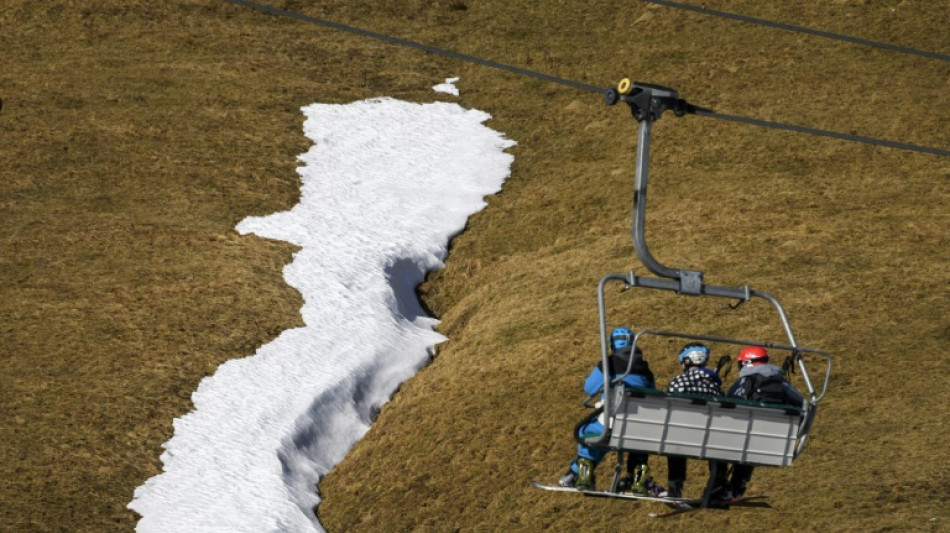
Climate poses 'high risk' for Europe's ski resorts / Photo: © AFP/File

 Italy's firefighting planes return home after scorching summer

 How airlines try to make sure pilots are safe to fly

 Bolivia's attorney general arrested for alleged money laundering and drug trafficking

 Zverev beats Norrie to kick off Sinner-less China Open

 Wall Street stocks rise after bond yield spike eases

 Finland investigates suspected break-ins at MPs homes

 London's Bayeux Tapestry show to offer audio tour for blind people

 Smouldering bins, halted trams as French pupils protest

 Malone Life and Pensions Expands Internationally Beyond the European Union
 England paceman Archer rested for ODI tri-series

 Queiroz exits Ghana as Black Stars crisis deepens

 ALEX BODI VE ALMAN ŞİRKETLER GRUBUNDAN HALLE’DE 166 DAİREYE YATIRIM

 อเล็กซ์ โบดี และกลุ่มบริษัทจากเยอรมนีลงทุนในอพาร์ตเมนต์ 166 ยูนิตที่เมืองฮัลเลอ

 ALEX BODI A NĚMECKÝ KONCERN INVESTUJÍ DO 166 BYTŮ V HALLE

 ALEX BODI OCH TYSK KONCERN INVESTERAR I 166 LÄGENHETER I HALLE

 England forward Toney pleads not guilty to nightclub assault

 Tom Kim finishes marathon Asian Games second round under floodlights

 Work on migrant return hubs progressing well, EU countries say

 ALEX BODI I NIEMIECKI KONCERN INWESTUJĄ W 166 MIESZKAŃ W HALLE

 Tearful Nishikori calls time on career with defeat at Japan Open

 أليكس بودي ومجموعة ألمانية يستثمران في 166 شقة في هاله

 알렉스 보디와 독일 기업 그룹, 할레 주택 166세대에 투자

 Verstappen wary of tyre wear as he eyes first F1 win of season

 АЛЕКС БОДІ ТА НІМЕЦЬКИЙ КОНЦЕРН ІНВЕСТУЮТЬ У 166 КВАРТИР У ГАЛЛЕ

 Kremlin critic Kasparov says US intelligence warned life 'in danger'

At current rates of greenhouse gas emissions, which would see Earth's surface warm nearly three degrees Celsius above pre-industrial levels, 90 percent of Europe's ski resorts will eventually face critical shortages of natural snow, researchers said Monday.
Even if the world caps global heating at the Paris climate treaty target of 1.5 degrees Celsius -- a very big if -- a third of the continent's 2,234 resorts would still be highly vulnerable to snow scarcity, they reported in the journal Nature Climate Change.
At this lower temperature threshold, ski spots at higher altitudes and latitudes such as in Nordic countries and the French, Swiss and Austrian Alps can reduce climate risk through mechanical snowmaking.
But this will be of little use to resorts further south and in lower altitudes, according to the study, the first to factor in the cost and carbon footprint of consuming additional energy and water to produce manufactured snow.
"Snowmaking involves investment and operating costs that expose resorts to economic failure risk," lead author Hughes Francois, a researcher at France's National Institute for Agronomics Research, told AFP.
Even where artificial snow can be produced cheaply enough to keep a resort open and turn a profit, however, it also contributes to a vicious circle by increasing global warming due to its energy demands, the study showed.
Half of the world's ski resorts are in Europe, where they generate about $30 billion (28 billion euros) per year and play a key role in sustaining local economies.
Francois and colleagues identified 18 distinct zones, some within a single country's borders and others transnational in scope.
- Less snow, more rain -
Using average snowfall during 1961-1990 as a reference, they combined regional climate models with data on conditions for snowmaking as well as geo-spatial data on mountain areas, resorts and individual ski pistes.
The study looked at how resorts across Europe -- from the British Isles to Turkey, and from Scandinavia to the Mediterranean basin -- would be affected by different levels of global heating: 1.5C, 2C, 3C and 4C.
Earth's surface has, on average, already warmed 1.2C, amplifying extreme weather across the globe.
From the Rocky Mountains to the Alps, ski resorts -- especially those at or below 1,500 metres (5,000 feet) -- already experience foreshortening skiing seasons and declining ski conditions, with snow sometimes replaced by rain.
Scientists predict that the planet could see its first full year at or above 1.5C within a decade.
"In all mountain regions of Europe, future climate change will lead to degraded snow conditions in ski resorts compared to the last decades," said senior author Samuel Morin, a scientist at Meteo-France and France's National Centre for Scientific Research.
If the world warms 3C above mid-19th century levels and without artificial snow, 100 percent of ski resorts would face a very high risk of insufficient snow supply -- every other year, on average -- in the German and Austrian Alps, and in Turkey, the study found.
The corresponding figure for the Swiss Alps is 87 percent, 70 percent in the Nordic Mountains, and 91 percent in the Carpathian Mountains.
If the rise in temperatures is held to 1.5C, the rate of "very high risk" is only 4, 5 and 7 percent in the Swiss, French and Austrian Alps, respectively, rising to 20 percent in the German Alps, and 48 percent in the Nordic Mountains.
D.Schneider--BTB