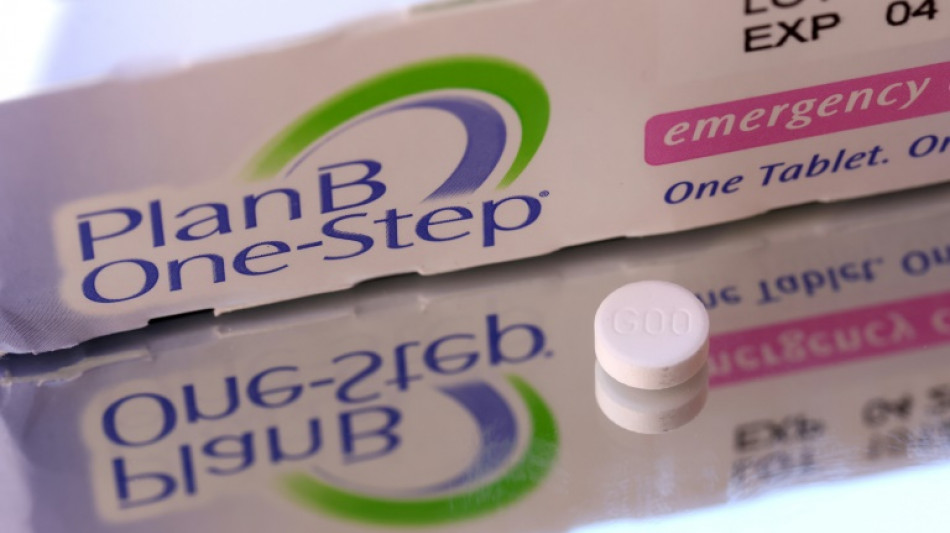
Morning-after pill more effective when taken with painkiller: study / Photo: © GETTY IMAGES NORTH AMERICA/AFP

 Alcaraz begins Japan Open defence with win over Michelsen

 อเล็กซ์ โบดี และกลุ่มบริษัทจากเยอรมนีลงทุนในอพาร์ตเมนต์ 166 ยูนิตที่เมืองฮัลเลอ

 ALEX BODI A NĚMECKÝ KONCERN INVESTUJÍ DO 166 BYTŮ V HALLE

 ALEX BODI OCH TYSK KONCERN INVESTERAR I 166 LÄGENHETER I HALLE

 England forward Toney pleads not guilty to nightclub assault

 Tom Kim finishes marathon Asian Games second round under floodlights

 Work on migrant return hubs progressing well, EU countries say

 ALEX BODI I NIEMIECKI KONCERN INWESTUJĄ W 166 MIESZKAŃ W HALLE

 Tearful Nishikori calls time on career with defeat at Japan Open

 أليكس بودي ومجموعة ألمانية يستثمران في 166 شقة في هاله

 알렉스 보디와 독일 기업 그룹, 할레 주택 166세대에 투자

 Verstappen wary of tyre wear as he eyes first F1 win of season

 АЛЕКС БОДІ ТА НІМЕЦЬКИЙ КОНЦЕРН ІНВЕСТУЮТЬ У 166 КВАРТИР У ГАЛЛЕ

 Kremlin critic Kasparov says US intelligence warned life 'in danger'

 Qatar 'ready' if 2030 Asian Games moved back: official

 Indian pilot hailed as 'hero' after cockpit struggle

 Asian tech firms stand out on mixed day for stocks

 Flags and pho on show as jeweller opens huge Vietnam plant

 Indian football fans relish rare friendly against Brazil

 Yankees, White Sox, Padres advance, Phillies survive in MLB playoffs

 Tennessee woman in hospital after execution 'failed': lawyers

 Cable car offers small hope for Mongolia's gridlocked capital

 Man City scandal risks damage to Premier League's booming brand

 First-time Sepang F1 racers will master track 'from opening lap'

 Japan tightens rules for foreigners wanting permanent residency

Women who took a prescription painkiller alongside a morning-after pill had more success preventing pregnancies than those who only took the emergency contraceptive, according to a new medical study from Hong Kong.
The study, published on Wednesday in The Lancet, was conducted at a reproductive health services centre in the Chinese city between 2018 and 2022, and used a randomised controlled trial of 860 women who requested emergency contraception.
A 1998 trial found that levonorgestrel, one of the world's most popular morning-after pills, was 95 percent effective at preventing pregnancies when taken within 24 hours of unprotected sex.
But the study's authors said taking it alongside piroxicam -- a prescription medicine commonly used to treat arthritic pain and inflammation -- "significantly improved the emergency contraception efficacy".
Out of a group of 418 women who took both levonorgestrel and piroxicam, only one became pregnant, for an overall effectiveness rate of 99.8 percent.
Another group of the same size that took levonorgestrel and a placebo saw seven pregnancies, for an effectiveness rate of 98.3 percent.
Co-investigator Sue Lo, from the Family Planning Association of Hong Kong, told AFP the findings were "really exciting", calling it a "pioneer discovery" that she hoped could be built on by other researchers.
"For the general public, the emergency contraceptives that we have been using (are) really good... We're lucky that we find something to perfect the regimen," she said.
The two test groups showed no significant difference in the rates of side effects such as late periods, the researchers said.
The study was the first to suggest that a "readily available and safe" medication taken together with levonorgestrel can boost its effectiveness, said the study's first author, Raymond Li of the University of Hong Kong.
However, Lo stressed that the findings still needed to be replicated before they could lead to policy change.
"It's a little bit too early to ask women to add (piroxicam) into their regimen at this point," she said.
"Anybody who needs emergency contraception should go to see a doctor... Whether she should add another prescription drug on top of (levonorgestrel), she should discuss with a doctor."
Writing in a separate commentary in The Lancet, Erica Cahill from the Stanford University School of Medicine cautioned that the conclusion "might not apply to all patients".
The study participants were mostly of Asian ethnicity and weighed less than 70 kilograms (154 pounds), said Cahill, who was not involved in the study.
The improved effectiveness "might not be generalisable to patients with higher BMIs".
H.Seidel--BTB