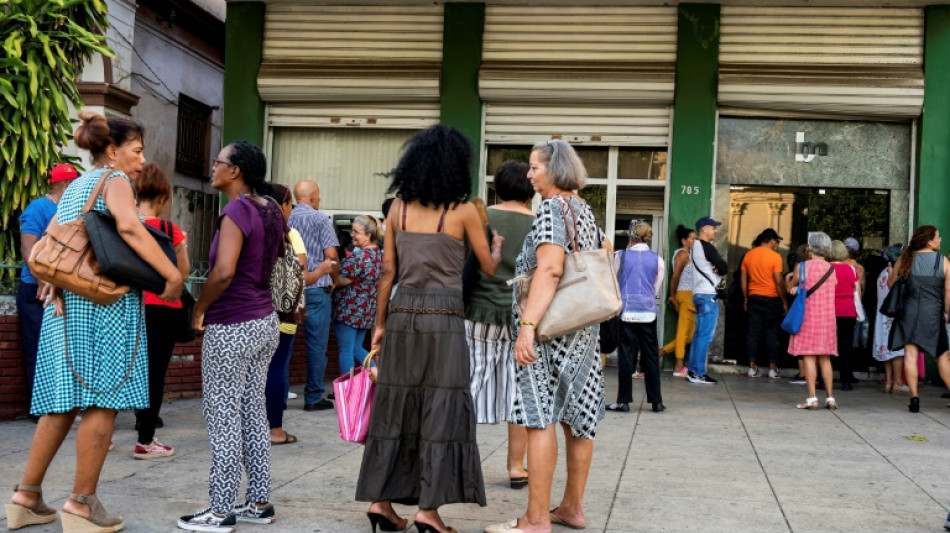
Cubans wary of banks as government cracks down on cash / Photo: © AFP

 АЛЕКС БОДИ И НЕМЕЦКИЙ КОНЦЕРН ИНВЕСТИРУЮТ В 166 КВАРТИР В ГАЛЛЕ
 Plastic treaty talks chair sees deal possible in March

 ALEX BODI AND GERMAN CONGLOMERATE INVEST IN 166 APARTMENTS IN HALLE
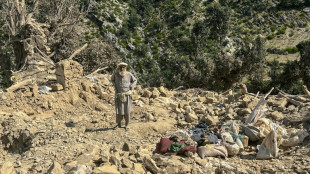 Afghanistan says deadly Pakistani strikes hit Helmand

 India thump Sri Lanka, will face Pakistan for Asian Games cricket gold

 Woman in hospital after Tennessee's second failed execution in 2026

 Cash-strapped Senegalese unmoved by Youth Olympic Games

 Indonesia haze chokes neighbours, but little legal recourse

 Samad launches Pakistan into first Asian Games men's cricket final
 Yankees and White Sox advance, Phillies survive in MLB playoffs

 Asian stocks mixed as positive US data offset by elevated oil, bond yields
 Rice work: Dutch test new crop to save sinking peatlands
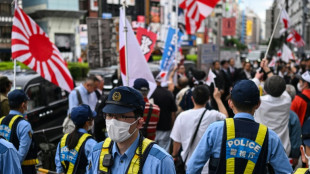
 Russians join street choirs to sing away sorrows -- or show dissent

 UK fears grow over AI giant Palantir's health service deal

 Empty nets in Latin America as fish flee El Nino

 Meidroth blasts White Sox through, Phillies survive in MLB playoffs

 'Catastrophic': Swiss glaciers lose fifth of mass in five years

 California roller coaster shut after brain damage claims

 Panama ministers push for reopening of huge open-pit copper mine

 Bohm's blast keeps Phillies alive in MLB playoffs

 US judge accepts Paramount's Warner Bros. buyout settlement

 Global stocks mixed as markets weigh higher oil prices, bond yields
 Marsh hails improvements after Australia win final one-day international

 Hegseth says US cut number of generals, admirals by 20%

 Kanye West's Russian concerts have been cancelled, organisers say

Accustomed to lugging around thick wads of cash, Cubans are skeptical of government efforts to force them to deposit their money into a crumbling banking system, in an effort to curb runaway inflation and boost liquidity.
The communist country is experiencing its worst economic crisis in decades, with double-digit inflation and rampant money printing in recent years boosting the amount of cash on the street.
Long wary of the country's poorly functioning banks, Cubans have in recent months embraced cash even more, to avoid long lines and withdrawal limits at ATMs.
The government, seeking liquidity, transparency, and greater control over monetary flow, last week announced restrictions on cash payments to force businesses and citizens to use electronic payments.
Cash transactions will be limited to 5,000 pesos (about $20 on the black market), under the reform which is to be gradually implemented over the next six months.
"In the times we are living in, 5,000 pesos is nothing," said mechanical engineer Lisandra Pupo, 30, who like most Cubans, prefers to have her cash safely in hand.
Soaring prices and the loss of value of banknotes mean people on the island have to cram cash into a bag or backpack to pay even minor purchases.
"If I had a lot of money, I would not put it in the bank, because if I need it tomorrow and I go to the bank, they will not be able to give it to me, so I will have to wait three days, or until the bank has enough money," said Pupo.
Independent economist Omar Everleny Perez said that "with such high prices and the inexistence of high denomination banknotes" the push toward banking is essential.
- Outdated banking tech -
However, Cuba's outdated banking system risks leaving users with no way of accessing their money at all.
Internet is unreliable, many people don't have smartphones for contactless payments, and Central Bank president Joaquin Alonso on Monday admitted there were few terminals for card payments.
"To install point-of-sale terminals, a communication line is required ... now imagine how much investment we would need to put terminals in all points of sale," said Alonso.
"This demands a lot of us, but we are not saying we won't move forward.
"Today there is a significant level of cash that is outside the banking system. That money does not circulate through the logical paths of the economy and is only traded between people," said Alonso.
He said the mass of freely circulating cash was "incentivizing the inflationary spiral."
- Complex economic crisis -
The island nation's current economic crisis is multi-pronged, and comes with a backdrop of decades of US sanctions, inefficiency, lack of foreign investment, and a heavy reliance on imports.
Former US President Donald Trump toughened sanctions against Cuba, and then the Covid pandemic battered the tourism industry -- the government's main source of foreign exchange -- which has battled to recover.
In 2021, a monetary reform phasing out a convertible peso pegged to the dollar, led the regular peso's value to plummet.
There are endless queues for food, fuel, and medicine, prompting an exodus of Cubans seeking to flee the island.
Year-on-year inflation reached 45.8 percent in May, while in 2022 it was 39 percent, according to official figures, but analysts believe it has already reached triple digits.
Small businesses in Cuba, given legal status for the first time in 2021 in a country where state-run stores were long the only option, also dread the switch to electronic transactions.
Private business consultant Oniel Diaz wrote on his Facebook account that these businesses will lose their ability to import "in an environment of scarcity and inflation."
lp/mr/fb/tjj
L.Dubois--BTB