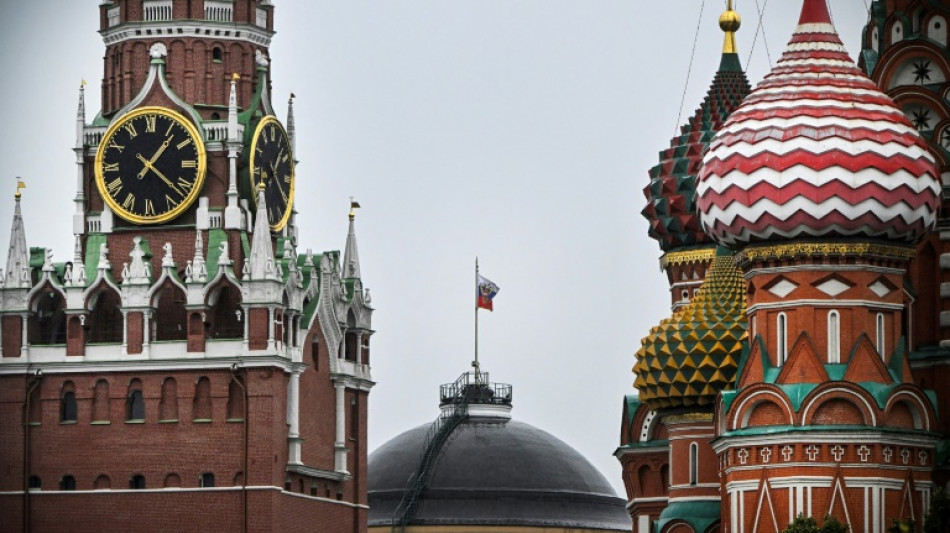
'Unsettled' Moscow residents tighten belts as ruble tanks / Photo: © AFP

 АЛЕКС БОДИ И НЕМЕЦКИЙ КОНЦЕРН ИНВЕСТИРУЮТ В 166 КВАРТИР В ГАЛЛЕ
 Plastic treaty talks chair sees deal possible in March
 ALEX BODI AND GERMAN CONGLOMERATE INVEST IN 166 APARTMENTS IN HALLE
 Afghanistan says deadly Pakistani strikes hit Helmand

 India thump Sri Lanka, will face Pakistan for Asian Games cricket gold

 Woman in hospital after Tennessee's second failed execution in 2026
 Cash-strapped Senegalese unmoved by Youth Olympic Games

 Indonesia haze chokes neighbours, but little legal recourse

 Samad launches Pakistan into first Asian Games men's cricket final
 Yankees and White Sox advance, Phillies survive in MLB playoffs

 Asian stocks mixed as positive US data offset by elevated oil, bond yields
 Rice work: Dutch test new crop to save sinking peatlands
 Russians join street choirs to sing away sorrows -- or show dissent

 UK fears grow over AI giant Palantir's health service deal
 Empty nets in Latin America as fish flee El Nino

 Meidroth blasts White Sox through, Phillies survive in MLB playoffs

 'Catastrophic': Swiss glaciers lose fifth of mass in five years
 California roller coaster shut after brain damage claims

 Panama ministers push for reopening of huge open-pit copper mine

 Bohm's blast keeps Phillies alive in MLB playoffs

 US judge accepts Paramount's Warner Bros. buyout settlement

 Global stocks mixed as markets weigh higher oil prices, bond yields
 Marsh hails improvements after Australia win final one-day international
 Hegseth says US cut number of generals, admirals by 20%

 Kanye West's Russian concerts have been cancelled, organisers say

In central Moscow, retired businessman Igor Inkin is preparing to turn down simple pleasures like dessert as the value of the ruble in his pocket continues to slide.
At 63 years old, he has seen the highs and lows of Russia's turbulent economy, but 17 months into the Kremlin's Ukraine offensive, Inkin is concerned about how to make ends meet.
The ruble has been trading around 97 against the dollar in recent days -- its lowest level since March 2022, weeks after Moscow unleashed full-scale hostilities in Ukraine.
"Prices in the shops are going up and we're having to adjust our expenditures. It's very unsettling," Inkin told AFP.
"We are denying ourselves many, many things... sweets and so on."
Coupled with a year and a half of unprecedented Western sanctions and a sharp drop in oil revenues, Russians are starting to feel the pinch.
Inflation has been on the rise since spring, forcing the central bank to hike its key rate to a greater-than-expected 8.5 percent to rein in prices.
"The situation with the ruble is especially worrying for us pensioners," Inkin said.
- 'Prices have gone up' -
For young Russians, who now face the kind of isolation their Soviet peers remember, the outlook is bleak.
President Vladimir Putin insists Moscow will weather the storm, presenting it as a historic opportunity to bolster Russia's domestic businesses and create jobs for the country's youth.
Many Muscovites echoed Putin's hope that isolation from the West would lead to a renaissance for Russian-made companies and businesses.
But, far from what is shown on Kremlin-controlled television screens, many are struggling.
Dmitry Bobrov, a 19-year-old freelance IT fixer and bicycle courier, cannot always afford spare computer parts.
"Video cards, processors... after the ruble fell their prices have gone up a lot," he said, weighed down by a large courier bag.
Western sanctions have made it harder for Russian businesses to buy goods and parts from abroad, forcing them to rely on parallel imports -- goods transported via another country.
The United Kingdom on Tuesday introduced new sanctions targeting Russia's access to military equipment, adding to a long list of restrictions designed to isolate the country.
"The special military operation is also having a big impact, I think," Bobrov said, using the Kremlin term for its offensive in Ukraine.
Around him, billboards of Western brands have largely disappeared, replaced by huge portraits of Russian soldiers.
- 'This cannot go on forever' -
While many Russians appear publicly stoic and receptive to the Kremlin's narrative, data show they are increasingly worried about their livelihoods.
Fearing for their savings, Russians withdrew one billion rubles in cash ($10.3 million) in the three days after the Wagner mercenary group staged a mutiny, according to central bank figures.
The number is some five times higher than the average of a normal three-day period in Russia.
Sofya Donets, chief economist for Russia at Renaissance Capital, said the weakening of the ruble presented no risk to the country's financial stability.
Analyst Arnaud Dubien meanwhile said the drop in the rouble was expected, reflecting the country's foreign trade.
What is not expected, he said, is that "the ruble is weakening even as the price of oil increases again." The Russian economy relies heavily on oil and gas exports.
He warned that the government must be careful not to let the ruble slip past 100 dollars to 1 ruble.
"Тhis could fuel speculation in society that the country has fallen by the wayside," he added.
Fyodor Tikhonov, a 37-year-old working in the film industry, said putting food on the table for his family has become far pricier.
He used to be able to buy dinner in the supermarket for around 1,000 rubles ($10).
"Now, it's minimum 2,000," the video editor said as he took his son to the shop.
"This cannot go on forever," he said.
F.Pavlenko--BTB