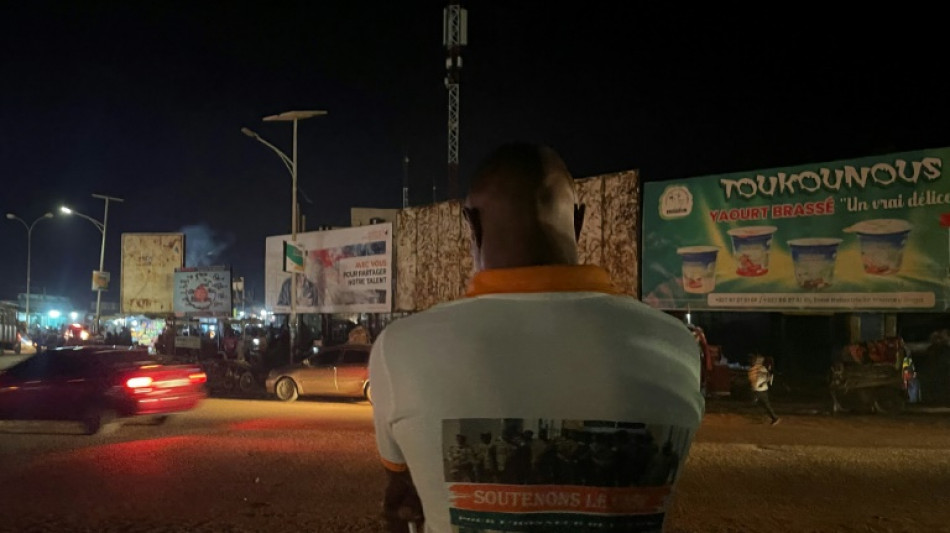
Coup sanctions plunge Niamey into the dark / Photo: © AFP

 Asian tech firms stand out on mixed day for stocks
 Flags and pho on show as jeweller opens huge Vietnam plant

 Indian football fans relish rare friendly against Brazil

 Yankees, White Sox, Padres advance, Phillies survive in MLB playoffs
 Tennessee woman in hospital after execution 'failed': lawyers
 Cable car offers small hope for Mongolia's gridlocked capital

 Man City scandal risks damage to Premier League's booming brand
 First-time Sepang F1 racers will master track 'from opening lap'
 Japan tightens rules for foreigners wanting permanent residency

 'Happiest moment': China's Mu first woman to win eSports Games gold

 EU talks deportations as five nations seek migrant centre in Africa

 Kenneth Branagh examines the scars of Iraq war in 'Atonement'

 Hundreds held, dozens wounded as French school protests escalate
 US government's new AI chatbot pulls back from debunking Trump
 US tennis star Navarro reveals health battle, ends season
 Panic, anger, tears: Evan Gershkovich's uneasy journey after Russian jail

 UK PM says 'strong indications' Iran involved in airbase incident

 Google restricts access to new AI model over safety concerns

 Watchdog clears former US Fed chief Powell in renovation probe
 Israel PM hails Indian pilot of rerouted flight for averting disaster

 Fury, Joshua kick off 'battle of Britain' in good spirits

 Ronaldo leaves Portugal training camp after coach says he is dropped

 Florence Pugh stars in 'East of Eden' adaption on Netflix

 Watchdog finds no criminal misconduct over US Fed renovations despite Trump probe
 In Manchester, City fans 'devastated' while rival fans call for relegation

The long-suffering people of Niger's capital, Niamey, are used to intermittent power cuts. But since the coup d'etat one week ago, interminable blackouts have tested their patience to the limit.
Faced with hours of enforced downtime every day, the poorer districts of the capital erupt into cheers of relief when lights, fridges and tools finally hum back into life.
In the Dan Zama area, the electric sewing machines in Issa Adamou's workshop are silent. Their owner idly swats at mosquitoes with a fan while he settles in for the long wait.
A group of young people while away the time at a "fada" ("club") down the street, sipping tea in the half-dark, while a chorus of frogs serenades them from the gloom of a nearby pond.
After the military took power on July 26, Niger's neighbours not only slapped financial sanctions on the coup leaders, they stopped transmitting electricity to the poverty-stricken Sahel country.
Given that 70 percent of Niger's power comes across the border from Nigeria, that has been a major blow.
Not that the Nigerian network was reliable. Blackouts there had a knock-on effect on Niger, one of the poorest countries in the world.
But now the state power company Nigelec has only its meagre domestic generation plants to rely on and their output is far from sufficient to supply the capital and its two million inhabitants.
Fada owner Kadi Moukaila is not impressed.
"Customers complain because they can't get chilled drinks here any more," she grumbles.
Elhadj Tidjani, a 70-year-old resident of Gawaye, on the other bank of the Niger river from Dan Zama, is also fuming.
"You can't hear the call to prayer from the loudspeaker at the mosque because of these damned power cuts," he complains.
- 'We can hold out for ages' -
The daily blackout is heralded, in the wealthier parts of the city, by the roar of an army of generators firing up shops, service stations, chemists and plush villas.
In districts like Dan Zama and neighbouring Lazaret, street vendors gather around solar-powered streetlamps when darkness falls, or tout their wares under the light of Chinese-made torches which are becoming costlier by the day.
Aziz Hama, one of the tea-sipping coterie in the fada, thinks Niger will carry on coping as usual.
"We're used to blackouts. We can hold out for ages. Nigeria will have to find another way if it wants to put pressure on our country," he says.
Mohamed, a barber from Dan Zama, also tries to remain sanguine.
"Sourou, sourou ("Be patient")," he tells the restless gaggle of children waiting for him to shave their heads.
He has invested in rechargeable solar-powered shavers so he can carry on working regardless but business is much slower.
And, a mechanic by trade, he worries how long Niger can hold on.
"For the moment the power cuts last about four to five hours. We can cope with that.
"But what if one of the (Nigerelec) turbines goes?" he says.
- Difficult times ahead -
"These cuts come at a bad time. Prices are going through the roof because of the attacks," says Moukaila, referring to the jihadist insurgencies plaguing sections of the Sahel belt spanning Africa from west to east.
"They're making it hard to source supplies."
Moussa Abba, who owns a chemist in Niamey, is not taking any chances.
"We bought a new generator as backup. These aren't ordinary power cuts," he explains.
Halidou Jika, who sells frozen foods, says he now only keeps the minimal amount of stock "so I don't have to throw loads away" if the cold chain breaks.
Niger has played a key part in Western strategies to combat the jihadist attacks that have undermined the Sahel since 2012, with France and the United States stationing troops there.
But hostility to France is growing in former West African colonies such as Niger, Mali and Burkina Faso, while Russian influence, often via the Wagner mercenary group, is on the rise.
Niamey warehouse handler Souley Kanta thinks the people of Niger "are prepared to pay the ultimate sacrifice to get rid of neo-colonialism".
And coup leader Abdourahamane Tiani used the anniversary of Niger's independence from France to warn that the coming weeks and months "will be difficult for our country".
Nigelec hopes things will become easier for its customers once a new 30-megawatt solar power plant near Niamey comes on stream at the end of August.
It was built with a grant from the European Union and a loan from France.
J.Horn--BTB