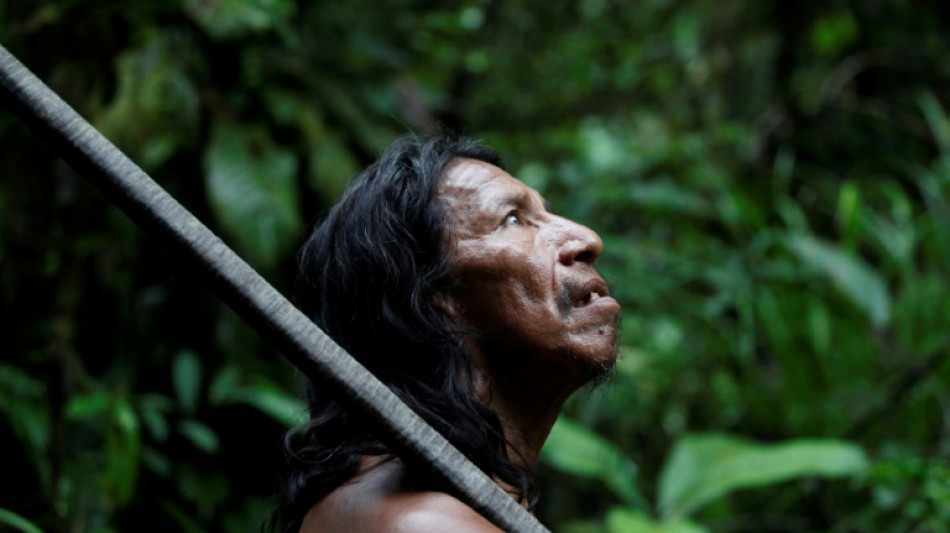
Ecuador jungle community hopes vote will end oil drilling / Photo: © AFP

 Cash-strapped Senegalese unmoved by Youth Olympic Games

 Indonesia haze chokes neighbours, but little legal recourse
 Samad launches Pakistan into first Asian Games men's cricket final
 Yankees and White Sox advance, Phillies survive in MLB playoffs

 Asian stocks mixed as positive US data offset by elevated oil, bond yields
 Rice work: Dutch test new crop to save sinking peatlands
 Russians join street choirs to sing away sorrows -- or show dissent

 UK fears grow over AI giant Palantir's health service deal

 Empty nets in Latin America as fish flee El Nino

 Meidroth blasts White Sox through, Phillies survive in MLB playoffs
 'Catastrophic': Swiss glaciers lose fifth of mass in five years

 California roller coaster shut after brain damage claims

 Panama ministers push for reopening of huge open-pit copper mine

 Bohm's blast keeps Phillies alive in MLB playoffs
 US judge accepts Paramount's Warner Bros. buyout settlement

 Global stocks mixed as markets weigh higher oil prices, bond yields

 Marsh hails improvements after Australia win final one-day international

 Hegseth says US cut number of generals, admirals by 20%

 Kanye West's Russian concerts have been cancelled, organisers say

 First Hollywood, now Fat Bear Week: nepobaby wins Alaska contest

 Barcelona lay down marker in Women's Champions League, Arsenal slip up

 US pushes against overproduction with eye on China at G20 meeting

 Swiss FA withdraws support for FIFA chief Infantino
 Man City's meteoric rise clouded by financial scandal

 Polish activists open first abortion pill locker in Warsaw

Armed with a long blowgun and darts laced with poison extracted from plants, Kominta walks naked through the thick Ecuadorian jungle, where oil exploration is threatening his way of life.
"The jungle is my home, and I don't want strangers in my territory," the Waorani hunter tells AFP in the southeastern village of Bameno, in a region bordering Peru.
His community of about 200 people is in Yasuni National Park, one of the most diverse biospheres in the world, and home to two of the world's last uncontacted Indigenous populations.
On August 20, along with general elections, Ecuadorans will vote in a referendum on whether to halt the exploitation of crude oil within the reserve, which currently provides 12 percent of the 466,000 barrels per day produced by the country.
"I don't want an oil company to reach my territory. That's how I want to live, freely, in a healthy place," adds Kominta in the Wao Terero language.
The government -- which opposes the referendum that was granted by the Constitutional Court in May -- estimates losses of some $16 billion over 20 years if the oil is left underground.
There are about 4,800 Waorani, who own some 800,000 hectares (1.9 million acres) of jungle in the Amazon provinces of Orellana, Pastaza and Napo.
However, the community -- some of whom still choose to live in isolation -- is divided, with some supporting the oil companies and the benefit economic growth has brought to their villages.
Drilling inside the Yasuni reserve began in 2016 after years of fraught debate and failed efforts by then President Rafael Correa to persuade the international community to pay Ecuador $3.6 billion not to do so.
But with his government strapped for cash amid a plunge in global oil prices, in the end the leftist leader asked Congress to give the go-ahead to drill.
Current President Guillermo Lasso, who took office in 2021, wants to double Ecuador's oil production.
- Grandmother ready to fight -
The oil industry "destroys the environment I live in," Kominta said through translator Elisa Enqueri.
Accessing Bameno requires 12 hours of navigation through various rivers in the Pastaza region.
"My grandmother says that she would fight with her spear. She has the energy and still feels young ... to prevent strange people from coming here," says Enqueri.
The Yasuni National Park houses some 2,000 tree, 610 bird, 204 mammal, 150 amphibian and more than 120 reptile species, according to the San Francisco University of Quito.
It is also home to the uncontacted Taromenane and Tagaeri tribes, who are rivals and sometimes fight each other. They have also attacked oil workers and loggers with their spears.
Oil activity "affects their way of life and puts their lives at risk. There is a serious risk of ethnocide, of the total extermination of these communities," said Pedro Bermeo, a lawyer and spokesman for Yasunidos, an environmental group backing the referendum.
Moi Guiquita, another young Wao, says the oil companies are "getting closer and closer" to Bameno.
"Sixty years ago they were much further away."
Indigenous communities seeking to escape their presence "can't go any further as there is no more" space, he said.
R.Adler--BTB