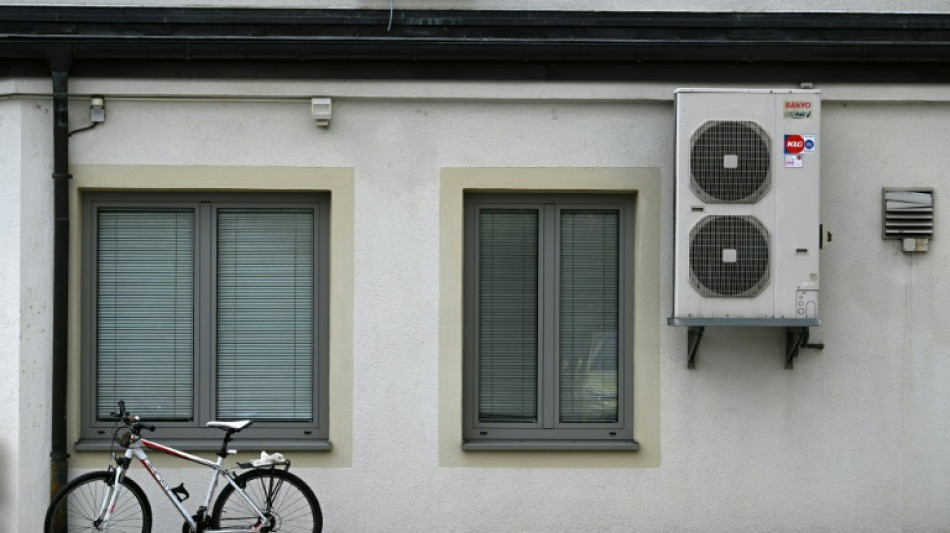
Less power, lower emissions: improving AC technology / Photo: © AFP

 Cable car offers small hope for Mongolia's gridlocked capital

 Man City scandal risks damage to Premier League's booming brand

 First-time Sepang F1 racers will master track 'from opening lap'

 Japan tightens rules for foreigners wanting permanent residency

 'Happiest moment': China's Mu first woman to win eSports Games gold

 EU talks deportations as five nations seek migrant centre in Africa

 Kenneth Branagh examines the scars of Iraq war in 'Atonement'

 Hundreds held, dozens wounded as French school protests escalate

 US government's new AI chatbot pulls back from debunking Trump

 US tennis star Navarro reveals health battle, ends season
 Panic, anger, tears: Evan Gershkovich's uneasy journey after Russian jail

 UK PM says 'strong indications' Iran involved in airbase incident

 Google restricts access to new AI model over safety concerns

 Watchdog clears former US Fed chief Powell in renovation probe

 Israel PM hails Indian pilot of rerouted flight for averting disaster
 Fury, Joshua kick off 'battle of Britain' in good spirits

 Ronaldo leaves Portugal training camp after coach says he is dropped

 Florence Pugh stars in 'East of Eden' adaption on Netflix

 Watchdog finds no criminal misconduct over US Fed renovations despite Trump probe

 In Manchester, City fans 'devastated' while rival fans call for relegation

 UK-France Channel migrant exchange deal scrapped: London

 Portugal boss denies 'incident' with Ronaldo

 Israel PM says one of the pilots of rerouted flight tried to crash plane

 Manchester City: Main points of damning judgement and possible sanctions

 Italy looking for 'identity' under Mancini says Scalvini

With air conditioner demand surging, scientists are looking for ways to improve the energy efficiency of cooling systems and limit damaging emissions that accelerate global warming.
- Improve efficiency -
Innovation is focused on three major fronts, with much of the attention on energy consumption. Air conditioning units account for six percent of electricity used in the United States.
Several breakthroughs have already cut power consumption by half since 1990, according to the US Department of Energy.
The most impactful was the so-called "inverter" technology, which makes it possible to modulate the motor's speed instead of running it at 100 percent continuously.
Other new features include demand controlled ventilation (DCV), which relies on sensors to determine the number of people in the building and adjust airflows.
- Different refrigerants -
Another major area is the search for substitutes to the refrigerant gases used in most of the nearly two billion installed AC units, according to the International Energy Agency.
For decades, air conditioners almost exclusively ran on chlorofluorocarbon (CFC) or hydrochlorofluorocarbon (HCFC) gases, which are thought to be up to 10,000 times as bad as CO2 in terms of global warming impact.
CFC and HCFC were banned under the Montreal Protocol, from 1987.
Then came hydrofluorocarbons (HFCs), which are now scheduled to be phased out by 2050.
Factories and commercial buildings already use other gases, such as ammonia -- which has no greenhouse gas impact -- as well as hydrocarbons, mainly propane, whose emissions are lower than methane.
"In some countries, you're starting to see hydrocarbon refrigerants," mostly propane, "being used, but there are restrictions around how much quantity you can put into the system" because such gas is flammable, said Ankit Kalanki, manager at the Rocky Mountain Institute.
Mandatory safety features make for a "level of sophistication" with "a price premium that gets added to the units itself," he added.
"And the residential air conditioning market tends to go towards the lowest first cost products, then the highest efficiency products."
Some are trying to go gasless, like Pascal Technology, a Cambridge, Massachusetts startup, that's working on a mechanism to keep refrigerants in a solid state, avoiding any discharge.
- A new generation -
Other innovation is focused on products that bypass compression, an energy-intensive process in air conditioning that has changed little since its invention in 1902.
Separate groups of scientists at the National University of Singapore (NUS) and the Wyss Institute at Harvard University, respectively have built air conditioners that use water to cool the air.
The Wyss Institute has already made prototypes based on its cSNAP model, that operates on a quarter of the electricity used in the traditional compression process.
The device is partly built with ceramic panels, made in Spain.
The startup Blue Frontier, which counts Bill Gates as an investor, uses a salt solution that captures the humidity of the air, then cools it through contact with water.
The solution also makes it possible to store energy, "so you're not having to deal with capacity limits of the infrastructure," said Daniel Betts, Blue Frontier's CEO.
The Florida-based startup plans to rent its AC units to commercial building owners for a subscription fee, recouping its investment from electricity savings.
Usually, acknowledges Betts, "building owners don't see the value, except for marketing, of having higher efficiency equipment."
"We eliminate the burden of financing high efficiency equipment, because we're doing it as a subscription service."
Air conditioning innovation has been slower to address the third major issue related to conventional units, the discharge of hot air outside buildings.
One of the few available options are geothermal heat pumps, which employ a grid of buried pipes that channel cooler temperatures from underground, and do not release warm air.
A.Gasser--BTB