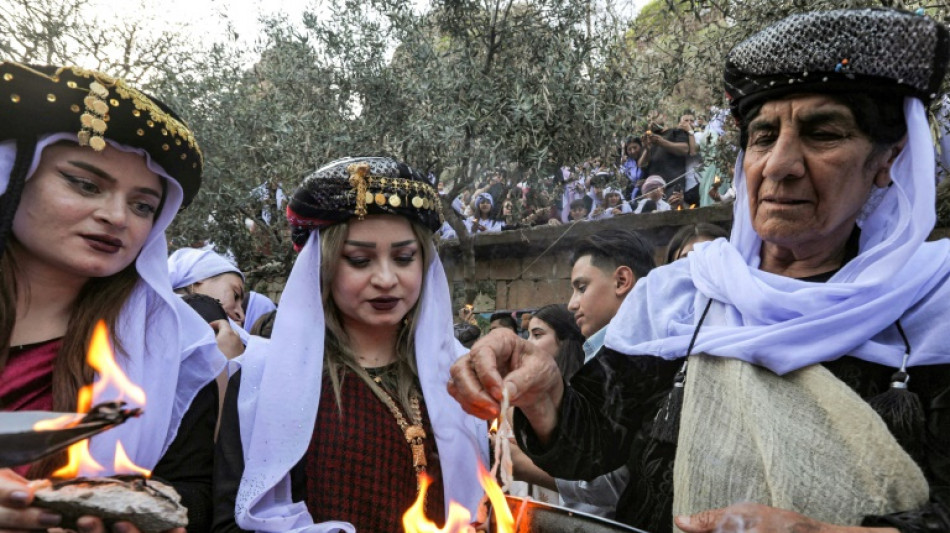
Iraq's Yazidis: reclusive group hunted by Islamic State / Photo: © AFP

 Cable car offers small hope for Mongolia's gridlocked capital

 Man City scandal risks damage to Premier League's booming brand

 First-time Sepang F1 racers will master track 'from opening lap'
 Japan tightens rules for foreigners wanting permanent residency

 'Happiest moment': China's Mu first woman to win eSports Games gold

 EU talks deportations as five nations seek migrant centre in Africa
 Kenneth Branagh examines the scars of Iraq war in 'Atonement'

 Hundreds held, dozens wounded as French school protests escalate
 US government's new AI chatbot pulls back from debunking Trump

 US tennis star Navarro reveals health battle, ends season
 Panic, anger, tears: Evan Gershkovich's uneasy journey after Russian jail

 UK PM says 'strong indications' Iran involved in airbase incident

 Google restricts access to new AI model over safety concerns

 Watchdog clears former US Fed chief Powell in renovation probe

 Israel PM hails Indian pilot of rerouted flight for averting disaster
 Fury, Joshua kick off 'battle of Britain' in good spirits

 Ronaldo leaves Portugal training camp after coach says he is dropped
 Florence Pugh stars in 'East of Eden' adaption on Netflix

 Watchdog finds no criminal misconduct over US Fed renovations despite Trump probe

 In Manchester, City fans 'devastated' while rival fans call for relegation

 UK-France Channel migrant exchange deal scrapped: London

 Portugal boss denies 'incident' with Ronaldo

 Israel PM says one of the pilots of rerouted flight tried to crash plane

 Manchester City: Main points of damning judgement and possible sanctions

 Italy looking for 'identity' under Mancini says Scalvini
The Yazidis, who Britain on Tuesday officially acknowledged as victims of "acts of genocide" by the Islamic State (IS), are a Kurdish-speaking ethno-religious minority found mainly in Iraq.
IS jihadists carried out horrific violence against the community in 2014, killing men en masse and abducting thousands of girls and women as sex slaves.
Here are some key facts about the Yazidis:
- Ancient faith -
The Yazidis are followers of an ancient religion that emerged in Iran more than 4,000 years ago and is rooted in Zoroastrianism.
Over time it has also absorbed elements of Islam and Christianity.
Organised into three castes -- sheikhs, pirs, and murids -- Yazidis pray to God facing the sun and worship his seven angels, led by Melek Taus, or Peacock Angel.
Their holiest site is Lalish, a stone complex of shrines and natural springs in Iraq's mountainous northwest.
Yazidis discourage marriage outside of their community and across their caste system.
Their beliefs and practices include a ban on eating lettuce and wearing the colour blue. Some Muslims wrongly accuse them of being devil worshippers.
The community was persecuted during Ottoman times and also under Iraqi dictator Saddam Hussein.
- Hunted by IS -
Of the world's nearly 1.5 million Yazidis, the largest number -- 550,000 -- lived in Iraq before the IS offensive in 2014.
The Sunni extremists attacked the Yazidi bastion of Sinjar in August 2014, killing more than 1,200 people, leaving several hundred children orphaned and destroying nearly 70 shrines, according to local authorities.
A further 6,400 Yazidis were abducted, around half of whom were rescued or managed to flee.
After the massacres, some 100,000 Yazidis fled to Europe, the United States, Australia and Canada, according to the UN.
Among those who found refuge in Germany was 2018 Nobel Peace Prize winner Nadia Murad who was captured, raped and forced to marry a jihadist before she was able to escape.
- 'Genocide' label -
In May 2021, a special UN investigation team said it had collected "clear and convincing evidence" that IS had committed genocide against the Yazidis.
Six months later, a German court was the first in the world to recognise crimes against the Yazidi community as genocide.
On Tuesday, Britain's government officially acknowledged that IS had committed "acts of genocide" against the Yazidis.
Germany's lower house of parliament in January also recognised the 2014 massacres as "genocide", following similiar moves in Australia, Belgium and the Netherlands.
burs-eab/cb/rox
O.Bulka--BTB