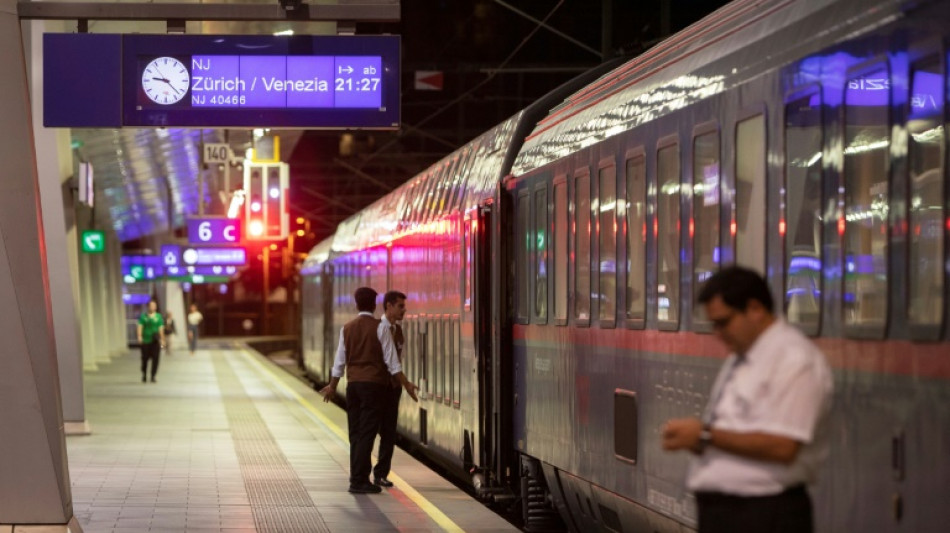
Back on track: Europe's night trains make bumpy comeback / Photo: © AFP

 Cable car offers small hope for Mongolia's gridlocked capital

 Man City scandal risks damage to Premier League's booming brand

 First-time Sepang F1 racers will master track 'from opening lap'

 Japan tightens rules for foreigners wanting permanent residency

 'Happiest moment': China's Mu first woman to win eSports Games gold
 EU talks deportations as five nations seek migrant centre in Africa

 Kenneth Branagh examines the scars of Iraq war in 'Atonement'

 Hundreds held, dozens wounded as French school protests escalate

 US government's new AI chatbot pulls back from debunking Trump
 US tennis star Navarro reveals health battle, ends season

 Panic, anger, tears: Evan Gershkovich's uneasy journey after Russian jail

 UK PM says 'strong indications' Iran involved in airbase incident

 Google restricts access to new AI model over safety concerns

 Watchdog clears former US Fed chief Powell in renovation probe

 Israel PM hails Indian pilot of rerouted flight for averting disaster

 Fury, Joshua kick off 'battle of Britain' in good spirits
 Ronaldo leaves Portugal training camp after coach says he is dropped

 Florence Pugh stars in 'East of Eden' adaption on Netflix

 Watchdog finds no criminal misconduct over US Fed renovations despite Trump probe

 In Manchester, City fans 'devastated' while rival fans call for relegation

 UK-France Channel migrant exchange deal scrapped: London

 Portugal boss denies 'incident' with Ronaldo

 Israel PM says one of the pilots of rerouted flight tried to crash plane

 Manchester City: Main points of damning judgement and possible sanctions

 Italy looking for 'identity' under Mancini says Scalvini

Night trains have made a comeback in Europe thanks to their low-carbon footprint, but after years of neglect, the renaissance has had a bumpy ride.
Operators admit that the trains are outdated -- with passengers facing the occasional delays, technical problems or malfunctioning toilets -- while companies compete in an overloaded network.
Despite the challenges, national rail operators are giving night trains another chance while startups are jumping on the bandwagon as climate concerns are making travellers ditch kerosene-burning planes for cleaner modes of transportation.
Sitting at the crossroads between western and eastern Europe, Austria has been at the heart of this revival with the backing of the government even as low-cost airlines threatened to relegate sleeper trains to the history books.
Austrian rail operator OeBB, a pioneer in the sector, has Europe's biggest fleet of night trains, serving 1.5 million passengers in carriages that include bed compartments.
The state-owned company considered abandoning its overnight services at one point, but it went the opposite direction and invested in them instead.
"Our night trains are nearly fully booked," OeBB spokesman Bernhard Rieder told AFP as summer travel is in full swing in Europe.
OeBB runs 20 routes connecting Vienna and other cities throughout Europe.
"We have a long tradition with night train service," Rieder said, pointing out how the Alpine nation's mountainous topography makes having high-speed connections difficult.
- 'Very convenient' -
Astrid Reiter, a 27-year-old consultant, booked a night train from Vienna to Zurich.
"It's nice because you basically wake up in a different country," she said. "If everything works out well, it's a very convenient way to travel."
She added: "I do hope that other companies other than the Austrian railway company develop more night trains and make it easier to have faster night trains."
Rieder admits that the quality of its service "is not always as high these days as what we want to deliver to our customers".
"There was no demand and no request for night trains for over 25 years" causing manufacturing to grind to a halt, he said.
In 2018, OeBB ordered 33 new night trains from German conglomerate Siemens to expand its reach and replace part of its ageing fleet.
The first trains -- with a modern design, more privacy and more shower facilities -- are expected to go into service at the end of this year.
Chris Engelsman, co-founder of the Belgian-Dutch startup European Sleeper, also complained about a shortage of "proper night train coaches".
Established in 2021, his company inaugurated a Berlin-Brussels link in May.
"The train is not always up to the modern standards, but despite that many people would like to travel by night train and the enthusiasm is quite big," he told AFP.
"There are breakdowns sometimes or the toilets are not working or electricity is not working properly, things like that," he added, blaming the "lack of investment for decades".
Competition from low-cost flights and a lack of coordination between different European rail operators and companies are other obstacles.
It is difficult to compete with some flights' "unreasonably low" prices, according to a recent report by NGO Greenpeace, with the aviation sector benefitting from subsidies and tax exemptions.
Rail transport, on the other hand, is "subject to various taxes and fees," in particular for using the infrastructure, said Philipp Kosok, an analyst at the German think tank Agora.
- 'Complex and expensive' -
"Operating night trains is very difficult, complex and expensive," Kosok said, adding that the infrastructure was "overloaded" even at night when freight trains ply the rails.
There is also no centralised site to consult timetables and compare prices, with some in the industry complaining of a lack of political will.
"There's not really a European approach to train travel at the moment," Engelsman said.
French startup Midnight Trains co-founder Adrien Aumont said his company's aim was to "reinvent" the night train "to make it a truly competitive means of transport against aviation".
Aumont had the idea to create the company when his partner "decided never to get on a plane again".
"I realised that it was almost impossible to travel in Europe (without flying). People were asked to get off the planes, but without necessarily offering them solutions," he told AFP.
He slammed a service that "has deteriorated" over time, far from the legendary and luxurious Orient Express.
D.Schneider--BTB