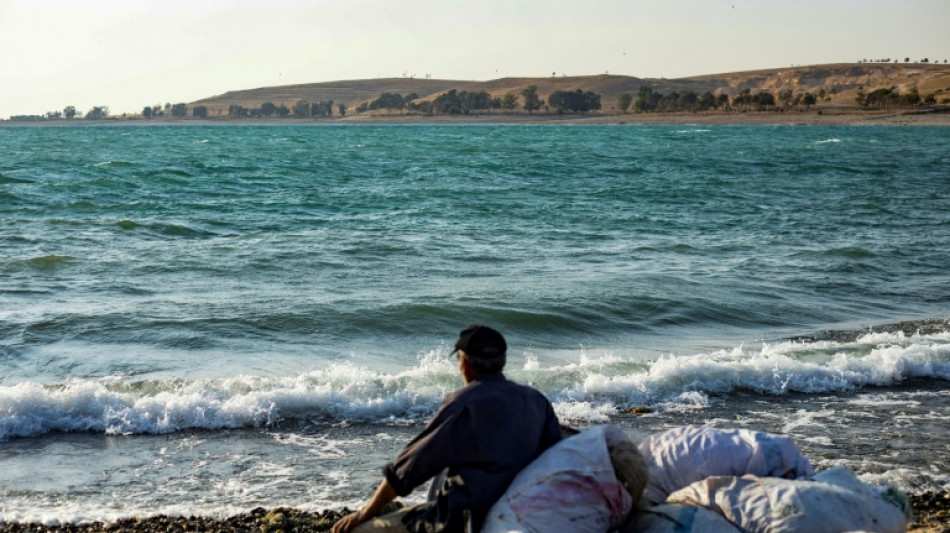
Syria fishermen despair at water loss, river pollution / Photo: © AFP

 UK fears grow over AI giant Palantir's health service deal

 Empty nets in Latin America as fish flee El Nino

 Meidroth blasts White Sox through, Phillies survive in MLB playoffs

 'Catastrophic': Swiss glaciers lose fifth of mass in five years

 California roller coaster shut after brain damage claims

 Panama ministers push for reopening of huge open-pit copper mine

 Bohm's blast keeps Phillies alive in MLB playoffs
 US judge accepts Paramount's Warner Bros. buyout settlement

 Global stocks mixed as markets weigh higher oil prices, bond yields

 Marsh hails improvements after Australia win final one-day international

 Hegseth says US cut number of generals, admirals by 20%

 Kanye West's Russian concerts have been cancelled, organisers say

 First Hollywood, now Fat Bear Week: nepobaby wins Alaska contest

 Barcelona lay down marker in Women's Champions League, Arsenal slip up

 US pushes against overproduction with eye on China at G20 meeting

 Swiss FA withdraws support for FIFA chief Infantino
 Man City's meteoric rise clouded by financial scandal

 Polish activists open first abortion pill locker in Warsaw

 NHL Avalanche ink Bednar to four-year coaching deal

 Polish activists opens first abortion pill locker in Warsaw

 Turkey says news site closed for 'LGBTQ propaganda'

 Oil companies close in on Venezuela despite hurdles

 Turkey freezes ex-minister's assets as fund scandal grows

 Guardiola backs Man City after bombshell guilty verdicts
 G20 trade ministers open talks under strain of Trump tariffs

Around war-torn Syria's biggest freshwater dam reservoir, fishermen say their catch is now a fraction of what it used to be as environmental pressures have decimated aquatic life.
Ismail Hilal, 50, sat on the hull of his rowboat -- now lodged firmly on the shores of Lake Assad -- as gentle waves washed in, talking about the way of life he has lost.
After 37 years as a fisherman, he has retired his nets, declaring defeat as fish stocks have declined, water levels have dropped and pollution has worsened in the Euphrates and the dam reservoir it feeds.
"I have spent my whole life on the water, since childhood," said Hilal, a father of seven. "But I was forced to stop this year. I couldn't live on fishing anymore."
Syria has endured more than a decade of civil war, and the nearby town of Raqa was the centre of the Islamic State group's brutal "caliphate" until their ouster in 2017.
The battered country, where half a million died in the conflict, has also suffered the impacts of climate change, from searing summer heat to prolonged drought.
The flow of the Euphrates -- one of the region's mighty streams, where the world's earliest civilisations flourished -- has been further impacted by upstream dams in Turkey.
Other fishermen AFP spoke to also blamed the river's low water levels, lack of rainfall, worsening pollution and overfishing for the sharp decline in fish stocks.
Fishermen now "barely take in five percent" of their catch from former times, Hilal said.
He now works in a restaurant in Tabqa, on the eastern edge of the lake, toiling in front of a flaming hot oven and preparing and grilling fish instead of catching them.
- 'Downward spiral' -
The Euphrates, said to have nourished the biblical Garden of Eden, runs for almost 2,800 kilometres (1,700 miles) through Turkey, Syria and Iraq, where it empties into the sea.
From the Turkish border, it flows southeast across Syria, irrigating its breadbasket region and filling the reservoirs of three hydroelectric dams that provide drinking water and electricity for millions.
Lake Assad is the biggest reservoir, stretching across 600 square kilometres (230 square miles).
But its water level has dropped by four metres (12 feet) since last year, says Dutch peace-building group PAX, which blames a "downward spiral of drought and water shortages".
The lack of water and the pollution are "driving further biodiversity loss along the lakes and rivers" in Syria's north and east, said the group's Wim Zwijnenburg.
Raqa province received only 208 mm per month of rainfall last year, according to the UN Food and Agriculture Organization.
An AFP team visiting Lake Assad saw vast plumes of algae -- an indicator of pollution, according to experts, that sucks oxygen from the water and kills aquatic life.
- 'Disastrous' situation -
When Ali Shebli, 37, a fisherman like his father, pulled in his long green nets, they were empty except for a few bits of the seagrass that now chokes some shallow areas.
"In the past, we could take in 50 kilogrammes of fish" per day, he said. "But now we barely get one or two kilos, and sometimes nothing ... because of the low water level and the pollution".
Shebli, who struggles to support his wife, three children and his ill father, said the falling fish stocks had made the family's situation "disastrous".
The crisis has impacted the wider local economy.
Fish are displayed on blocks of ice at a market in nearby Raqa, a town under Kurdish control since the IS was ousted by the Kurdish-led Syrian Democratic Forces.
But fishmonger Ragheb Ismail, 45, scaling fresh fish on a bench, said what is on offer now is a far cry from the times when there were "tons of fish" for sale.
"Now even the biggest fishmonger has no more than 200 kilogrammes on offer because of the drought, the lack of water and the high temperatures," he said.
These days, he said with frustration, there are plenty of customers but "not enough fish".
L.Janezki--BTB