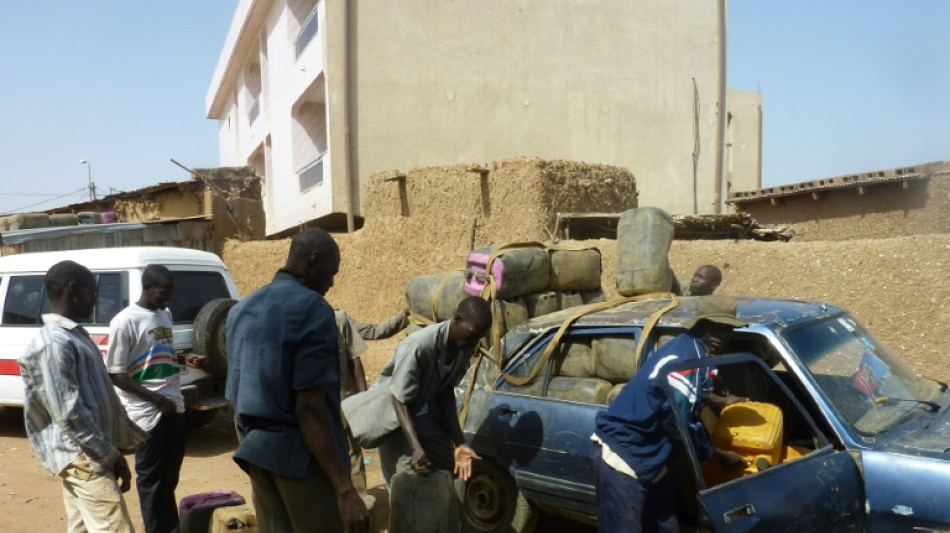
Nigeria's end to petrol subsidies hits Niger black market / Photo: © AFP/File

 UK fears grow over AI giant Palantir's health service deal

 Empty nets in Latin America as fish flee El Nino

 Meidroth blasts White Sox through, Phillies survive in MLB playoffs
 'Catastrophic': Swiss glaciers lose fifth of mass in five years

 California roller coaster shut after brain damage claims

 Panama ministers push for reopening of huge open-pit copper mine

 Bohm's blast keeps Phillies alive in MLB playoffs
 US judge accepts Paramount's Warner Bros. buyout settlement

 Global stocks mixed as markets weigh higher oil prices, bond yields
 Marsh hails improvements after Australia win final one-day international
 Hegseth says US cut number of generals, admirals by 20%

 Kanye West's Russian concerts have been cancelled, organisers say

 First Hollywood, now Fat Bear Week: nepobaby wins Alaska contest

 Barcelona lay down marker in Women's Champions League, Arsenal slip up
 US pushes against overproduction with eye on China at G20 meeting
 Swiss FA withdraws support for FIFA chief Infantino
 Man City's meteoric rise clouded by financial scandal

 Polish activists open first abortion pill locker in Warsaw
 NHL Avalanche ink Bednar to four-year coaching deal
 Polish activists opens first abortion pill locker in Warsaw

 Turkey says news site closed for 'LGBTQ propaganda'
 Oil companies close in on Venezuela despite hurdles

 Turkey freezes ex-minister's assets as fund scandal grows
 Guardiola backs Man City after bombshell guilty verdicts
 G20 trade ministers open talks under strain of Trump tariffs

On the road linking Niger's capital Niamey with the south of the country, illegal fuel warehouses have closed and intrepid black-market touts waving petrol canisters at passing cars have become an endangered species.
The reason?
Neighbouring Nigeria has scrapped its subsidies for petrol -- a move that tripled domestic prices and ended the fat profits that smugglers could make by sneaking fuel into Niger.
In Niamey's suburbs, residents no longer witness the spectacular chases between customs officers and gasoline vendors.
Gone too are the streams of cars and motorcycles which under the noses of customs officers shuttled across the border, laden with loads of jerrycans.
The rampant trafficking "has stopped", said Adamou Gueraou, mayor of Dan-Issa, the smugglers' gateway to southern Niger.
Before Nigeria ended its subsidies, petrol exchanged hands on Niger's black market for between 250-275 CFA francs (42-46 US cents) a litre, or $1.61-1.76 per US gallon.
Today, the price varies between 550-700 CFA francs, which is more expensive than at regular petrol stations.
Since 2011, Niger has been producing 20,000 barrels of refined petrol and diesel per day, while the scourge of smuggling has cost it billions of CFA francs (millions of dollars) in lost revenue, according to the authorities.
The current shortage on the black market is causing a rush to the few filling stations, especially in areas close to Nigeria which used to rely heavily on smuggled petrol.
- Jihadist groups to take a hit -
"The petrol has stopped flowing, we're screwed!" complained Dari Amadou, one of many contraband hawkers striving to make a living on the back streets of Niamey.
Ilia Mahamadou, another black market vendor and father of four, was also worried.
"The future's grim," he said. "Our main source of income is going to dry up."
The squeeze could also have an impact on the financing of armed jihadist groups in the Sahel.
A recent report by the United Nations Office on Drugs and Crime (UNODC) noted that fuel smuggling from Nigeria "even finances terrorist groups" through "taxes" levied for transit and storage in areas under their control.
According to Niger's oil ministry, official sales doubled between May and June.
Prices even increased "tenfold" in Zinder and Maradi in the south and Tahoua in the southwest, according to Kabirou Zakari, director general of hydrocarbons at the Niger's oil ministry.
"As black market stocks run out, demand at the pump increases," explained Bio Abdourahamane, head of communications for SONIDEP, the Nigerien Company for Oil Products.
The firm, he said, had braced for the move and was for now coping with the surge thanks to reserves and supplies from the nation's sole refinery, located at Zinder.
- Youth could 'turn to crime' -
But "when the reserves run out, decisions will have to be made," he said.
"Niger will have to purchase petrol from elsewhere or operate the Zinder refinery at full capacity to boost output."
On the other side of the coin, transport costs in Niger are going up, especially on main roads leading to Nigeria where petrol is scarcer, and this is having a domino effect on prices in other sectors.
At some markets the price for a 100-kilogramme (220-pound) sack of maize has gone up 4,000 CFA francs to 28,000.
At N'Konni, a town close to Nigeria, "activity has slumped" because of the end of the black market, said local journalist Daouda Kaka.
The petrol smuggling networks "are a lifeline for thousands of youngsters", said Zinder University sociologist Abdoul-Wahab Soumana.
"If this work disappears, some of them could turn to crime."
D.Schneider--BTB