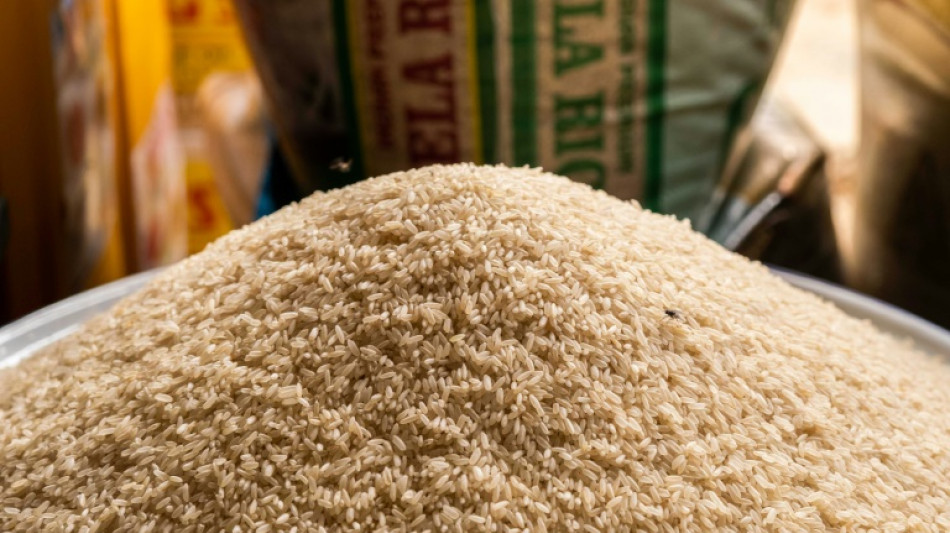
Record grain harvest eyed as market under pressure / Photo: © AFP/File

 UK fears grow over AI giant Palantir's health service deal

 Empty nets in Latin America as fish flee El Nino

 Meidroth blasts White Sox through, Phillies survive in MLB playoffs

 'Catastrophic': Swiss glaciers lose fifth of mass in five years

 California roller coaster shut after brain damage claims

 Panama ministers push for reopening of huge open-pit copper mine

 Bohm's blast keeps Phillies alive in MLB playoffs

 US judge accepts Paramount's Warner Bros. buyout settlement

 Global stocks mixed as markets weigh higher oil prices, bond yields

 Marsh hails improvements after Australia win final one-day international

 Hegseth says US cut number of generals, admirals by 20%

 Kanye West's Russian concerts have been cancelled, organisers say

 First Hollywood, now Fat Bear Week: nepobaby wins Alaska contest

 Barcelona lay down marker in Women's Champions League, Arsenal slip up

 US pushes against overproduction with eye on China at G20 meeting

 Swiss FA withdraws support for FIFA chief Infantino

 Man City's meteoric rise clouded by financial scandal

 Polish activists open first abortion pill locker in Warsaw

 NHL Avalanche ink Bednar to four-year coaching deal

 Polish activists opens first abortion pill locker in Warsaw

 Turkey says news site closed for 'LGBTQ propaganda'

 Oil companies close in on Venezuela despite hurdles

 Turkey freezes ex-minister's assets as fund scandal grows

 Guardiola backs Man City after bombshell guilty verdicts

 G20 trade ministers open talks under strain of Trump tariffs

The world is heading for a record grain harvest in the 2023-2024 season thanks to gains for maize and rice, but the market remains under pressure thanks to El Nino and risks due to the war in Ukraine.
The International Grain Council (IGC), which includes both major producer and consumer nations, now forecasts 2.3 billion tonnes of grains excepting rice, slightly higher than the 2021-2022 season.
Maize production continues to rise, with a 5.5 percent rise to 1.2 billion tonnes, thanks to more acreage in the United States and a record harvest expected in Brazil.
The IGC expects the production of rice, the top grain consumed by people, to rise by 2.5 percent to 527 million tonnes.
But the wheat harvest is expected to come in at 784 million tonnes. That is stable in comparison to the last five years, but a reduction of 2.4 percent from last year when Russia and Australia had bumper harvests.
- Hard time for hard wheat -
"The pressure on wheat is due to the consumption forecast which is 20 million tonnes more than production," said Damien Vercambre, a trader at Inter-Courtage commodities brokerage.
Demand for maize is even stronger, with consumption up by 30 million tonnes over the past year, but is covered by production.
The increase is essentially for animal feed and is a sign of "the return of economic growth in Asia, where people eat more meat when their income permits," said Vercambre, but he noted the uncertainty around China's recovery.
The pressure on the wheat market is due to the level of stocks.
According to the latest monthly report from the US Department of Agriculture, wheat stocks at major exporters are roughly 55 million tonnes.
This is a ten-year low and output hasn't risen much in the past three years, noted Sebastien Poncelet, a grain specialist at Agritel agricultural information service.
Added to this are concerns about how weather may affect output as well as geopolitical risks, with the grain deal which allowed Ukraine to export grain via the Black Sea having expired and Russia targeting the country's grain exporting infrastructure, including on the Danube.
"The situation in Ukraine is stirring up concern in importing nations, which could feel the need to build up stocks" and which would add to food price inflation, said Poncelet.
The situation in the United States is improving after a severe drought.
"The driest area now is the hard wheat areas in Canada, which export five million tonnes annually, or more than 60 percent of the world market," said Poncelet.
Hard wheat is prized for baking bread.
- Ample rice stocks -
In Asia, analysts are keeping a close eye on the El Nino weather phenomenon, which is generally associated with a rise in global temperatures but for the moment is not expected to have a major impact on rice.
"The monsoons arrived normally, which allowed planting the crops in good conditions," said Patricio Mendez del Villar, an economist who specialises in rice at CIRAD, a French governmental agency for agricultural research and international development.
But unexpectedly, India, the world's top rice exporter, banned exports of non-basmati white rice -- which accounts for around a quarter of its total.
The move was made "ensure adequate availability" and "allay the rise in prices in the domestic market," India's consumer affairs and food ministry said.
The move risks triggering price increases elsewhere when world prices are already up 30 percent from last year and despite the fact that Thailand, Vietnam and Pakistan could compensate for the reduced Indian exports, said Mendez del Villar.
One comforting element is that rice stocks are ample at 37 percent of annual consumption, compared to 25 percent during the 2008 crisis, when prices more than quadrupled in the space of a few months.
C.Kovalenko--BTB