
US on 'very narrow path' to avoid recession: IMF chief economist / Photo: © AFP

 US government's new AI chatbot pulls back from debunking Trump

 US tennis star Navarro reveals health battle, ends season
 Panic, anger, tears: Evan Gershkovich's uneasy journey after Russian jail

 UK PM says 'strong indications' Iran involved in airbase incident

 Google restricts access to new AI model over safety concerns

 Watchdog clears former US Fed chief Powell in renovation probe

 Israel PM hails Indian pilot of rerouted flight for averting disaster
 Fury, Joshua kick off 'battle of Britain' in good spirits

 Ronaldo leaves Portugal training camp after coach says he is dropped

 Florence Pugh stars in 'East of Eden' adaption on Netflix

 Watchdog finds no criminal misconduct over US Fed renovations despite Trump probe

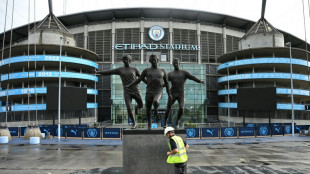 In Manchester, City fans 'devastated' while rival fans call for relegation

 UK-France Channel migrant exchange deal scrapped: London

 Portugal boss denies 'incident' with Ronaldo

 Israel PM says one of the pilots of rerouted flight tried to crash plane

 Manchester City: Main points of damning judgement and possible sanctions

 Italy looking for 'identity' under Mancini says Scalvini

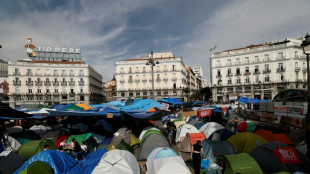 The voices of Spain's housing camp protesters

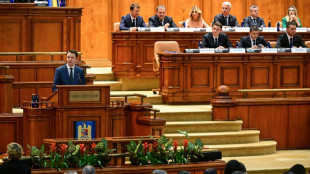 Romanian parliament rejects pro-EU PM candidate

 Court halts Tennessee's first execution of woman in 200 years

 Israelis march between once-closed West Bank settlements

 'Welcome back,' says Macron, as UK PM opens door to EU return

 Israel PM says pilot of rerouted flight tried to crash plane

 Demuro hopes to deliver Japan a 'magical' Arc victory

 'Devastated' AI scandal author Orelien returns to Quebec

The US economy is on a "very narrow path" to avoiding a recession, the International Monetary Fund's chief economist says, while warning of risks to China's strong post-pandemic recovery.
"A recession is not in our baseline," Pierre-Olivier Gourinchas told AFP during an interview at the IMF's headquarters in Washington, ahead of the publication of its updated global growth projections on Tuesday.
"We are cautiously prudent that the US economy could avoid a recession and, you know, glide towards its inflation target without having a recession in its future," he said.
"But it's a very, very narrow path," he warned.
On Tuesday morning, the IMF raised its forecast for global growth in 2023 to 3.0 percent, up 0.2 percentage points from its previous forecast in April, citing resilient service sector activity in the first quarter of the year.
The IMF still expects much of the growth this year and next to come from emerging and developing economies, with countries like the United States, Germany and Japan due to grow at a much slower pace than China and India.
But the IMF report also noted there are growing risks to China's economy following its post-pandemic reopening, especially in its troubled real estate sector.
- 'Slack' in Chinese economy -
The IMF continues to predict that China's economy will grow by 5.2 percent this year, up sharply from last year.
But there are now signs that China's rapid economic rebound from the Covid-19 pandemic could be "weakening faster than maybe was anticipated," Gourinchas told AFP, while noting "some concerns about the strength of the Chinese economy going forward."
"Maybe there's still a certain amount of slack in the Chinese economy that is not going away and that is weighing on prices," he said.
This slack has had a positive impact on the global inflation outlook: The IMF now forecasts consumer price increases will slow from 8.7 percent in 2022 to 6.8 percent this year, due largely to the decline in Chinese inflation.
But while it may be good news for the global economy, it could pose challenges for Chinese policymakers, Gourinchas told AFP.
"It might require some stronger policies by the Chinese authorities both in terms of monetary policy -- maybe a little bit more supportive easing monetary policy -- and also in terms of fiscal policy," he said.
- Russia still weathering sanctions -
Russia's economy is expected to grow significantly faster this year than the IMF forecast back in April, due largely to stronger-than-expected domestic demand, and continued government spending.
The IMF now sees Russian growth this year of 1.5 percent, up by 0.8 percentage points since April.
"There is a strong component coming from fiscal spending in the context of the Russian invasion of Ukraine," Gourinchas said.
"There is a strong defense and military effort, and that is providing some stimulus to the domestic economy," he added.
The IMF now expects the Russian government's budget deficit will grow to 6.1 percent this year, up from 1.4 percent last year, said a spokesperson for the fund.
Export revenues have also remained resilient despite a series of US-backed sanctions in response to the invasion of Ukraine, and a G7 price cap on Russian oil.
"So far, export revenues coming from especially crude oil have remained fairly strong," he said.
"There is some softening on refined products, this is a little bit harder, but on crude oil, they certainly the oil revenues have been have been quite sustainable," he added.
Over the medium term, the IMF still expects the Russian economy to slow significantly compared with its projections before the war in Ukraine began.
"Our projections for medium term growth for Russia are below one percent," he told AFP, adding that the Russian government's increased fiscal spending have "dimmed" the country's long-term growth prospects.
M.Ouellet--BTB