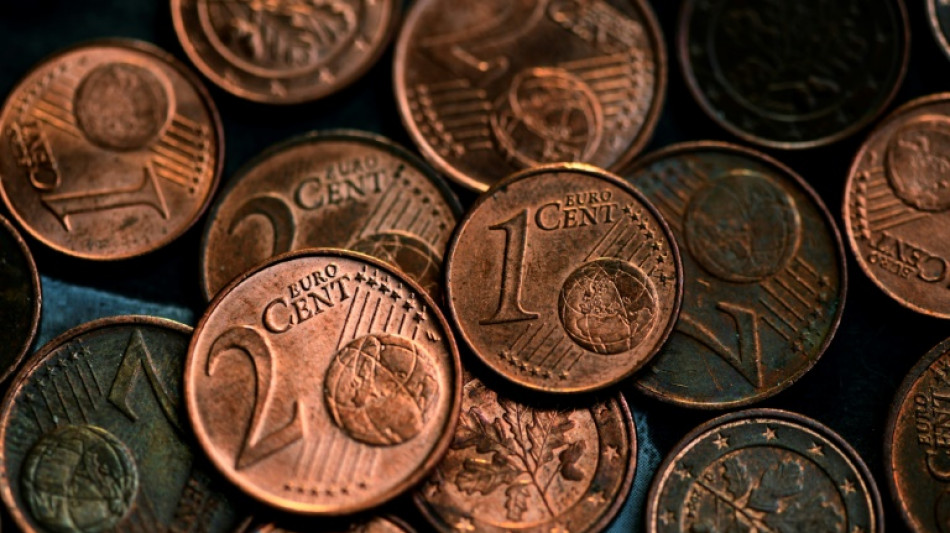
ECB set to hike again with inflation stubbornly high / Photo: © AFP

 US government's new AI chatbot pulls back from debunking Trump

 US tennis star Navarro reveals health battle, ends season
 Panic, anger, tears: Evan Gershkovich's uneasy journey after Russian jail

 UK PM says 'strong indications' Iran involved in airbase incident

 Google restricts access to new AI model over safety concerns

 Watchdog clears former US Fed chief Powell in renovation probe

 Israel PM hails Indian pilot of rerouted flight for averting disaster
 Fury, Joshua kick off 'battle of Britain' in good spirits

 Ronaldo leaves Portugal training camp after coach says he is dropped

 Florence Pugh stars in 'East of Eden' adaption on Netflix

 Watchdog finds no criminal misconduct over US Fed renovations despite Trump probe

 In Manchester, City fans 'devastated' while rival fans call for relegation

 UK-France Channel migrant exchange deal scrapped: London

 Portugal boss denies 'incident' with Ronaldo

 Israel PM says one of the pilots of rerouted flight tried to crash plane

 Manchester City: Main points of damning judgement and possible sanctions

 Italy looking for 'identity' under Mancini says Scalvini

 The voices of Spain's housing camp protesters

 Romanian parliament rejects pro-EU PM candidate

 Court halts Tennessee's first execution of woman in 200 years

 Israelis march between once-closed West Bank settlements
 'Welcome back,' says Macron, as UK PM opens door to EU return

 Israel PM says pilot of rerouted flight tried to crash plane

 Demuro hopes to deliver Japan a 'magical' Arc victory

 'Devastated' AI scandal author Orelien returns to Quebec

Another interest rate hike appears a near certainty when ECB policymakers meet Thursday as inflation remains high, but the central bank faces increasing discontent among countries scared high interest rates will hurt growth.
The Frankfurt-based institution has lifted borrowing costs at the fastest rate ever to combat red-hot inflation after Russia's war in Ukraine sent food and energy prices soaring.
Key rates have risen by four percentage points since July last year, with the ECB's deposit rate now sitting at 3.50 percent -- its highest level since 2001.
The sequence of rate hikes does not look like it will stop this week, despite moves by other central banks to slow the tempo of increases.
At its last meeting in June, ECB President Christine Lagarde said it was "very likely" that the bank would raise rates again at its next meeting.
"Virtually everyone is anticipating a 0.25 percentage point increase," the head of the influential German central bank, Joachim Nagel, told the RND media group last week.
But future increases are in doubt as inflation slowly eases and the eurozone economy looks weak.
Consumer prices rose at a 5.5-percent pace in June -- still well above the ECB's two-percent target but down from its double-digit peak towards the end of last year.
Collectively, the eurozone fell into recession around the turn of the year, shrinking in two straight quarters.
- Core inflation -
The outlook for the economy is not much rosier. At its last meeting in June, the ECB lowered its forecast for eurozone growth this year to 0.9 from 1.0 percent.
The eurozone economy will "strengthen in the course of the year" as inflation eases, it said.
With a new hike almost a given, the July meeting is an opportunity to weigh the "advisability of extending the tightening", said Eric Dor, a director at the IESEG business school.
The Federal Reserve, which started its hiking cycle before the ECB, hit pause on new increases at its last meeting in June as US inflation fell more than expected, but could hike again at its meeting this week.
Meanwhile, falling inflation in the eurozone was "mainly due to the reduction in the annual growth of energy prices", which are little influenced by monetary policy, Dor said.
"Excluding energy, the reduction in annual price growth is still very limited," he said.
Core inflation -- a closely watched measure that excludes volatile energy, food, alcohol and tobacco prices -- in fact rose to 5.4 percent in the eurozone in June from 5.3 percent in May.
The persistence of inflation was "caused by the fact that inflation is working its way through the economy in phases", Lagarde said at the end of June.
ECB officials are now concerned about the impact of rising wages as workers demand higher salaries to cover rising costs.
- 'Difficult situation' -
Concerns over stubborn inflation will ultimately convince the bank to keep hiking beyond Thursday's meeting, according to Ulrike Kastens, European economist at DWS.
"Neither the labour market nor the underlying price trend will weaken significantly," Kastens said, predicting another rise in September.
But some members of the governing council have raised the prospect of stopping hikes.
"We might have one further move... but I'm not sure that we're going to go further than that," the head of the Greek central bank, Yannis Stournaras, said last week.
Steep interest rate rises have also provoked an angry backlash from political leaders in southern eurozone countries, where debt levels are higher and growth has been weaker.
"The ECB's simplistic recipe of raising interest rates does not appear to many to be the right way forward," Italy's far-right Prime Minister Giorgia Meloni said at the end of June.
Meloni pinned the blame on the Ukraine conflict and worried over the impact of rising rates on the economy.
More hikes "could create a more difficult situation for growth at the European level", Portuguese Finance Minister Fernando Medina concurred.
T.Bondarenko--BTB