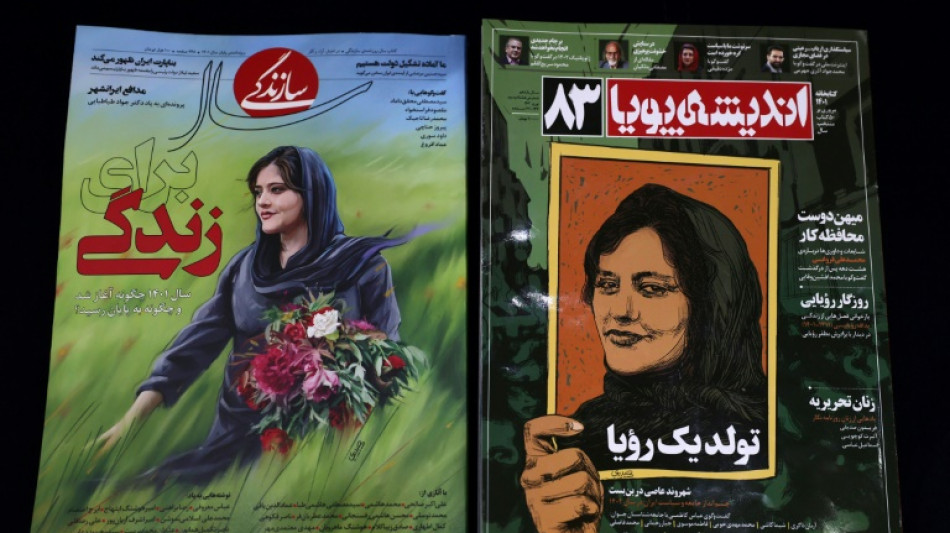
10 months since Iran's protests, Kurdish exiles in limbo / Photo: © AFP

 US government's new AI chatbot pulls back from debunking Trump
 US tennis star Navarro reveals health battle, ends season
 Panic, anger, tears: Evan Gershkovich's uneasy journey after Russian jail

 UK PM says 'strong indications' Iran involved in airbase incident

 Google restricts access to new AI model over safety concerns
 Watchdog clears former US Fed chief Powell in renovation probe
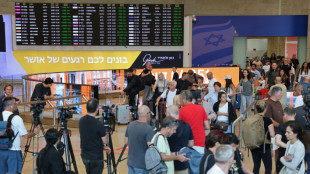 Israel PM hails Indian pilot of rerouted flight for averting disaster
 Fury, Joshua kick off 'battle of Britain' in good spirits

 Ronaldo leaves Portugal training camp after coach says he is dropped
 Florence Pugh stars in 'East of Eden' adaption on Netflix

 Watchdog finds no criminal misconduct over US Fed renovations despite Trump probe
 In Manchester, City fans 'devastated' while rival fans call for relegation

 UK-France Channel migrant exchange deal scrapped: London

 Portugal boss denies 'incident' with Ronaldo

 Israel PM says one of the pilots of rerouted flight tried to crash plane

 Manchester City: Main points of damning judgement and possible sanctions

 Italy looking for 'identity' under Mancini says Scalvini
 The voices of Spain's housing camp protesters
 Romanian parliament rejects pro-EU PM candidate

 Court halts Tennessee's first execution of woman in 200 years

 Israelis march between once-closed West Bank settlements
 'Welcome back,' says Macron, as UK PM opens door to EU return
 Israel PM says pilot of rerouted flight tried to crash plane
 Demuro hopes to deliver Japan a 'magical' Arc victory
 'Devastated' AI scandal author Orelien returns to Quebec
Like other Iranian Kurds who fled into exile during last year's women-led mass protests, 17-year-old Sarina tries to keep a low profile in her new home in northern Iraq.
She avoids drawing attention in her waitress job and hides her face behind a Covid mask when she walks the streets of Arbil, the capital of Iraqi Kurdistan.
The teenager -- who asked not to be fully identified citing security fears -- was among the thousands who joined the wave of street protests sparked by the September death of Mahsa Amini.
Anger flared after the 22-year-old Kurdish-Iranian died in morality police custody after her arrest for allegedly flouting the strict Islamic dress code for women.
At the time, Sarina was visiting her mother in Mahabad, in Iran's West Azerbaijan province, and joined the protests. She then took to the streets again in her nearby hometown of Oshnavieh.
When a friend of hers was arrested, Sarina went into hiding.
"At first, I said I wouldn't be returning home for two days," Sarina recalled. Then the authorities raided her home while she was away and detained her uncle.
In mid-October, Sarina crossed the porous mountain border, a region long used by smugglers, from Iran's mainly Kurdish west into Iraq's autonomous Kurdistan region.
She now spends her mornings serving tea at a corporate office and her evenings working as a waitress, making ends meet on $800 a month.
"My family is forced to accept that I am here," she said. "It is very difficult for them. They are worried about me."
Sarina said she has no plans to move further away, explaining that "I don't like being too far from my country. I want to be able to go back to my family quickly if something happens."
- 'Woman, life, freedom' -
Iran's protests under the motto "woman, life, freedom" sparked a state crackdown during which hundreds were killed, mostly protesters but also dozens of security personnel.
Thousands were arrested in what authorities labelled "riots" and blamed on foreign enemies. Seven men were executed for protest-related violence against security forces.
Many Iranian Kurds fled to Iraq, some on tourist visas. Their number is unclear in the absence of official statistics.
People on both sides speak Kurdish, and many have relatives across the Iraq-Iran border. The dire economic situation in sanctions-hit Iran has compelled many to seek work in Iraq.
Kurdish Iranian opposition groups have long had bases in Iraqi Kurdistan. Iran launched deadly military strikes on some of them during the unrest, accusing them of instigating the protests.
Early this year, Iraq and Iran signed an agreement to reinforce security along the border. Tehran has threatened to resume attacks if the Kurdish opposition groups are not disarmed by September.
- 'An aimless life' -
Another Iranian Kurd, a 27-year-old architect speaking with AFP under the pseudonym of Fuad, said he had crossed the mountains along a snow-covered smuggling path in January.
Originally from the western Iranian town of Piranshahr, he now sells laptops in an Arbil store where he also sleeps on an old mattress, his clothes hanging from wall hooks.
"I am living an aimless life," he said. "Day turns to night and night turns to day. I left behind all I had in Iran -- my mother, my father, my house, my job."
Fuad also took part in the protests, until his friend's brother was arrested. This sent him into hiding for 40 days during which, he said, "the security forces raided my house".
Being away from his family weighs heavily on him, Fuad said: "Every time my mother calls me, she has tears in her eyes, my father as well."
Despite this, he said he won't go back, for fear of being arrested.
More than 10,000 Iranians live in Iraqi Kurdistan, according to data published by the Kurdistan regional government in May, many of them long-time residents.
Rizgar Khasraw, 47, who hails from the Iranian city of Mariwan, has lived in Arbil with his wife and two daughters for 11 years, running a sweets business.
When the protests erupted, he wanted to show his support.
When he opened his second branch, he named the shop after Amini and put up a signboard showing the young woman with a rose in her hair and a light scarf over her head.
Ten months after the protests flared, Khasraw hailed Amini as "a symbol of freedom for all of Iran".
Back in Iran, authorities said last week that they had resumed morality police patrols to deal with women who "insist" on violating the dress code.
E.Schubert--BTB