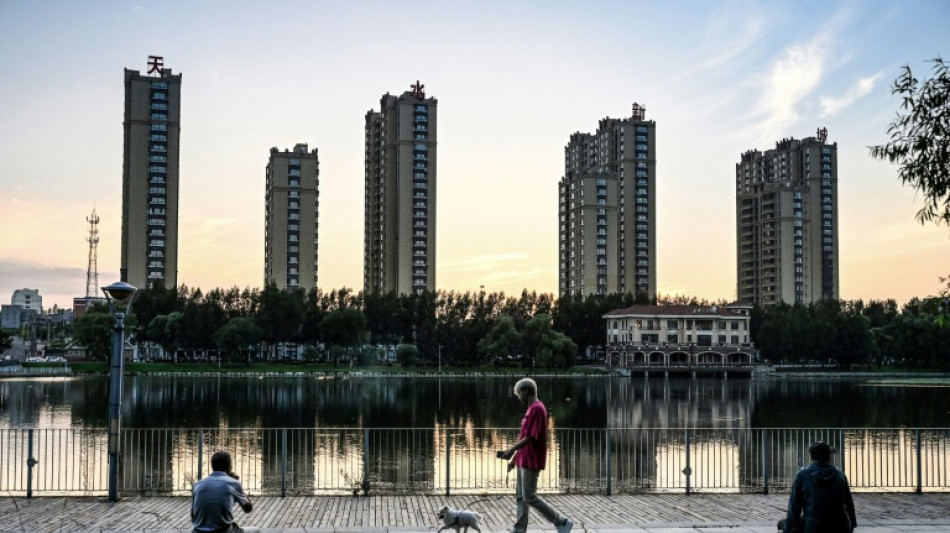
Young homebuyers take refuge in China's rust-belt towns / Photo: © AFP

 US government's new AI chatbot pulls back from debunking Trump

 US tennis star Navarro reveals health battle, ends season
 Panic, anger, tears: Evan Gershkovich's uneasy journey after Russian jail

 UK PM says 'strong indications' Iran involved in airbase incident

 Google restricts access to new AI model over safety concerns

 Watchdog clears former US Fed chief Powell in renovation probe

 Israel PM hails Indian pilot of rerouted flight for averting disaster

 Fury, Joshua kick off 'battle of Britain' in good spirits

 Ronaldo leaves Portugal training camp after coach says he is dropped

 Florence Pugh stars in 'East of Eden' adaption on Netflix

 Watchdog finds no criminal misconduct over US Fed renovations despite Trump probe

 In Manchester, City fans 'devastated' while rival fans call for relegation

 UK-France Channel migrant exchange deal scrapped: London

 Portugal boss denies 'incident' with Ronaldo

 Israel PM says one of the pilots of rerouted flight tried to crash plane

 Manchester City: Main points of damning judgement and possible sanctions

 Italy looking for 'identity' under Mancini says Scalvini

 The voices of Spain's housing camp protesters

 Romanian parliament rejects pro-EU PM candidate

 Court halts Tennessee's first execution of woman in 200 years

 Israelis march between once-closed West Bank settlements

 'Welcome back,' says Macron, as UK PM opens door to EU return

 Israel PM says pilot of rerouted flight tried to crash plane

 Demuro hopes to deliver Japan a 'magical' Arc victory

 'Devastated' AI scandal author Orelien returns to Quebec

Fontana Fang has dived into China's cutthroat real estate market and emerged victorious, shaking off soaring prices to snap up a handsome property for next to nothing -- a distant dream for many.
But there's a catch: her new apartment is in a coal town near the Russian border where winter temperatures plummet well below zero, nearly 4,000 kilometres (2,500 miles) from her glitzy home city.
Fang, 29, is part of a wave of young Chinese choosing to invest in dirt-cheap real estate in declining and remote industrial regions, ditching China's modern, expensive metropolises.
In major cities, "unless you're a child of the super-elite, I don't see how young people can ever earn enough for a house", the brand management professional told AFP.
Fang's main residence is in southern Guangzhou, where she lives with her husband and two children, but the apartment is owned bythe couple's parents.
Flats there routinely sell for over 100,000 yuan ($14,000) per square metre, beyond the means of many middle-class residents, she said.
But last winter, a road trip took Fang to Hegang, a hardscrabble mining settlement in China's frigid northeast.
There, entire properties sell for a fraction of the going rate down south.
Fang and her husband ended up paying just 40,000 yuan ($43,000) on the spot for an entire top-floor apartment with a covered balcony and expansive hill views.
They plan to renovate it into a retreat from Guangzhou's stifling summers.
"I was incredibly surprised. I never expected to be able to get a house for so little money, even if you built it yourself," Fang said.
- Shrinking cities -
China's hinterland is scattered with hundreds of industrial cities long past their heyday.
Towns like Hegang have endured decades of population loss since the 1980s, as market reforms shifted the economic centre of gravity towards the increasingly affluent eastern and southern coast.
Hegang shed over 15 percent of its population between 2010 and 2020, according to official figures.
But now these shrinking cities are seeing a surge in interest from young buyers seeking alternatives to the urban rat race, drawn by easily affordable housing and a growing reputation for low-cost, carefree living.
One young homeowner who bought a 68,000-yuan flat in Gejiu -- a fading mining city in southern Yunnan province -- told AFP they had done so "mainly to 'lie flat'".
The phrase refers to a burgeoning dropout culture that pushes back against China's intense and often burnout-inducing study and work pressure.
The country's Communist Party leadership has criticised "lying flat" as a rejection of the values of hard work and innovation, and encouraged young people to strive for the good of the nation.
The homeowner, who requested anonymity, said they "hadn't even thought about working" since relocating to Gejiu.
"I'll stay here, live off the little money I have, and find temporary work in a big city when I run out," they said.
- Fading prospects -
During an AFP visit to Hegang this month, roadside sellers hawked fresh fruit, vegetables and snacks for the equivalent of a few US cents each.
Bathed in mild sunshine, clusters of retirees played cards outside on their porches.
"There's something spiritual about (Hegang's) slower pace," said newly minted homeowner Kathy Cao, 28.
"In (wealthier) cities... you might just talk work or business all day," said Cao, who previously resided in the cities of Xi'an and Zhengzhou.
"But people here don't do that so much, because your chances of earning big money are fairly slim anyway."
A formerly prosperous town, Hegang has recently struggled to pay mounting municipal debts, and the government stepped in with an unprecedented fiscal "restructuring" in 2021.
The move has helped to avert a catastrophic bankruptcy, but money remains tight, and cheap housing alone is unlikely to reverse Hegang's fortunes.
The city frequently fails to pay wages to public sector workers on time, a local administrator told AFP.
Shen Wenxin, a Hegang native who recently returned to open a cafe, said: "The more people who come here, the better".
"But they only account for a fraction of the economy."
"Our low house prices are all well and good, but what should our mainstream economy rely on?"
Other locals contacted by AFP said they were sceptical about the city's ability to rejuvenate itself.
Max Chu moved to Beijing for university and now works there -- with no plans to return.
"After a while, this trend won't be so popular anymore," she predicted.
"People's memories of it will fade."
P.Anderson--BTB