AI-supercharged neurotech threatens mental privacy: UNESCO / Photo: © AFP

 Fury, Joshua kick off 'battle of Britain' in good spirits

 Ronaldo leaves Portugal training camp after coach says he is dropped

 Florence Pugh stars in 'East of Eden' adaption on Netflix

 Watchdog finds no criminal misconduct over US Fed renovations despite Trump probe

 In Manchester, City fans 'devastated' while rival fans call for relegation

 UK-France Channel migrant exchange deal scrapped: London

 Portugal boss denies 'incident' with Ronaldo

 Israel PM says one of the pilots of rerouted flight tried to crash plane

 Manchester City: Main points of damning judgement and possible sanctions

 Italy looking for 'identity' under Mancini says Scalvini

 The voices of Spain's housing camp protesters

 Romanian parliament rejects pro-EU PM candidate

 Court halts Tennessee's first execution of woman in 200 years

 Israelis march between once-closed West Bank settlements

 'Welcome back,' says Macron, as UK PM opens door to EU return

 Israel PM says pilot of rerouted flight tried to crash plane

 Demuro hopes to deliver Japan a 'magical' Arc victory

 'Devastated' AI scandal author Orelien returns to Quebec

 US reports firm Q2 economic growth, inflation steady
 Energy costs spark inflation surge across Europe

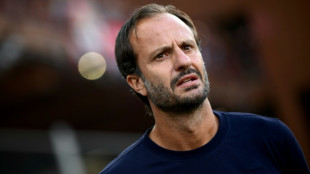 Parma appoint Italy World Cup winner Gilardino
 West Indies pile up record 405-7 in second ODI against India

 Romanian parliament rejects pro-EU PM candidate amid political deadlock

 Passenger on rerouted flydubai flight says pilot tried to crash plane

 Russia targets Kyiv power supply as freezing winter approaches

The combination of "warp speed" advances in neurotechnology, such as brain implants or scans that can increasingly peek inside minds, and artificial intelligence poses a threat to mental privacy, UNESCO warned on Thursday.
The UN's agency for science and culture has started developing a global "ethical framework" to address human rights concerns posed by neurotechnology, it said at a conference in Paris.
Neurotechnology is a growing field seeking to connect electronic devices to the nervous system, mostly so far to treat neurological disorders and restore movement, communication, vision or hearing.
Recently neurotechnology has been supercharged by artificial intelligence algorithms which can process and learn from data in ways never before possible, said Mariagrazia Squicciarini, a UNESCO economist specialising in AI.
"It's like putting neurotech on steroids," she told AFP.
Gabriela Ramos, UNESCO's assistant director-general for social and human sciences, said that this convergence of neurotechnology and AI was "far-reaching and potentially harmful".
"We are on a path to a world in which algorithms will enable us to decode people's mental processes and directly manipulate the brain mechanisms underlying their intentions, emotions and decisions," she told the conference.
In May, scientists in the United States revealed they had used brain scans and AI to turn "the gist" of what people were thinking into written words -- as long as they had spent long hours inside a large fMRI machine.
Later that month, billionaire Elon Musk's firm Neuralink received approval to test its coin-sized brain implants on humans in the United States.
Musk has said his ultimate goal is to ensure that humans are not intellectually overwhelmed by AI -- though on Thursday he launched his own artificial intelligence company xAI.
Squicciarini emphasised that UNESCO was not saying that neurotechnology is a bad thing.
"If anything it's fantastic," she said, pointing to how the technology could let blind people see again, or paralysed people walk.
But with neurotechnology "advancing at warp speed," UN Secretary-General Antonio Guterres said that ethical guidelines were needed to protect human rights.
Investment in neurotech companies increased by 22 times from 2010 to 2020, rising to $33.2 billion, according to a new UNESCO report co-authored by Squicciarini.
The number of patents for neurotech devices doubled between 2015 and 2020, with the United States accounting for nearly half of all patents worldwide, the report said.
The neurotech devices market is projected to reach $24.2 billion by 2027.
W.Lapointe--BTB