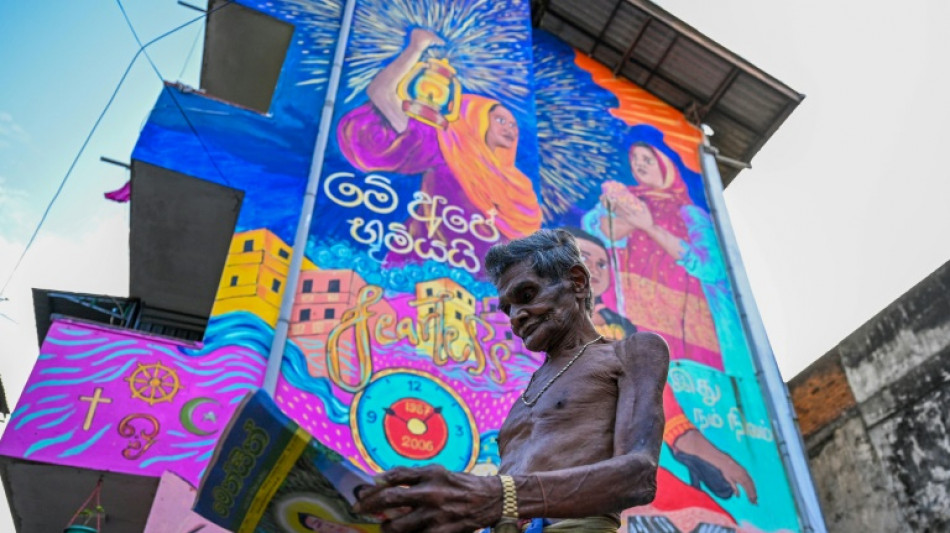
A year after Sri Lanka unrest, Slave Island hungers / Photo: © AFP

 US pushes against overproduction with eye on China at G20 meeting
 Swiss FA withdraws support for FIFA chief Infantino
 Man City's meteoric rise clouded by financial scandal

 Polish activists open first abortion pill locker in Warsaw
 NHL Avalanche ink Bednar to four-year coaching deal
 Polish activists opens first abortion pill locker in Warsaw

 Turkey says news site closed for 'LGBTQ propaganda'
 Oil companies close in on Venezuela despite hurdles
 Turkey freezes ex-minister's assets as fund scandal grows
 Guardiola backs Man City after bombshell guilty verdicts
 G20 trade ministers open talks under strain of Trump tariffs

 France in talks with UK to end 2025 migrant accord: ministry
 Europe's surging inflation spreads gloom in stock markets

 Truth commission demands compensation for Sweden's Sami people

 Japan win marathon penalty shootout to set up South Korea gold-medal clash
 Djokovic grinds out opening-round win at China Open
 Northern Ireland police probe blockade of disputed parade

 UK PM Burnham reopens divisive debate on rejoining EU
 Man City future in doubt after guilty verdict
 'Do something,' begs Iranian woman after death sentence over protests
 China extends 52-year unbeaten record as Games organisers say sorry
 In Manchester, people say City scandal is 'shame for football'
 Stocks lacklustre as inflation data weighs on sentiment
 Israel-bound plane rerouted, pilots wounded in reported fight

 Truth commission on Sweden's Sami people seeks redress

As Sri Lankans flocked to a jubilant street party celebrating their president's ouster, retired accountant Milton Perera sat at home pondering whether his family could afford to eat the next morning.
Before his dramatic toppling last year, Gotabaya Rajapaksa was blamed for an economic crisis that brought food and fuel shortages, blackouts and runaway inflation to the island nation.
But Perera told AFP at the time that with the once-loved leader out of office, the hardships his country had endured to that point would get worse.
A year later, with millions of his compatriots struggling to put enough food on the table, the 75-year-old says his prediction has proved correct.
"Last year we had money, but no goods," Perera told AFP inside his rundown government flat, a short distance from the seafront protest site where Rajapaksa's toppling was orchestrated last year.
"Now there are goods, but we don't have money."
His home in Slave Island -- a working-class pocket of Colombo where the Portuguese housed African slaves during the colonial period -- is damp from a leaking water main.
Municipal authorities have not come around to repair it because they no longer have money for maintenance.
With sunken cheeks and veins protruding from his gaunt limbs, Perera wheezes as he moves gingerly around his kitchen, the product of his chronic asthma.
Before the crisis, medication to treat his condition was provided free by public hospitals -- a government programme that has now been scrapped.
Two months ago Perera's welfare payments were stopped as part of other spending cuts, meaning he is no longer able to afford an inhaler to treat his symptoms.
His family's water and electricity bills have doubled thanks to the removal of government utility subsidies.
The economic crisis had already forced Perera, his wife, his two children and their extended families to regularly skip meals when AFP first visited their home.
A year later, supermarkets are again fully stocked with the kitchen staples that disappeared from the shelves during last year's chronic shortages -- but Perera's family can't buy them.
"We can't afford meat, fish and eggs," B. M. Pushpalatha, Perera's wife, told AFP as the couple shared an unadorned meal of rice and lentils. "They are too expensive."
- 'You won't starve' -
Sri Lanka defaulted on its $46 billion foreign debt in April 2022 as its economy went into a tailspin unprecedented in its history as an independent nation.
Petrol queues at pumping stations stretched for miles and motorists -- several of whom died in queue -- spent days waiting to top up their tanks.
Families had no gas to cook food, farm yields fell dramatically due to a ban on fertiliser imports, and hospitals were empty of life-saving pharmaceuticals.
Months of angry protests culminated in the July 9 storming of Rajapaksa's presidential palace, a short walk from Perera's home, with its occupant forced into a brief but humiliating exile.
Rajapaksa's departure did not conclude Sri Lanka's economic woes, with inflation peaking at 70 percent in September. Petrol rationing also remains in force.
His successor Ranil Wickremesinghe secured a $2.9 billion IMF bailout in March by agreeing on a tough austerity regimen to plug the country's black hole of debt.
"Many of the decisions I have been compelled to take since assuming the presidency have been unpopular," Wickremesinghe said in a February address to the nation.
"However, because of those decisions, today no citizen of this country will die of dehydration in oil queues. You won't starve without gas or fertiliser."
- Seven million in poverty -
But the steep cuts to government spending and welfare programmes have exacerbated hardship across the country.
An additional four million Sri Lankans had fallen below the poverty line since the crisis began, said Dhananath Fernando, chief executive of the Colombo-based Advocata Institute think-tank.
"That means about seven million people in a country of 22 million are earning less than 14,000 rupees ($46) a month," he told AFP.
Of those, nearly four million Sri Lankans did not have the means to adequately feed themselves, the United Nations said in June.
Fernando said the figures showed a sharp deterioration in living standards across the country in the past year with no prospect of a quick recovery.
Unless the austerity measures began to bear fruit, the island risked a return to the sustained social unrest that broke out last year, he added.
"If we really fail to take Sri Lanka to a growth trajectory in the future, I'm not completely ruling it out," Fernando said.
H.Seidel--BTB