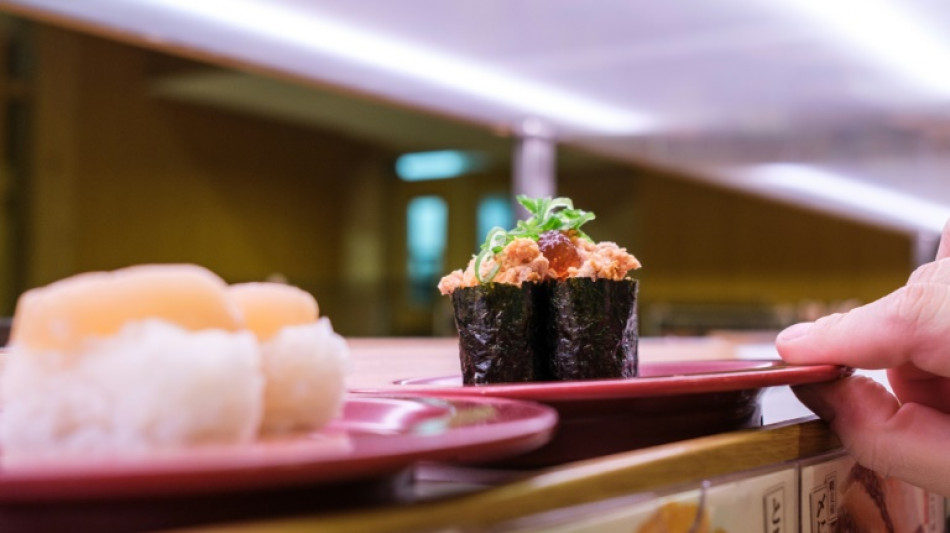
The UK botanist who helped revive Japan's seaweed industry / Photo: © AFP

 US pushes against overproduction with eye on China at G20 meeting

 Swiss FA withdraws support for FIFA chief Infantino

 Man City's meteoric rise clouded by financial scandal

 Polish activists open first abortion pill locker in Warsaw

 NHL Avalanche ink Bednar to four-year coaching deal

 Polish activists opens first abortion pill locker in Warsaw

 Turkey says news site closed for 'LGBTQ propaganda'

 Oil companies close in on Venezuela despite hurdles

 Turkey freezes ex-minister's assets as fund scandal grows

 Guardiola backs Man City after bombshell guilty verdicts

 G20 trade ministers open talks under strain of Trump tariffs

 France in talks with UK to end 2025 migrant accord: ministry

 Europe's surging inflation spreads gloom in stock markets

 Truth commission demands compensation for Sweden's Sami people

 Japan win marathon penalty shootout to set up South Korea gold-medal clash

 Djokovic grinds out opening-round win at China Open

 Northern Ireland police probe blockade of disputed parade

 UK PM Burnham reopens divisive debate on rejoining EU

 Man City future in doubt after guilty verdict

 'Do something,' begs Iranian woman after death sentence over protests

 China extends 52-year unbeaten record as Games organisers say sorry
 In Manchester, people say City scandal is 'shame for football'
 Stocks lacklustre as inflation data weighs on sentiment

 Israel-bound plane rerouted, pilots wounded in reported fight

 Truth commission on Sweden's Sami people seeks redress

Each year in southern Japan, dozens of people gather at a seafront shrine to honour a British botanist who never visited the country but is credited with revitalising its crucial seaweed industry.
Kathleen Drew-Baker made groundbreaking discoveries about the reproduction of "nori" seaweed -- the crispy dried sheets that encircle sushi rolls -- helping kick-start its farming on a commercial scale.
Her studies at the University of Manchester allowed Japan to ramp up production in the difficult period after World War II, when small-scale growers were having trouble meeting demand.
But she carried out her most influential work as an unpaid research fellow, having lost her academic post after marriage because of the university's policy at the time against employing married women.
Although Drew-Baker died in 1957, her memory lives on in the city of Uto in Kumamoto, one of Japan's largest nori-growing regions.
Dozens of people from local fisheries, as well as scientists and history buffs, gather each April in the leafy grounds of a shrine by the ocean, where a stone plinth displays an embossed metal plaque of her face.
Large Japanese and British flags are raised at the event, where a Shinto priest "gives thanks" to Drew-Baker, organiser Fumiichi Yamamoto, 86, told AFP.
"Seaweed producers were happy and grateful" for the ability to grow more nori seaweed in the aftermath of the war, "when people were struggling with food shortages," he said.
The crop has been harvested from Japan's coastline for centuries, and farmed for 500 years.
Apart from its use in sushi, it is also a key ingredient in "onigiri" rice balls, a staple snack food in Japan, and is used to garnish bowls of ramen and other classic dishes.
But the seaweed is notoriously fragile, and easily wiped out by typhoons and pollution.
In 1949, Drew-Baker published a landmark study in the scientific journal Nature about laver, another name for nori. The crop grows off the coast of Wales, and is used to produce a traditional dish called laverbread.
"Up until that point, the life cycle of nori wasn't well known," Yamamoto said.
The research gave new insights into how the plant bores into seashells where it produces new spores.
Drew-Baker made contact with a professor at Kyushu University, and "sent over an academic paper to him with a question: isn't Japanese seaweed like this too?" he said.
Japanese scientists and nori farmers then began experimenting with using oyster shells to help the marine plant thrive.
"It was a success," said Yamamoto, the son of a seaweed wholesaler, who has run the memorial event for 50 years.
Now, "nori is one of the essential foods of Japan".
A.Gasser--BTB