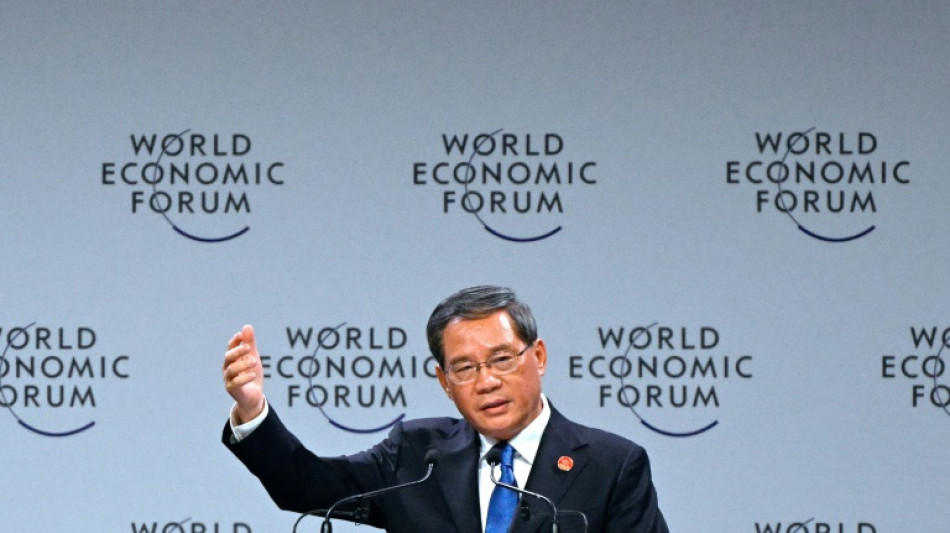
China calls West's economic de-risking a 'false proposition' / Photo: © AFP

 Japan win marathon penalty shootout to set up South Korea gold-medal clash
 Djokovic grinds out opening-round win at China Open

 Northern Ireland police probe blockade of disputed parade

 UK PM Burnham reopens divisive debate on rejoining EU

 Man City future in doubt after guilty verdict
 'Do something,' begs Iranian woman after death sentence over protests

 China extends 52-year unbeaten record as Games organisers say sorry
 In Manchester, people say City scandal is 'shame for football'
 Stocks lacklustre as inflation data weighs on sentiment
 Israel-bound plane rerouted, pilots wounded in reported fight

 Truth commission on Sweden's Sami people seeks redress

 Energy costs spark inflation surges in France, Italy

 South Korea break China hearts to reach Asian Games football final
 Eala storms into Asian Games semi-finals to thrill adoring fans

 Turkey freezes ex-minister's assets as fund crisis grows

 What we know about the North Korean POW dispute

 Most equities rise after oil price plunge, US data in focus
 Polar oceans transformed as warming melts ice habitats: research

 Lost shark becomes viral star in South Korea

 Dangote to launch $16bn refinery in Kenya

 North Korean leader 'extremely obese': Seoul spy agency
 Yankees and pope-backed White Sox start MLB playoffs with wins

 Malaysia's ex-PM Mahathir in hospital for observation
 'No limits': Marathon world record holder Sawe chasing history

 Countdown begins to biggest-ever Rugby World Cup

Chinese Premier Li Qiang slammed efforts in the West to "de-risk" their economies as a "false proposition" on Tuesday, hitting back against US and EU policy aimed at reducing their reliance on China.
The United States and the European Union have in recent months moved to "de-risk" from the world's second-largest economy.
"In the West, some people are hyping up what is called 'cutting reliance and de-risking'," Li told delegates at the opening of a World Economic Forum meeting in northern China.
"These two concepts... are a false proposition, because the development of economic globalisation is such that the world economy has become a common entity in which you and I are both intermingled," he said in a wide-ranging speech calling for deepening economic globalisation and cooperation.
"The economies of many countries are blended with each other, rely on each other, make accomplishments because of one another, and develop together," he added.
"This is actually a good thing, not a bad thing."
This week's meeting of the World Economic Forum in the port city of Tianjin -- known colloquially as the "Summer Davos" -- is the first of its kind after a three-year hiatus caused by the Covid pandemic. It will last until Thursday.
European Commission President Ursula von der Leyen in January described the EU's approach to China as "de-risking rather than decoupling" since the bloc still sought to work and trade with Beijing.
And President Joe Biden has kept former leader Donald Trump's hard line on China, and in some areas gone further, including banning exports of high-end semiconductors to the rising power.
Responding to Beijing's heated criticism of the move, Secretary of State Antony Blinken in Beijing last week insisted that the United States was not seeking "economic containment" of China.
"But at the same time," he said, "it's not in our interest to provide technology to China that could be used against us."
- Five percent growth -
China is on course to achieve its five percent target for economic growth in 2023 set by Beijing earlier this year, Li also told the audience at the forum, which is being attended by leaders from New Zealand, Mongolia, Vietnam and Barbados, as well as a large delegation from Saudi Arabia.
"For the whole year, we are expected to achieve the target of about five percent economic growth set at the beginning of this year," Li said.
"We are fully confident and capable of pushing ahead the steady and long-term development of China's economy on the track of high-quality development in the relative long term."
China is grappling with a slowing post-Covid recovery, with a number of lacklustre indicators in recent weeks signalling the rebound is running out of steam.
Beijing's central bank last week cut two key interest rates in a bid to counter the slowdown in the world's second-largest economy.
And reports this month have suggested Beijing is lining up a tranche of measures targeting multiple areas of the economy, particularly the real estate sector, which makes up a huge portion of gross domestic product.
Beijing set an economic growth target of "around five percent" in March, one of its lowest in decades as it emerged from strict zero-Covid rules that hammered business activity.
Premier Li at the time admitted the target would be "no easy task".
C.Meier--BTB