Indigenous defenders of oil in the Amazon / Photo: © AFP

 Japan win marathon penalty shootout to set up South Korea gold-medal clash

 Djokovic grinds out opening-round win at China Open

 Northern Ireland police probe blockade of disputed parade

 UK PM Burnham reopens divisive debate on rejoining EU

 Man City future in doubt after guilty verdict

 'Do something,' begs Iranian woman after death sentence over protests
 China extends 52-year unbeaten record as Games organisers say sorry
 In Manchester, people say City scandal is 'shame for football'
 Stocks lacklustre as inflation data weighs on sentiment

 Israel-bound plane rerouted, pilots wounded in reported fight

 Truth commission on Sweden's Sami people seeks redress

 Energy costs spark inflation surges in France, Italy

 South Korea break China hearts to reach Asian Games football final
 Eala storms into Asian Games semi-finals to thrill adoring fans

 Turkey freezes ex-minister's assets as fund crisis grows

 What we know about the North Korean POW dispute
 Most equities rise after oil price plunge, US data in focus

 Polar oceans transformed as warming melts ice habitats: research

 Lost shark becomes viral star in South Korea
 Dangote to launch $16bn refinery in Kenya
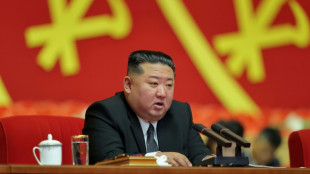 North Korean leader 'extremely obese': Seoul spy agency

 Yankees and pope-backed White Sox start MLB playoffs with wins

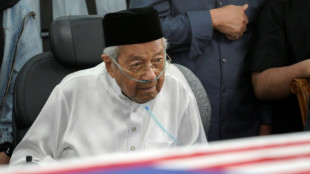 Malaysia's ex-PM Mahathir in hospital for observation

 'No limits': Marathon world record holder Sawe chasing history

 Countdown begins to biggest-ever Rugby World Cup
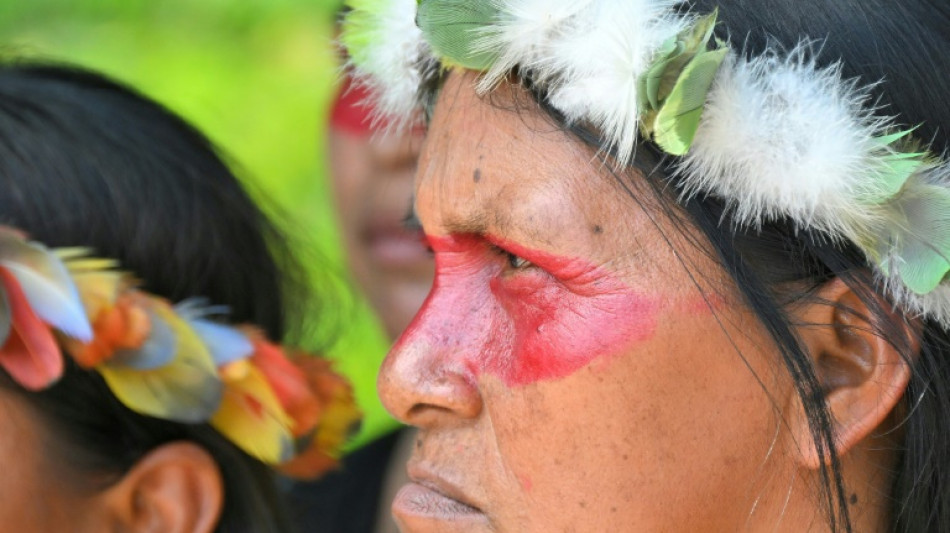
A group of Indigenous Waorani women give a war cry warning that environmentalists are not welcome in their part of the Ecuadoran Amazon, where an oil field operates partly on a protected reserve.
"We will not allow 'kowori' (strangers)... to enter," said Waorani leader Felipe Ima, translating the belligerent words of the group of seven women from the Kawymeno community that supports oil extraction at the nearby Ishpingo field.
The community is pitted in a battle of wills against environmental group Yasunidos, which has been fighting for a decade for a referendum on leaving the oil underground.
In May, Ecuador's Constitutional Court allowed the request, and a plebiscite has been scheduled for August.
Escorted by a spear-wielding warrior, the women from Kawymeno hold hands and dance in little clothing and feather crowns at the entrance to Ishpingo A platform.
They demand that any consultation should be with "the owners" of the land, and not with anyone that is "not even from the territory," explained Ima.
In Ecuador, the Constitution recognizes Indigenous people's "collective ownership of land as an ancestral form of territorial organization."
The State, however, maintains control over anything under the soil.
Ishpingo together with the nearby fields of Tiputini and Tambococha form the so-called ITT block, or block 43, which holds an estimated 282 million of the South American country's proven crude reserves of 1.2 billion barrels.
Extraction at Tiputini and Tambococha started in 2016 after years of fraught debate over whether to drill inside the Yasuni National Park.
This came after the government of then-president Rafael Correa failed to persuade the international community to pay former OPEC member Ecuador $3.6 billion not to exploit the ITT block to protect the Amazon and help curb climate change.
In April last year, the government announced pumping has also started at Isphingo.
- Pays for education, healthcare -
At the site protected by women in the dense, green jungle, stands one of twelve platforms of the ITT block that contributed 57,000 barrels per day (bpd) to Ecuador's total production of 464,000 bpd from January to April.
It is in the Yasuni National Park -- a biosphere reserve that houses some 2,000 tree, 610 bird, 204 mammal, 150 amphibian and more than 120 reptile species, according to the San Francisco University of Quito.
The Waorani community of Kawymeno, a journey of about four hours by foot and canoe from Ishpingo, is near the border with Peru.
Its 400 inhabitants have declared themselves defenders of the oil activity and its windfalls they say make up for the absence of government services.
"If there were no oil industry, we would not... have had education, health, family welfare," says Panenky Huabe, leader of the village where many work in the oil sector.
- Black gold benefits -
Besides being among the most biodiverse areas on Earth, the million-hectare (2.5-million acre) Yasuni park is home to two of the world's last uncontacted Indigenous populations.
It also holds oil fields that started operating before the ITT block.
"We see how extraction has been besieging the Yasuni for many years, since the 1970s when exploitation began," Yasunidos lawyer and spokesman Pedro Bermeo told AFP.
"Basically, the (block) 43 is the only one with a part (of jungle) that remains to be saved," he said.
But the referendum has generated deep divisions even among the Waorani, whose 4,800 members own some 800,000 hectares of jungle in the provinces of Orellana, Pastaza and Napo.
In 2019, the Waorani of Pastaza won a historic court ruling that prevents the entry of oil companies on 180,000 hectares on their territory.
But at Ishpingo A in Orellana, oil worker Akao Yetebe -- also a Waorani -- insisted "we will continue working" because "black gold benefits big cities, teachers, education, health, everything."
State-owned Petroecuador is authorized to operate on about 300 hectares of the Yasuni for its ITT block.
So far it has used about 80 hectares, generating $4.2 billion for the State -- some $1.2 billion in 2022 alone.
If the "Yes" wins in next month's referendum, "losses will be substantial," said Petroecuador manager Ramon Correa -- some $16.4 billion in projected income as well as jobs and investments already made.
I.Meyer--BTB