Turkey set to pivot to orthodoxy with rate hike / Photo: © AFP

 In Manchester, people say City scandal is 'shame for football'

 Stocks lacklustre as inflation data weighs on sentiment
 Israel-bound plane rerouted, pilots wounded in reported fight
 Truth commission on Sweden's Sami people seeks redress

 Energy costs spark inflation surges in France, Italy

 South Korea break China hearts to reach Asian Games football final

 Eala storms into Asian Games semi-finals to thrill adoring fans

 Turkey freezes ex-minister's assets as fund crisis grows
 What we know about the North Korean POW dispute

 Most equities rise after oil price plunge, US data in focus
 Polar oceans transformed as warming melts ice habitats: research

 Lost shark becomes viral star in South Korea

 Dangote to launch $16bn refinery in Kenya

 North Korean leader 'extremely obese': Seoul spy agency
 Yankees and pope-backed White Sox start MLB playoffs with wins

 Malaysia's ex-PM Mahathir in hospital for observation

 'No limits': Marathon world record holder Sawe chasing history

 Countdown begins to biggest-ever Rugby World Cup

 Bangladesh women lose ground after quota reform

 Vietnam admits 'differing opinions' on Hanoi development

 Stocks temper gains as oil pares heavy losses, US data in focus
 New Zealand denies breaching climate commitments to EU
 Albert becomes youngest US scorer in 4-2 win over Chile
 Pirate island's plunging population shows Greece's demographic decline

 With elections ahead, Latvia's Russian-speakers reject Moscow's help

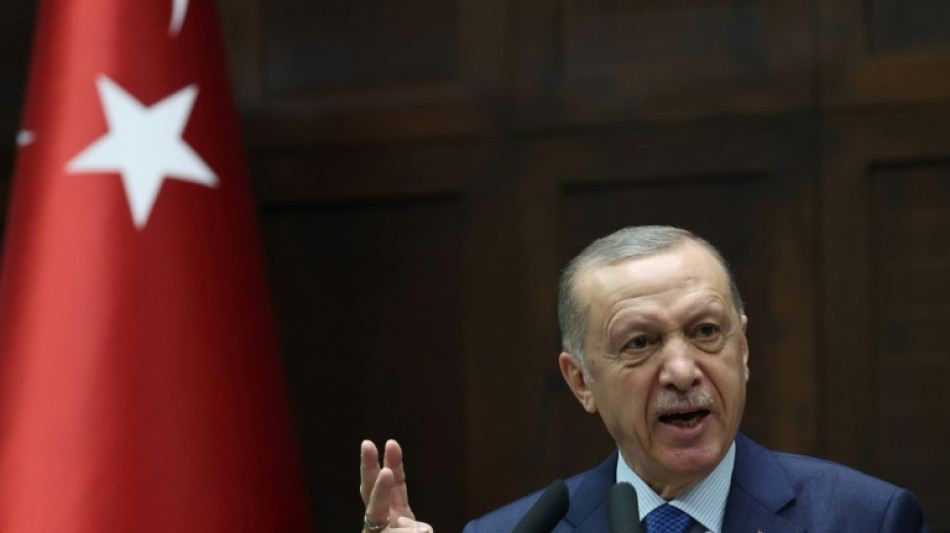
Turkey was widely expected Thursday to pivot away from years of unconventional economics promoted by President Recep Tayyip Erdogan and dramatically raise interest rates to fight inflation and steady the troubled lira.
Erdogan still defends his markets-defying idea that high interest rates contribute to -- rather than cure -- rising consumer prices that have been Turkey's bane for the past five years.
But the central bank is expected to change course and raise rates on Thursday after Erdogan appointed a former Wall Street executive to head the institution following his re-election last month.
The Turkish leader pushed the central bank to start slashing interest rates two years ago as part of a "new economic model" that focuses on job creation and economic growth.
The policy badly backfired and nearly cost the veteran Turkish leader last month's general election.
The annual inflation rate reached 85 percent late last year and the central bank burned through most of its reserves trying to prop up the lira -- down 90 percent against the dollar over 10 years -- from even bigger falls.
Erdogan was forced into his first election runoff and then orchestrated one of his trademark policy reversals after extending his two-decade rule until 2028.
He appointed investor-backed economist Mehmet Simsek as finance minister and former Goldman Sachs director Hafize Gaye Erkan as the head of the nominally independent central bank.
Turkish media said Simsek agreed to join the government only after winning assurances that he would be free to steady the ship as he saw fit.
Turkey had "no choice but to return to rational ground", Simsek said after taking office.
Erdogan said last week that he "accepted" that his new team would pursue policies that contradicted his own firmly held beliefs.
- How high? -
Simsek's presence has already made an impact.
The lira has lost an additional 15 percent against the dollar since the May 28 election runoff -- a sign that the central bank is slowly unwinding its costly currency defence.
A dollar was worth about 23.6 liras heading into one of the central bank's most closely watched policy meetings in years.
But analysts are deeply divided over how far and how fast Turkey will raise its policy rate from the current 8.5 percent.
Goldman Sachs economist Clemens Grafe said that "an orthodox policymaker would raise rates to 40 percent, the current level of deposit rates".
JPMorgan and the Bank of America both predicted a hike to 25 percent.
But Capital Economics said "there are grounds for caution" because the new team was showing signs of favouring a more slow-moving approach.
"Indeed, the lira's depreciation already appears to have stalled," the London-based consultancy pointed out.
Turkey's May annual inflation figure of 39.6 percent means banks lose money if they lend liras for a year at the official policy rate.
- Borrowed time -
Foreign investors who initially cheered Erdogan's new appointments now worry about how long the Turkish leader's patience with his new team will last.
Many point to the grim experience of Naci Agbal -- a market-friendly central banker whom Erdogan fired four months into his attempts to raise rates in late 2020 and early 2021.
Some analysts encourage the new team to act quickly and then brace for the possible political fallout.
Others suggest that Turkey's economic problems are too complex to address at the same time.
One of Turkey's most costly programmes involves a bank deposit protection scheme that Erdogan rolled out in late 2021.
It commits the government to cover any losses lira deposits incur from the currency's depreciation against the dollar.
That means that a quick return to a free-floating exchange rate could put an even bigger burden on the strained budget.
Many expect Simsek to gradually phase out the scheme.
Erdogan said Wednesday that he was putting his trust in his new appointments.
"We have placed very heavy responsibilities on our economy management. We have established a strong, harmonious and competent team," he said.
H.Seidel--BTB