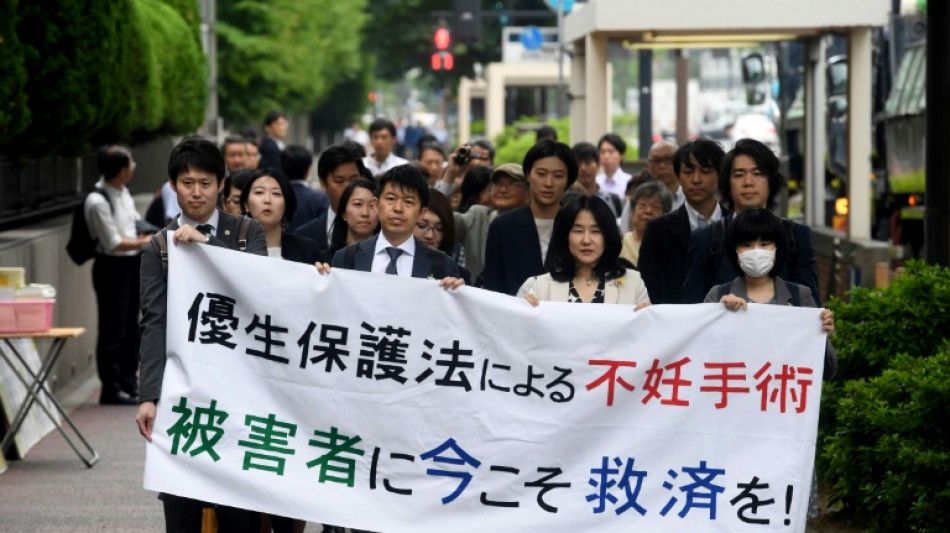
Campaigners slam Japan government forced sterilisation report / Photo: © AFP/File

 In Manchester, people say City scandal is 'shame for football'
 Stocks lacklustre as inflation data weighs on sentiment

 Israel-bound plane rerouted, pilots wounded in reported fight

 Truth commission on Sweden's Sami people seeks redress

 Energy costs spark inflation surges in France, Italy

 South Korea break China hearts to reach Asian Games football final

 Eala storms into Asian Games semi-finals to thrill adoring fans

 Turkey freezes ex-minister's assets as fund crisis grows

 What we know about the North Korean POW dispute

 Most equities rise after oil price plunge, US data in focus

 Polar oceans transformed as warming melts ice habitats: research

 Lost shark becomes viral star in South Korea

 Dangote to launch $16bn refinery in Kenya

 North Korean leader 'extremely obese': Seoul spy agency

 Yankees and pope-backed White Sox start MLB playoffs with wins

 Malaysia's ex-PM Mahathir in hospital for observation
 'No limits': Marathon world record holder Sawe chasing history

 Countdown begins to biggest-ever Rugby World Cup

 Bangladesh women lose ground after quota reform

 Vietnam admits 'differing opinions' on Hanoi development

 Stocks temper gains as oil pares heavy losses, US data in focus

 New Zealand denies breaching climate commitments to EU

 Albert becomes youngest US scorer in 4-2 win over Chile

 Pirate island's plunging population shows Greece's demographic decline

 With elections ahead, Latvia's Russian-speakers reject Moscow's help

Japanese campaigners on Wednesday slammed a government report into the sterilisation of thousands under a eugenics law in place until 1996, saying it failed to take responsibility for the procedures.
The 1,400-page report submitted to parliament this week details how some 16,500 people -- including some as young as nine -- were sterilised without their consent under the law in force from 1948.
Around 8,500 more were sterilised after their consent was obtained, though campaigners have cast doubt on how freely agreement was given.
The law allowed doctors to sterilise people with heritable intellectual disabilities, to "prevent ... poor quality descendants".
In 2019, lawmakers passed legislation offering each victim government compensation of 3.2 million yen ($22,800) -- an amount campaigners called insufficient given the damage inflicted.
Lawmakers also commissioned the report made public this week, which Koji Niisato, a lawyer who has represented victims of the policy, said fell short.
It is "largely a compilation of what has been investigated and reported" which merely confirms "that it was an extremely terrible law," he told journalists Wednesday.
But "it lacks a summary of why this terrible law was enacted and existed for 48 years, and fails to mention why the government didn't take responsibility even after the law was amended," he said.
"That is extremely regrettable."
Victims of the sterilisation programme campaigned for decades seeking recognition of the harm they suffered and compensation.
They have also turned to the courts seeking relief, and last year three people were awarded damages in a landmark victory.
The Osaka High Court overturned a lower court decision, and ordered the national government to pay a combined 27.5 million yen ($200,000) to the elderly trio.
But earlier this month, a different high court rejected damages requests by plaintiffs, arguing a 20-year statute of limitations had passed.
The ruling "is a terrible verdict that doesn't consider why victims couldn't file lawsuits" sooner, plaintiff Junko Iizuka, 77, told reporters.
"As the government's responsibility is obvious, I want to see a quick solution," with more adequate compensation offered without the need for continued lawsuits, she said.
F.Müller--BTB