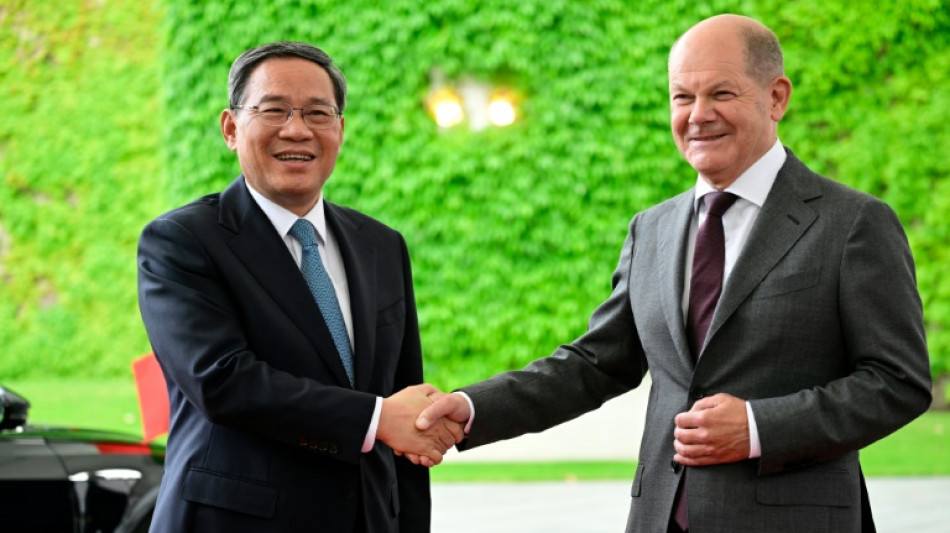
'Tough balancing act': Chinese, German leaders hold talks / Photo: © AFP

 South Korea break China hearts to reach Asian Games football final

 Eala storms into Asian Games semi-finals to thrill adoring fans

 Turkey freezes ex-minister's assets as fund crisis grows

 What we know about the North Korean POW dispute

 Most equities rise after oil price plunge, US data in focus
 Polar oceans transformed as warming melts ice habitats: research

 Lost shark becomes viral star in South Korea

 Dangote to launch $16bn refinery in Kenya

 North Korean leader 'extremely obese': Seoul spy agency
 Yankees and pope-backed White Sox start MLB playoffs with wins

 Malaysia's ex-PM Mahathir in hospital for observation

 'No limits': Marathon world record holder Sawe chasing history

 Countdown begins to biggest-ever Rugby World Cup

 Bangladesh women lose ground after quota reform

 Vietnam admits 'differing opinions' on Hanoi development
 Stocks temper gains as oil pares heavy losses, US data in focus

 New Zealand denies breaching climate commitments to EU
 Albert becomes youngest US scorer in 4-2 win over Chile

 Pirate island's plunging population shows Greece's demographic decline

 With elections ahead, Latvia's Russian-speakers reject Moscow's help

 Brazil football clubs face massive sponsorship blow from betting ban

 ChatGPT maker wants to be the App Store for AI as safety concerns grow

 Women fight fires and sexism in Indonesian Borneo

 Forsling's OT blast lifts Florida over Carolina in NHL opener

 Hurricane Polo sweeps over Mexico's Pacific coast, heads inland

Chancellor Olaf Scholz hosts Premier Li Qiang for talks on Tuesday, seeking to recalibrate cooperation between Germany and China after Berlin branded Beijing a "systemic rival".
Li is on his first trip abroad since he was named premier in March and tasked with shoring up China's sputtering post-Covid economy.
But unlike previous visits by Chinese dignitaries, when pragmatic German leaders eager to expand business ties with the Asian giant rolled out the red carpet, Li's trip comes as Germany is rushing to diversify its trading partners.
Burned by its reliance on Russian gas and hurt by supply chain disruptions during the pandemic, Germany is intensifying its efforts to "de-risk" from China.
Meeting Germany's President Frank-Walter Steinmeier on Monday, Li said China was ready to work with Germany to contribute to "global stability and prosperity".
Yet when he sits down with Scholz, Germany's first national security strategy, published days ago, will set the tone.
The blueprint stridently accused China of acting against German interests, putting international security "under increasing pressure" and disregarding human rights.
But it also underlined the necessity of getting Beijing's cooperation on global issues such as fighting climate change.
Beijing has bristled at being described as a "partner, competitor and systemic rival" in the text, saying such labels would only "push our world towards a vortex of division and confrontation".
- 'Stress test' -
Tuesday's talks between the two governments is "a stress test on whether genuine partnership between Berlin and Beijing is still possible", Thorsten Benner, director of the Global Public Policy Institute, told AFP.
"It's open as to whether Germany continues to play the game of pretending there is broad agreement with Beijing... or whether it chooses a new path of straight talk and limiting the final statement to areas where there is a genuine path forward for cooperation," he added.
Spiegel magazine said that "finding the right and appropriate way to deal with China is almost impossible".
China has been accused of stirring regional instability with threats against Taiwan and of rights abuses against Uyghurs, while refusing to distance itself from Russia's Vladimir Putin. On the other hand, it is "important to continue to have a relationship of trust" with Beijing, Spiegel noted.
"Managing this balancing act without suffering a hernia is a real challenge" not just at Tuesday's talks, but "in the years and decades to come", it said.
German Foreign Minister Annalena Baerbock, one of the most strident critics of Beijing's human rights policies, has signalled that the way to handle the delicate situation was to boost cooperation with China on areas on which both sides can agree, such as the climate.
But on economic issues, Scholz's government has repeatedly underlined that ending reliance is the key.
Speaking at a major German industry event on Monday, Scholz said the "G7 has no interest in preventing China's economic rise".
"At the same time, we are looking carefully at preventing dangerous economic reliance in the future."
Addressing the same event, NATO chief Jens Stoltenberg noted that many had previously thought that buying gas from Russia was "a purely commercial decision, only to learn the hard way".
"We must not make the same mistake once again with other authoritarian regimes, not least China," he warned.
R.Adler--BTB