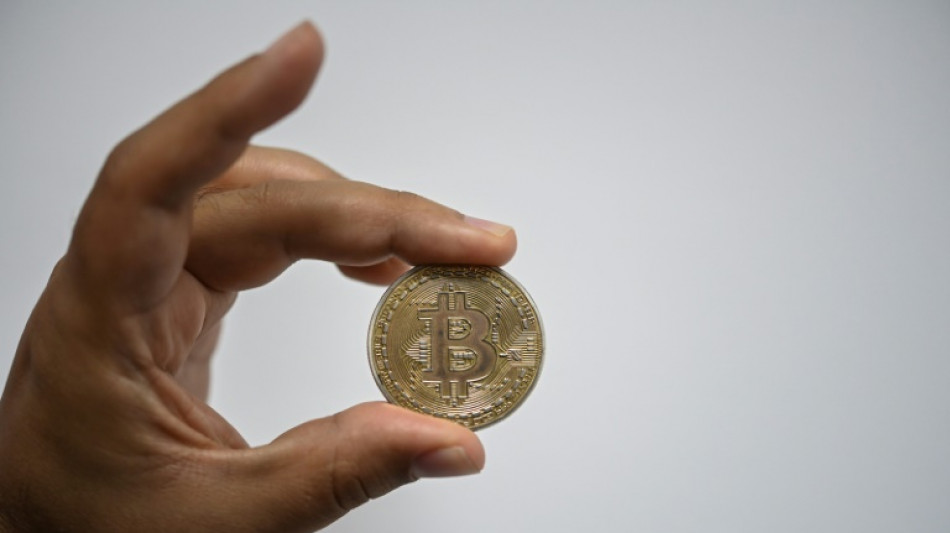
US clampdown has crypto kings looking abroad / Photo: © AFP/File

 South Korea break China hearts to reach Asian Games football final

 Eala storms into Asian Games semi-finals to thrill adoring fans

 Turkey freezes ex-minister's assets as fund crisis grows

 What we know about the North Korean POW dispute

 Most equities rise after oil price plunge, US data in focus

 Polar oceans transformed as warming melts ice habitats: research

 Lost shark becomes viral star in South Korea

 Dangote to launch $16bn refinery in Kenya

 North Korean leader 'extremely obese': Seoul spy agency
 Yankees and pope-backed White Sox start MLB playoffs with wins

 Malaysia's ex-PM Mahathir in hospital for observation

 'No limits': Marathon world record holder Sawe chasing history

 Countdown begins to biggest-ever Rugby World Cup

 Bangladesh women lose ground after quota reform

 Vietnam admits 'differing opinions' on Hanoi development

 Stocks temper gains as oil pares heavy losses, US data in focus

 New Zealand denies breaching climate commitments to EU

 Albert becomes youngest US scorer in 4-2 win over Chile

 Pirate island's plunging population shows Greece's demographic decline

 With elections ahead, Latvia's Russian-speakers reject Moscow's help

 Brazil football clubs face massive sponsorship blow from betting ban

 ChatGPT maker wants to be the App Store for AI as safety concerns grow

 Women fight fires and sexism in Indonesian Borneo

 Forsling's OT blast lifts Florida over Carolina in NHL opener

 Hurricane Polo sweeps over Mexico's Pacific coast, heads inland

After years on the sidelines, financial regulators in the United States are throwing the book at the free-wheeling cryptocurrency industry, with angry entrepreneurs threatening to take their business overseas.
Earlier this month, Wall Street's regulator, the Securities and Exchange Commission, pressed a raft of charges against Binance, the world's biggest cryptocurrency exchange, and US-based Coinbase.
Both companies, along with the now defunct FTX, were key brands in the crypto industry, helping grow what began as a secretive playground for tech geeks into a new way to invest embraced by Wall Street.
The SEC has been slowly tightening the screws on crypto since 2020.
But the blows against Binance and Coinbase hit the industry with an accusation that stung: some crypto currencies are securities that must be traded under strict rules and not an alternative to dollars, yen or euros and outside the reach of regulators.
Defenders of digital currencies have argued that regulators are stuck in the past and applying rules unfit for the likes of bitcoin or ethereum.
"Cases lodged by regulators are likely to ramp up uncertainty and confusion about crypto as they drag through US courts," lamented Scott Freeman, co-founder and partner at JST Capital, which specializes in crypto.
"We wish to see from regulators a bit more proactive guidance and legislation rather than regulation by enforcement," said Paolo Ardoino, chief technology officer at Bitfinex, a cryptocurrency trading company that was fined by another US regulator, the CFTC, in 2021.
Crypto companies are also "caught in the middle of a turf war" between US regulatory authorities, Coinbase chief legal officer Paul Gruwal told AFP.
The industry, eager to join the financial establishment, has asked for clear regulation, but progress on that front has been thwarted by political gridlock in Washington.
"If we don't see that regulatory clarity emerge in the US we may have to consider investing more elsewhere in the world," Coinbase CEO Brian Armstrong told a conference in London.
"Anything is on the table, including relocating."
- 'Wake up' -
Nonplussed by the controversies facing crypto, political leaders in several countries are keen to capitalize on the opportunity.
British Prime Minister Rishi Sunak on Sunday welcomed the opening of a London office by American private equity giant Andreessen Horowitz, notably to invest in crypto projects.
New regulation in Europe, while not unanimously favored, "at least gives us a list of rules" and visibility, said Bitfinex's Ardoino.
The clampdown in the US has brought a dose of self doubt to a whole ecosystem behind cryptocurrency and the blockchain idea at its core, in which transactions do away with middlemen, including governments and banks.
Spooked by Washington's push, Crypto investor Derek Boirun, who founded Realio, a company mixing real estate and blockchain, posted a "Why I'm leaving the US" piece at website Medium.
Boirun wrote of burning through money and time fruitlessly working with US regulators.
"Ultimately, it will be up to Congress to step in to establish the US as a jurisdiction open for businesses," Freeman told AFP.
"Until that happens, we expect that Europe and Asia will continue to be viewed as more receptive to those seeking to innovate."
But with Democrats and Republicans so bitterly divided in Washington, securing a law won't be easy.
"Some of the most vocal anti-crypto folks are Democrats and some of the most pro-crypto folks have been Republican," said Carol Rose Goforth, professor of law at the University of Arkansas.
"I hope we don't turn that into a bipartisan mess, but given where politics are, that could happen too."
The hostile climate for crypto also stems from the position of the White House, which in March published a paper questioning the usefulness of cryptocurrencies.
"The US government is making it very difficult for traditional financial institutions", particularly banks, "to engage in cryptocurrencies", said Goforth.
The White House set out its concerns succinctly, calling cryptocurrencies "too risky".
They are "largely speculative investment vehicles and are not an effective alternative to fiat currency," it said in the paper.
M.Odermatt--BTB