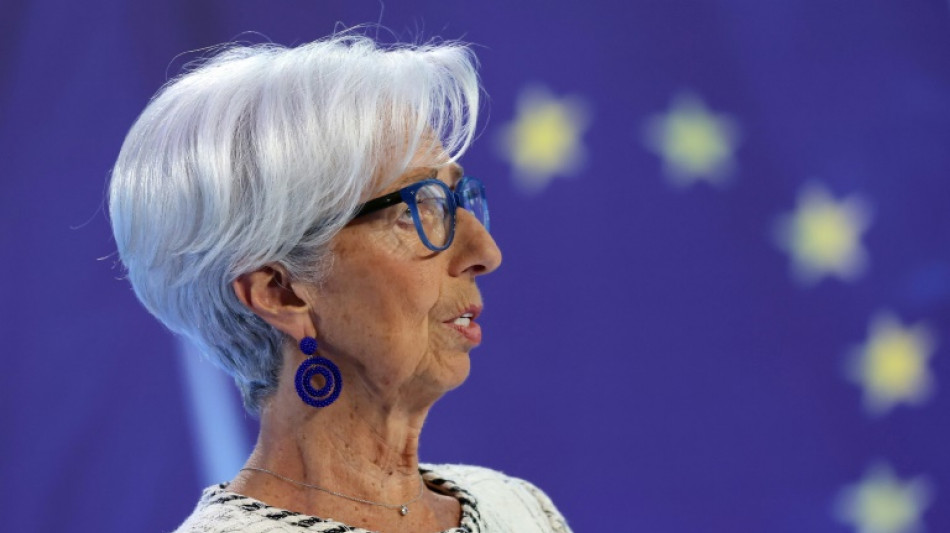
ECB hikes rates to 22-year high and says not done yet / Photo: © AFP

 South Korea break China hearts to reach Asian Games football final

 Eala storms into Asian Games semi-finals to thrill adoring fans

 Turkey freezes ex-minister's assets as fund crisis grows

 What we know about the North Korean POW dispute

 Most equities rise after oil price plunge, US data in focus

 Polar oceans transformed as warming melts ice habitats: research

 Lost shark becomes viral star in South Korea

 Dangote to launch $16bn refinery in Kenya

 North Korean leader 'extremely obese': Seoul spy agency
 Yankees and pope-backed White Sox start MLB playoffs with wins

 Malaysia's ex-PM Mahathir in hospital for observation

 'No limits': Marathon world record holder Sawe chasing history

 Countdown begins to biggest-ever Rugby World Cup

 Bangladesh women lose ground after quota reform

 Vietnam admits 'differing opinions' on Hanoi development

 Stocks temper gains as oil pares heavy losses, US data in focus

 New Zealand denies breaching climate commitments to EU

 Albert becomes youngest US scorer in 4-2 win over Chile

 Pirate island's plunging population shows Greece's demographic decline

 With elections ahead, Latvia's Russian-speakers reject Moscow's help

 Brazil football clubs face massive sponsorship blow from betting ban

 ChatGPT maker wants to be the App Store for AI as safety concerns grow

 Women fight fires and sexism in Indonesian Borneo

 Forsling's OT blast lifts Florida over Carolina in NHL opener

 Hurricane Polo sweeps over Mexico's Pacific coast, heads inland

The European Central Bank hiked interest rates to a 22-year high Thursday and said another increase in July was "very likely", as it pushed ahead with its fight against inflation despite a darkening eurozone economy.
The ECB's governing council increased rates by a further 25 basis points, taking the closely-watched deposit rate to 3.50 percent -- its highest level since 2001.
"Inflation has been coming down but is projected to remain too high for too long," ECB president Christine Lagarde said.
The move comes a day after the US Federal Reserve held off from raising rates after 10 straight increases.
"We're not thinking about pausing," Lagarde said, adding that the ECB still has "ground to cover" on rates after the Frankfurt institution lifted its inflation outlook for 2023-2025 in fresh forecasts on Thursday.
"Barring a material change to our baseline, it is very likely the case that we will continue to increase rates in July," she told reporters.
The ECB has lifted borrowing costs at the fastest rate ever to combat red-hot inflation after Russia's war in Ukraine sent food and energy prices soaring, raising its key rates by 4.00 percentage points since July.
Eurozone inflation slowed to 6.1 percent in May year-on-year, down from a peak of 10.6 percent in October, mainly thanks to rapidly falling energy costs.
The ECB said its inflation-busting efforts were "gradually having an impact", with loan demand slowing sharply as higher borrowing costs take their toll on eurozone households and firms.
But inflation remains three times above the ECB's target while core inflation -- which strips out volatile food and energy prices -- eased only slightly to 5.3 percent in May, after 5.6 percent in April.
Lagarde reiterated on Thursday that the ECB will "follow a data-dependent approach" as it charts the way forward.
"The ECB simply cannot afford to be wrong on inflation," said ING bank economist Carsten Brzeski.
"The bank wants and has to be sure that it has slayed the inflation dragon before considering a policy change."
- 'Not satisfactory' -
Like all central banks, the ECB has to walk a fine line in raising interest rates sufficiently to dampen demand and contain inflation, without provoking a sharp economic slowdown in the process.
But the eurozone economy has proved less resilient than initially thought.
Revised data last week showed that the economy in the 20-nation currency union shrank by 0.1 percent for two straight quarters at the end of 2022 and the start of 2023, meeting the technical definition of a recession.
While still mild, the surprise winter slump has cast doubt on more optimistic economic forecasts for 2023.
In updated forecasts, the ECB now sees the eurozone economy growing by 0.9 percent in 2023 -- down from 1.0 percent previously.
Lagarde said the economy would "strengthen in the course of the year" as inflation slows, supply chains ease and the service sector remains resilient.
But she stressed that the outlook remained "highly uncertain", citing Russia's war in Ukraine and potentially weak global growth among the risk factors.
- 'We will get there' -
Thursday's updated projections also showed inflation reaching 5.4 percent in 2023, 3.0 percent in 2024 and 2.2 percent in 2025 -- a 0.1-percentage-point increase for each year from its last forecasts in March.
With the ECB's two-percent target still out of reach by 2025, Lagarde called the outlook "not satisfactory".
Wage pressures were becoming an "increasingly important source" of inflation, she said, as workers -- boosted by record-low eurozone unemployment -- push for pay rises to help compensate for the higher cost of living.
She also expressed concern about high corporate profits, urging companies and employees to avoid a "tit-for-tat" where both sides sought full compensation for inflation -- potentially creating an unwanted spiral of price rises.
The ECB was watching the discussions and developments between the different parties in the labour market closely, Lagarde said.
The central bank "will take all necessary measures to return inflation to two percent. That they can count on," she said.
"And we are confident that we will get there."
M.Furrer--BTB