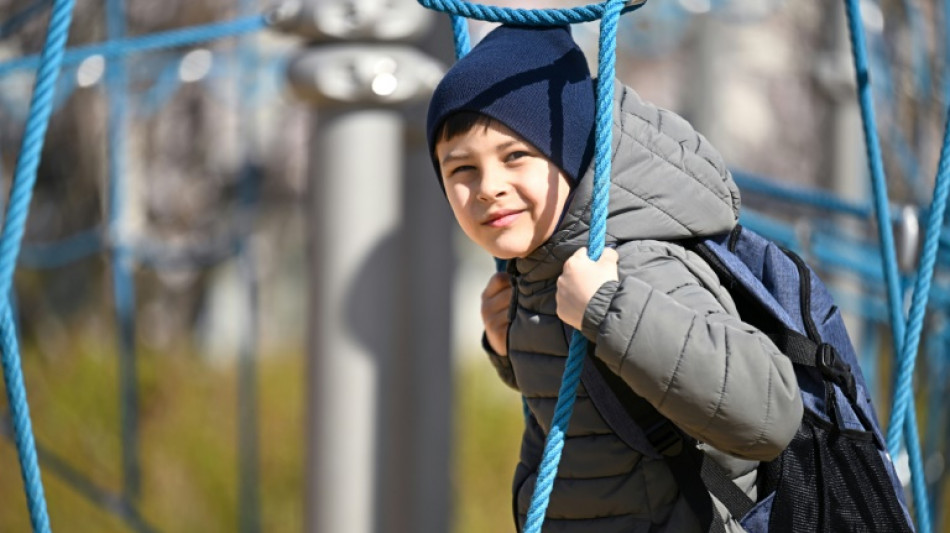
Ukraine children with disabilities struggle for therapy abroad / Photo: © AFP

 Fashion's mystery man Margiela sells off his archives
 Nuclear test-scarred Marshall Islands criticises China missile

 Chip titan SK hynix to set price for mega US listing

 Crude extends rally as US-Iran flare-up rocks peace hopes
 Democrat accused of rape exits key US Senate race

 Japan student Ito keeps place against Ireland as Jones returns

 Belgium bid to crack Spain's ironclad defence in World Cup quarter-final

 US man sentenced after swapping 17th century manuscript
 US launches new strikes on Iran after Trump vows to hit 'hard'

 Taylor Swift fans pay $25 for garbage from outside wedding

 After quakes, Venezuelans fear losing damaged homes

 PSG's Lee set to join Athletico
 Erdogan gave pistols to NATO leaders, Starmer says

 Nocera Expands Diversified Technology Strategy With Binding Agreement to Acquire an Equity Interest in INERGX, an Integrated Energy Storage and Power Platform for AI, Defense and Mission-Critical Demand
 China sends nuclear missile message as US looks elsewhere
 Justin Bieber added to 11-minute World Cup final halftime show

 Fery targets Wimbledon final birthday present after royal seal of approval
 Egypt file complaint against referee after World Cup exit

 Women's semi-finalists in uncharted territory at Wimbledon
 US man jailed after swapping 17th century manuscript

 UN maritime head urges halt to Hormuz transit to protect seafarers
 Trump skips new Air Force One on return from Turkey NATO summit

 New York building that buckled now 'stable,' says mayor

 UN says pledges for global connectivity project pass $100 bn

 McIlroy hoping for 'home' comforts at Scottish, British Opens

More than a year after fleeing from Ukraine to Hungary with her autistic son Roman, Iryna Bryk has still not found suitable therapy for her nine-year-old.
"They only speak Hungarian in public institutions and there are few places," the 31-year-old teacher from Cherkasy in central Ukraine told AFP.
The Bryks are not alone in their struggle.
An estimated 12 percent of families fleeing Ukraine include a member with a disability, according to a recent survey by the United Nations refugee agency UNHCR.
Many Ukrainian children with disabilities were also evacuated from institutions at the beginning of the war, according to the European Disability Forum.
Health workers warn that forced displacement can worsen existing disabilities, in addition to the struggles of adjusting to new surroundings.
- 'Time is crucial' -
Roman was diagnosed with autism at the age of four and communicates only through facial expressions and hand gestures.
"With the right therapies I know he will talk one day. But for kids with autism and other disorders time is crucial," said Bryk, looking on as Roman played silently with toys on the kitchen table in a Budapest apartment.
In Ukraine, Roman attended a centre that focused on interaction with others. Now it is up to Bryk to practise developmental activities with him at home.
During the day, he accompanies his mother to her work at a charity, where she teaches preschoolers -- all Ukrainian refugees.
Bryk said she fled Ukraine to avoid her son being traumatised.
"My biggest fear when the invasion happened was to imagine his reaction if he saw Russian tanks shooting," she told AFP.
Hundreds of Ukrainian children with developmental difficulties have moved to Hungary since the invasion, according to speech therapist Olena Andriichuk.
Herself a refugee, Andriichuk ran a secondary school in Kyiv that integrated 87 children with special needs.
Now the 42-year-old plans to launch a self-help therapy programme for refugee children to ensure they receive timely and qualified care.
"They cannot adapt to local schools due to their disorders and lack of language knowledge," Andriichuk told AFP in Budapest during a project meeting.
So far, some 40 Ukrainian refugee families in Hungary have expressed interest in joining her programme, which is seeking charity donations to fund the recruitment of specialists.
One of those keen on the programme -- called AKSEN (Assistance for Kids with Special Educational Needs) -- is refugee Yuliia Stavytska. Her daughter Daryna, 6, has sensory-motor alalia, a speech disorder.
"The war meant development time with the specialists was lost," the 26-year-old hair stylist told AFP at a private speech and language therapy session with Andriichuk.
Later, the project hopes to send updates about refugee children's development to the Ukrainian health authorities in Kyiv.
"When they left Ukraine they disappeared from the radar. Ultimately our goal is to help refugee parents be calmer about their kids' life chances," said Andriichuk.
- 'Same opportunities' -
In Poland, which hosts a much larger number of Ukrainian refugees than Hungary, the language barrier and access to therapy are also challenges for those with disabilities.
Krakow-based Patchwork Association, run by Ukrainian mothers of children with disabilities, works in partnership with Polish organisations to help more than 180 Ukrainian refugee families in Poland access care and help with integration.
In 2014 the group's co-founder, Khrystyna Rudenko, 50, left Ukraine for Germany before settling in Poland.
With the help of Polish specialists, her daughter Sonia, 20, who has cerebral palsy and epilepsy, learned to eat unaided in a few months.
"I want Ukrainian refugee families to have the same opportunities," she told AFP.
But high demand for places on programmes at state- and municipality-run facilities causes bottlenecks, Rudenko said.
Though most families stay in Poland, many choose to return.
For these families, despite the "daily shelling in Kyiv...there is simply not enough help available and they are missing home, friends and family," she said.
K.Thomson--BTB