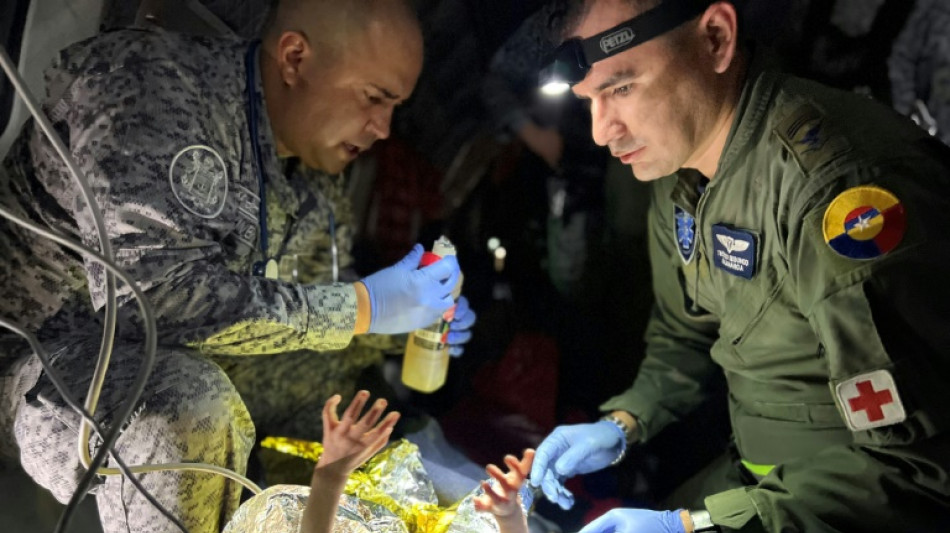
Courage, 'intelligence' got children through 40-day jungle odyssey / Photo: © Colombian Presidency/AFP/File

 Most equities rise after oil price plunge, US data in focus

 Polar oceans transformed as warming melts ice habitats: research

 Lost shark becomes viral star in South Korea
 Dangote to launch $16bn refinery in Kenya
 North Korean leader 'extremely obese': Seoul spy agency

 Yankees and pope-backed White Sox start MLB playoffs with wins

 Malaysia's ex-PM Mahathir in hospital for observation
 'No limits': Marathon world record holder Sawe chasing history

 Countdown begins to biggest-ever Rugby World Cup
 Bangladesh women lose ground after quota reform
 Vietnam admits 'differing opinions' on Hanoi development
 Stocks temper gains as oil pares heavy losses, US data in focus
 New Zealand denies breaching climate commitments to EU
 Albert becomes youngest US scorer in 4-2 win over Chile
 Pirate island's plunging population shows Greece's demographic decline

 With elections ahead, Latvia's Russian-speakers reject Moscow's help
 Brazil football clubs face massive sponsorship blow from betting ban
 ChatGPT maker wants to be the App Store for AI as safety concerns grow

 Women fight fires and sexism in Indonesian Borneo

 Forsling's OT blast lifts Florida over Carolina in NHL opener

 Hurricane Polo sweeps over Mexico's Pacific coast, heads inland

 Grynspan pulls ahead in race to lead UN: diplomat

 Trump touts AI boss pledge to self-regulate

 Oil down, but stocks lower as bond yields rise

 England break down stubborn Czechs to claim first Nations League win

Ample courage and honed jungle smarts have been hailed as the main reasons four Indigenous children managed to stay alive in Colombia's Amazon jungle for 40 days after surviving a plane crash.
Against all odds, siblings Lesly, Soleiny, Tien Noriel and Cristin -- ages 13, nine, five and one respectively -- were found weak, but alive, on Friday after a massive search by some 200 soldiers and Indigenous jungle experts.
The children had been travelling with their mother, who died in the aftermath of the crash on May 1 that killed the two other adults on the small plane.
This is what the experts have to say about the youngsters' survival, dubbed a "miracle" by hardened military general Pedro Sanchez, who was in charge of the search.
- Food and water -
For the first days after the crash, the children stayed near the plane wreck, eating cassava flour and other food they had found on board.
When their food dwindled, the children decided to try and find a way out of the rainforest, a place teeming with wild animals and armed guerrillas.
On their odyssey, the children ate "chontaduro (palm fruit) and wild mango... fruits from the jungle," said Sanchez.
Search team member Luis Acosta of the National Indigenous Organization of Colombia said they had also grazed on seeds, roots and other plants they were able to identify as edible.
It was enough to keep them alive, though the children were very weak when found, with Tien Noriel no longer able to walk.
Lesly brought a soda bottle with her from the plane and followed a path never far from the river so they would always have something to drink, said another Indigenous search party member, Henry Guerrero.
It was not clear whether the children had found or consumed any of the food and water the army had air dropped into the jungle for them.
- Tools -
Along with the bottle Lesly brought from the crash site, she also packed a suitcase with a tarpaulin, a towel, a flashlight and some clothes, said Guerrero.
The children had used these to build a rudimentary shelter which they moved several times. They slept on the towel on the ground.
The children took two cellphones, which they probably used "to distract themselves at night" until the batteries died, said Guerrero.
There is no signal in the rainforest for the children to have made any telephone calls for help.
In the suitcase Lesly also carried a toy music box.
- Courage and know-how -
Colombia's defense ministry has given a special nod to Lesly: "It is thanks to her, her courage and her leadership, that the three others were able to survive, with her care, her knowledge of the jungle."
According to Guerrero, Lesly is clearly "very intelligent" given her selection of items for the suitcase.
Acosta said the older children know the jungle "very well." They are members of the Huitoto Indigenous group, whose children learn the ways of the rainforest from a young age.
"They know what to eat and what not (to eat). They survived because of that and because of their spiritual strength," said Acosta.
The search by dozens of people and several dogs was hamstrung by difficult conditions in the jungle: rainfall that lasted 16 hours a day lowered visibility and made it difficult to track the children's trail.
The rescuers covered more than 2,600 kilometers (1,615 miles), only to finally find the children some five kilometers from the wreck.
The siblings are receiving medical and psychological care.
Astrid Caceres, director of the Colombian Family Welfare Institute said Monday children were catching up on sleep, and the two eldest were battling spikes of fever.
Their recovery was going "as expected... the prognosis is still two to three weeks" of hospitalization in Bogota, said Caceres.
J.Bergmann--BTB