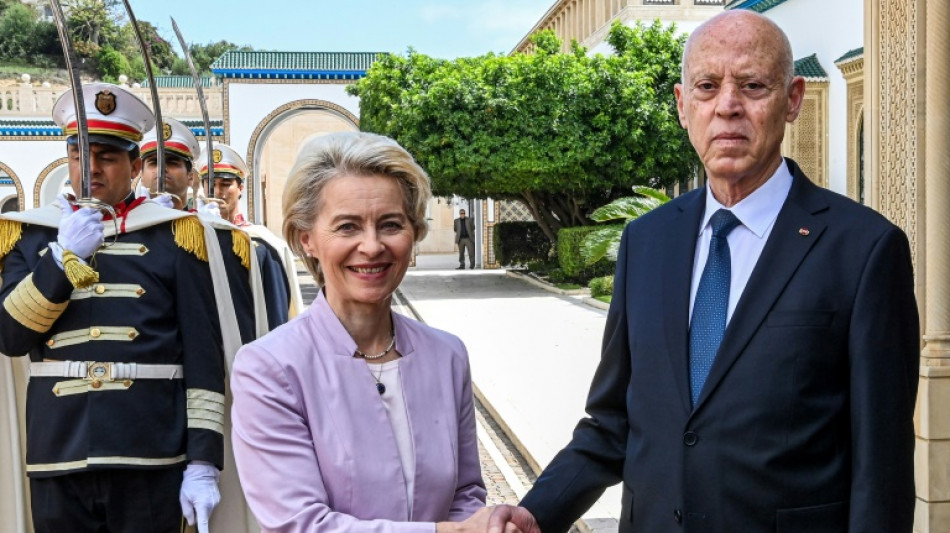
EU considers aid to Tunisia to boost economy, reduce migrant flows / Photo: © TUNISIAN PRESIDENCY/AFP

 Most equities rise after oil price plunge, US data in focus
 Polar oceans transformed as warming melts ice habitats: research

 Lost shark becomes viral star in South Korea
 Dangote to launch $16bn refinery in Kenya

 North Korean leader 'extremely obese': Seoul spy agency
 Yankees and pope-backed White Sox start MLB playoffs with wins

 Malaysia's ex-PM Mahathir in hospital for observation

 'No limits': Marathon world record holder Sawe chasing history

 Countdown begins to biggest-ever Rugby World Cup
 Bangladesh women lose ground after quota reform
 Vietnam admits 'differing opinions' on Hanoi development

 Stocks temper gains as oil pares heavy losses, US data in focus
 New Zealand denies breaching climate commitments to EU
 Albert becomes youngest US scorer in 4-2 win over Chile

 Pirate island's plunging population shows Greece's demographic decline
 With elections ahead, Latvia's Russian-speakers reject Moscow's help
 Brazil football clubs face massive sponsorship blow from betting ban
 ChatGPT maker wants to be the App Store for AI as safety concerns grow

 Women fight fires and sexism in Indonesian Borneo

 Forsling's OT blast lifts Florida over Carolina in NHL opener

 Hurricane Polo sweeps over Mexico's Pacific coast, heads inland

 Grynspan pulls ahead in race to lead UN: diplomat

 Trump touts AI boss pledge to self-regulate
 Oil down, but stocks lower as bond yields rise

 England break down stubborn Czechs to claim first Nations League win
The European Union on Sunday said it is considering more than one billion euros in aid to boost crisis-hit Tunisia's economy and reduce the flow of irregular migrants across the Mediterranean Sea.
The North African country, highly indebted and in talks for an IMF bailout loan, is a gateway for migrants and asylum-seekers attempting the dangerous voyages to Europe.
The EU is ready to offer Tunisia 900 million euros in long-term aid plus 150 million euros in immediate support in a bid to "strengthen our relationship", European Commission head Ursula von der Leyen said on a joint visit with the Italian and Dutch prime ministers.
The aid would be contingent on approval of the nearly $2 billion loan currently under negotiation with the International Monetary Fund, according to a document posted on the European Commission's website.
But Tunisian President Kais Saied again on Tuesday rejected what he termed the "diktats" of the Washington-based lender.
Aside from trade and investment, the EU package would help Tunisia with border management and to combat human trafficking, with support worth 100 million euros this year, von der Leyen said.
"We both have a vast interest in breaking the cynical business model of smugglers and traffickers," she said. "It is horrible to see how they deliberately risk human lives for profit."
She said other joint projects with the bloc would help Tunisia export clean renewable energy to Europe, and deliver high-speed broadband, all with the aim of creating jobs and to "boost growth here in Tunisia".
Von der Leyen, after the four-way talks with Saied, said she hoped an EU-Tunisia agreement could be signed before the next European summit later this month.
- 'Long and difficult road' -
She stressed that the EU is Tunisia's top trade and investment partner and had "supported Tunisia's path to democracy" since it became the birthplace of the Arab Spring popular revolts in 2011, describing it as "a long and difficult road".
Von der Leyen visited Tunisia with Italy's Prime Minister Giorgia Meloni and her Dutch counterpart Mark Rutte for talks with Saied, who has assumed near total governing powers over the country since 2021.
Rights groups have accused him of an "authoritarian drift" for restricting civil liberties and jailing opposition activists in what Amnesty International has labelled "a witch hunt".
Andrea Cellino, of the Middle East Institute Switzerland, said the EU should be doing more to hold Saied's administration accountable.
"And what about Tunisia reforms and restoring its democratic path?" he tweeted. "This sounds a lot like 'money for nothing'."
EU governments, under pressure to reduce migrant arrivals, last week agreed on steps to fast-track migrant returns to their countries of origin or transit countries deemed "safe", including Tunisia.
Italy's far-right premier, Meloni, on her second Tunisia visit within a week, said she was "satisfied" with the EU offer of "a real partnership to face the migratory crisis and the question of development" in Tunisia.
Tunisia lies less than 150 kilometres (90 miles) from the Italian island of Lampedusa, and has long been a departure point for migrants, mostly from sub-Saharan African countries.
According to the UN's refugee agency, 51,215 migrants have arrived illegally by sea in Italy so far this year, up more than 150 percent from last year, and nearly 1,000 have died or disappeared at sea.
An increasing number of the migrants hail from Tunisia, whose tourism-based economy was hit hard by the Covid pandemic and is now marked by high inflation and unemployment.
- Not Europe's 'border guard' -
Tunisia reached an in-principle deal last year for an IMF bailout loan of around $2 billion.
But talks have since stalled over the reforms demanded by the fund, especially on state-run enterprises and the scrapping of state subsidies on basic goods.
Tunisian rights groups accused Saied of hate speech after he charged in February that "hordes" of sub-Saharan Africans were responsible for rising crime and posed a "demographic" threat to the Arab-majority country.
Violence against migrants rose sharply after his speech, and thousands fled the country.
Saied on Saturday visited a migrant camp in the coastal city of Sfax and said he rejected turning Tunisia into Europe's "border guard".
The Tunisian Forum for Economic and Social Rights denounced the European leaders' visit as an attempt to "blackmail" Tunisia with an offer of financial support in return for stepped-up border vigilance.
F.Pavlenko--BTB