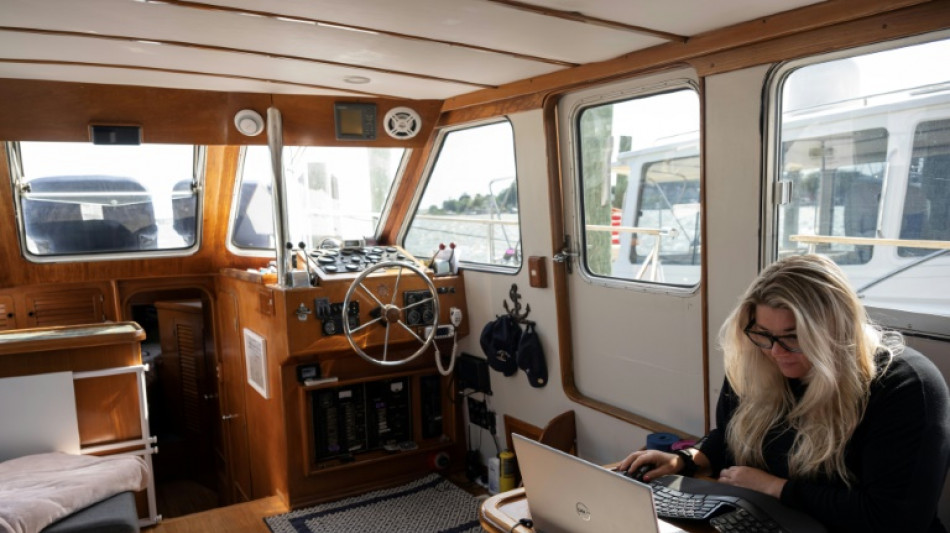
Commute no more: US employees embrace telework / Photo: © AFP

 Most equities rise after oil price plunge, US data in focus

 Polar oceans transformed as warming melts ice habitats: research

 Lost shark becomes viral star in South Korea
 Dangote to launch $16bn refinery in Kenya
 North Korean leader 'extremely obese': Seoul spy agency
 Yankees and pope-backed White Sox start MLB playoffs with wins

 Malaysia's ex-PM Mahathir in hospital for observation

 'No limits': Marathon world record holder Sawe chasing history

 Countdown begins to biggest-ever Rugby World Cup

 Bangladesh women lose ground after quota reform

 Vietnam admits 'differing opinions' on Hanoi development

 Stocks temper gains as oil pares heavy losses, US data in focus

 New Zealand denies breaching climate commitments to EU

 Albert becomes youngest US scorer in 4-2 win over Chile

 Pirate island's plunging population shows Greece's demographic decline
 With elections ahead, Latvia's Russian-speakers reject Moscow's help

 Brazil football clubs face massive sponsorship blow from betting ban

 ChatGPT maker wants to be the App Store for AI as safety concerns grow

 Women fight fires and sexism in Indonesian Borneo

 Forsling's OT blast lifts Florida over Carolina in NHL opener

 Hurricane Polo sweeps over Mexico's Pacific coast, heads inland

 Grynspan pulls ahead in race to lead UN: diplomat

 Trump touts AI boss pledge to self-regulate
 Oil down, but stocks lower as bond yields rise

 England break down stubborn Czechs to claim first Nations League win

Commuting to and from the office five times a week?
"It's just not what I want for my life," said Claire, a consultant in her thirties living in Washington.
Like Claire, millions of employees across the United States have grown fond of telework since the Covid-19 lockdown and now companies are struggling to bring them back to the office.
Before Covid-19, Americans workers had grown used to less-than-friendly job conditions, such as short vacations and little or no maternity leave, but the experience of working from home left them wanting more.
"All of these practices that workers had become accustomed to in the US before have now then kind of disrupted by the pandemic," chief economist Nela Richardson with the ADP Research Institute told AFP.
American offices are still half-empty compared to February 2020, according to a weekly average calculated by Kastle, which manages the entry badges of 40,000 companies around the country.
- 'The world is changing' -
There are also wide disparities between different regions and cities: offices in California's Silicon Valley, for example, have only recovered a third of their pre-pandemic occupants, compared with around half in New York and Washington, and as much as two-thirds in the Texas cities of Austin and Houston.
"Collaborating and inventing is easier and more effective when we're in person," Amazon CEO Andy Jassy wrote in a memo to the company's vast workforce back in February, ordering them to return to the office for at least three days a week.
Many Amazon employees disagreed so strongly with the in-person working requirements that they took to the streets in front of the company's Seattle headquarters last month to protest the move.
"The world is changing, and Amazon needs to embrace the new reality of remote and flexible work," the organizers of the demonstration said in a statement.
Elon Musk, the billionaire boss of Tesla and Twitter, went a step further than Jassy, banning telework in the name of productivity and morality.
"You're going to (tell) the people who make your food that gets delivered, that they can't work from home, the people that come fix your house, they can't work from home, but you can?" he said in a recent interview.
- Half-empty offices -
A third of employees in the United States currently have complete freedom about where they work, compared with just 18 percent in France, according to a recent ADP study of 17 countries.
"If I worked for an employer that required five days a week, I just don't think that would be on the table for me," Claire, the Washington-based consultant, told AFP.
Claire, who requested anonymity to discuss her employment, goes to the office irregularly, usually once every two weeks, sometimes more often. And, given the upsides, she can't see herself going back full-time.
She has replaced the metro to work with a walk around the block, no longer wastes time dressing for the office, and sits outside with her laptop whenever the sun shines.
Claire said she sometimes misses conversations with colleagues, but she also realizes the small talk led her to be less productive.
- A challenge -
Despite the headlines made by chief executives like Elon Musk, not all managers are opposed to telework.
Questions about "quality and lifestyle efficiency" have emerged, said Gayle Smith, chief executive of the Washington-based anti-poverty NGO One, which has offices in cities around the world.
"Raising kids became a bit easier if you didn't have to commute every morning," she told AFP.
Since the onset of the pandemic, some of her employees have left the Washington area in order to be closer to their aging parents, or to follow a spouse who relocates for work.
Gayle has seen no decline in efficiency but regrets the loss of the positive dynamic that comes from face-to-face work.
The question now, she says, is how to replicate this dynamic while preserving the lifestyle improvements for her employees.
"If we can regain that, at least in part, it'll put us in a very good place," she said.
Teleworking has become "part of a cluster of benefits and options that companies can choose to offer workers," said Nela Richardson from ADP.
For potential employees, "it's a choice of whether or not you are willing to negotiate that or look for that in your job search," she added.
But what employees really want, according to Richardson, is the flexibility to choose when they work.
"It's not necessarily (that) I want to work from home, I want to be surrounded by dirty dishes and unmade bedsshe said.
"It's the fact that I can choose what hours I work."
J.Bergmann--BTB