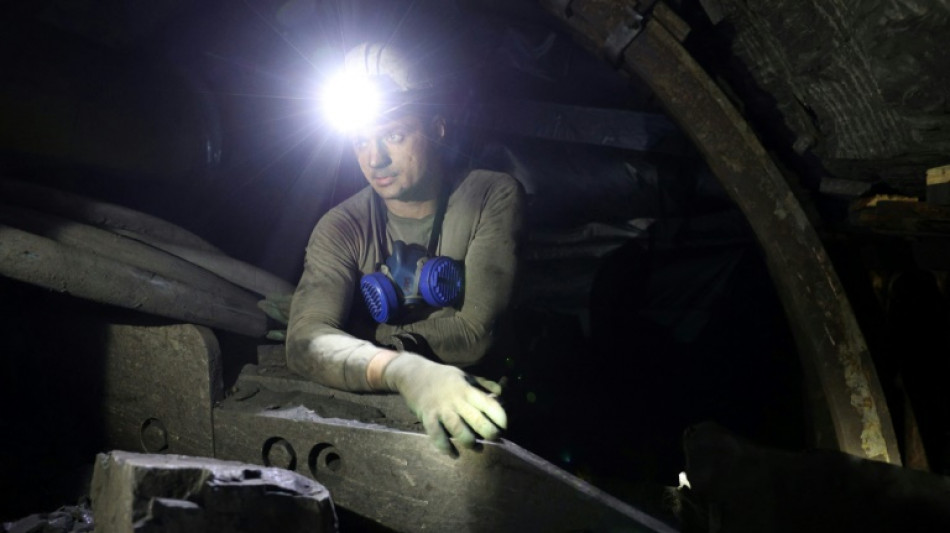
Ukraine coal propped up by miners who fled Russian occupation / Photo: © AFP

 Alpacas, mini pigs on the loose after floods hit south China zoo
 All Blacks make five changes for Italy Nations Championship clash

 Western Europe records its hottest June as heatwaves surge: EU monitor
 Fashion's mystery man Margiela sells off his archives
 Nuclear test-scarred Marshall Islands criticises China missile

 Chip titan SK hynix to set price for mega US listing

 Crude extends rally as US-Iran flare-up rocks peace hopes
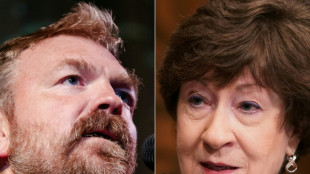 Democrat accused of rape exits key US Senate race

 Japan student Ito keeps place against Ireland as Jones returns

 Belgium bid to crack Spain's ironclad defence in World Cup quarter-final

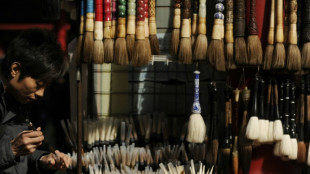 US man sentenced after swapping 17th century manuscript

 US launches new strikes on Iran after Trump vows to hit 'hard'
 Taylor Swift fans pay $25 for garbage from outside wedding

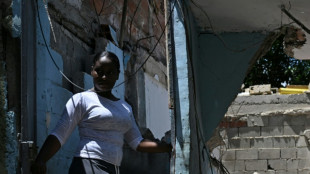 After quakes, Venezuelans fear losing damaged homes

 PSG's Lee set to join Athletico

 Erdogan gave pistols to NATO leaders, Starmer says

 Nocera Expands Diversified Technology Strategy With Binding Agreement to Acquire an Equity Interest in INERGX, an Integrated Energy Storage and Power Platform for AI, Defense and Mission-Critical Demand
 China sends nuclear missile message as US looks elsewhere
 Justin Bieber added to 11-minute World Cup final halftime show

 Fery targets Wimbledon final birthday present after royal seal of approval

 Egypt file complaint against referee after World Cup exit

 Women's semi-finalists in uncharted territory at Wimbledon
 US man jailed after swapping 17th century manuscript

 UN maritime head urges halt to Hormuz transit to protect seafarers

 Trump skips new Air Force One on return from Turkey NATO summit

Ukraine's energy sector is under attack.
Kyiv power stations have been targeted by cruise missiles, the Kakhovka hydroelectric dam has been breached and the Zaporizhzhia nuclear plant is under Russian occupation.
Of the 89 coal mines that were in newly-independent Ukraine at the break-up of the Soviet Union, 71 are in the eastern Donbas region, now partly held by Russian forces.
But the remaining mines -- which power 30 percent of Ukraine's grid -- are working hard, thanks to an influx of new recruits fleeing the Russian-occupied east.
In the build-up to the war, some in Moscow argued Russia had a duty to defend Russian speakers in the Donbas from alleged persecution by Ukrainian nationalists.
But in February last year, when Russia launched a full-scale invasion and tightened its grip on the east of the country, many civilians fled west into Kyiv-held towns.
Meanwhile, mines in Russian-occupied areas or close to the frontline closed and some were flooded as power to their water pumps was cut.
Further inside Ukraine, there was another problem.
"When the full-scale war started a lot of miners from this area enlisted as volunteers," said Oleg Bilousov, chief engineer at a cluster of mines in the central region of Dnipropetrovsk.
Mineworkers who remained had to work double shifts to maintain production.
- 'Impossible to survive' -
"It was a hard time for the company and for the country," Bilousov said, describing how during four blackouts last year miners trapped underground had to be evacuated.
Relief for Ukraine's industry came from miners from the Donbas, men and women that Moscow had once tried to portray as a downtrodden minority cut off from their motherland.
Some of those kicked out of pits in the Donetsk and Lugansk regions headed to central Ukraine, finding secure employment and contributing to the national war effort.
"Many, many of those who were forced to move from the occupied area wanted to work for us," said Bilousov, adding that Donbas-born miners now make up a third of his 2,780 workers.
Under a landscape of rolling green fields splashed with swathes of red poppies, Ukraine's renowned fertile black earth gives way to even richer seams of black coal.
Under a towering headframe equipped with a powerful winch, a rusty steel lift lowers the miners down a 180-meter (590-foot) shaft.
Then the workers clamber into closed metal trucks behind an electric locomotive and are carried down more than a kilometre of galleries to the coalface, 370 metres down.
Here, miners like 37-year-old Artyom, who studied in now occupied Donetsk, describe the mix of political and economic pressures that drove many west.
He laughed off Kremlin chief Vladimir Putin's claim to be the Donbas' protector.
"It's all fake," he said, his face smeared with sweat and coal dust as he worked the morning maintenance shift.
Some of his friends fled to Russia and some like him into unoccupied Ukraine, but none now mine the eastern region's once rich coalfield.
"It's impossible to survive there. There's literally no jobs there. Living conditions are really bad, they don't get paid at all, or receive really little," he told AFP.
Still, even with the arrival of the Donbas miners, the pit is short of manpower. "Many of them are fighting now, some of them are mobilised," Artyom said.
Thankfully, the mine does not just rely on "manpower". Ukraine's wartime economy has seen women taking up posts that would once have been limited to men.
- 'I want to go home' -
This has been a lifeline for 36-year-old Vika, who fled war-torn Lysychansk in the Russian-occupied part of the Lugansk region with her two children, mother and husband.
Before the war, she had worked as a shop assistant in a grocery. Now she is a surface elevator operator in a hard hat and overalls, responsible for the lift to the mine.
"For us, the people who came from over there, can you imagine how it is to suffer from the mines being closed? Where can we work? After losing our homes, we lost our jobs," she said.
The mines are run by DTEK, Ukraine's biggest private power industry player owned by Donetsk-born billionaire Rinat Akhmetov, reputedly Ukraine's richest man.
Workers like Vika appreciate the steady salary and health insurance that comes with the job.
"Here I feel fine, even though I cannot speak Ukrainian fluently. It's not a problem at all," she said.
"Of course I would love to go home. But I don't have a home anymore, it's destroyed. I hope Ukraine gives me my home back, and maybe helps me rebuild it.
"I want to go home, and for home to be Ukraine."
N.Fournier--BTB