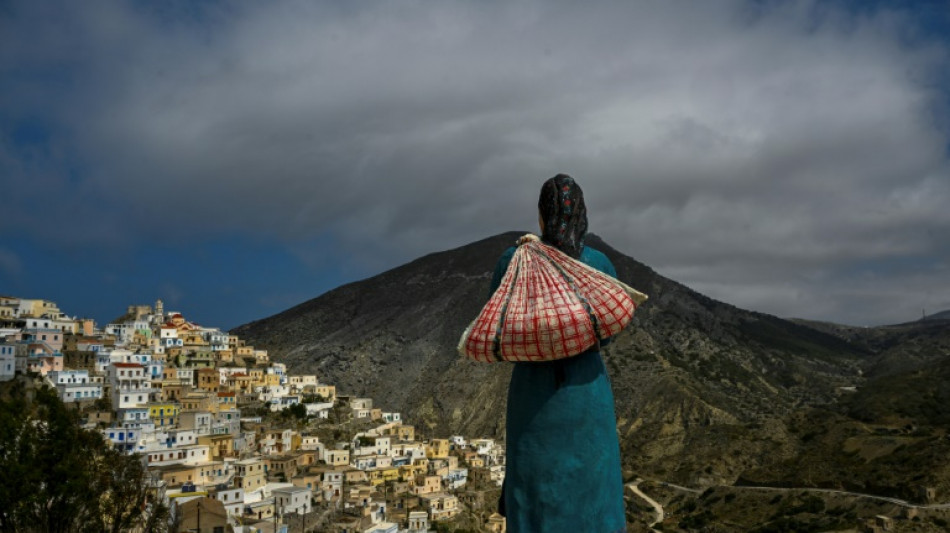
Women rule on the Greek island of Karpathos / Photo: © AFP

 Nagoya mayor says sorry for Asian Games 'inconveniences'

 G20 trade officials meet under shadow of tariffs, overcapacity

 India's fat dog vote goes viral
 Asian Games crowds in spotlight as 998 see hosts in 50,000 stadium

 The eight stadiums for the 2027 Rugby World Cup

 Thieves swipe drugs under nose of Fiji police, swap with flour
 South Korea demands North apologise for DMZ mine blasts
 In Nepal's flood zone, teachers mourn students who never returned

 US Supreme Court lifts limits on third-country deportations

 Antonelli eager to 're-establish order' as F1 returns to Malaysia

 Paw-fect candidate: Australia finds new koala rescue dog
 One third of world population exposed to harmful air pollution: monitor

 North Korea denies South's claim it was apparently behind DMZ mine blasts

 West Bank's violent settlers part of a new generation fuelled by ideology

 US-led coalition ends mission in Iraq
 Pope-backed White Sox join Braves with MLB playoff wins

 NBA close to picking new $12-13bn Vegas team owners: report
 LA28 Olympics torch relay to visit all 50 states
 Spain brush aside Croatia in Nations League, England down Czechs

 Trump hails 'morally binding' AI self-regulation pledge

 Yamal inspires Spain to Croatia romp on World Cup homecoming

 UN to hold fourth informal poll of secretary-general candidates
 Who are the Emiratis behind crisis-hit Manchester City?

 Singer Angelique Kidjo urges Africans to 'create together'

 Alleged Rihanna mansion shooter mentally fit for trial, says judge
"Here it is women who command!" declared Rigopoula Pavlidis, as she sang the virtues of her remote village on the island of Karpathos, one of Greece's rare matriarchal societies.
Sitting at a desk across the room painting religious icons, her husband Giannis nodded silently.
"My husband can't do anything without me, not even his tax return," Pavlidis laughed as she embroidered a traditional dress inside her workshop.
In contrast to most of patriarchal Greece, the women of Olympos play a commanding role in village life.
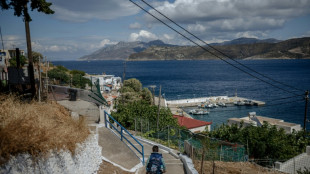
Isolated from the rest of the Dodecanese island, the spectacular hillside village has safeguarded this centuries-old tradition, which has survived the Ottoman Empire in the 16th century and Italian rule in the 20th.
Until the 1980s, there was no asphalt road to Olympos.
Among the traditions that survive is a Byzantine-era inheritance system that gives a mother's property to the eldest daughter, said local historian Giorgos Tsampanakis.
Rigopoula, the seamstress, is one of the beneficiaries of the tradition. She inherited 700 olive trees from her mother.
"The families did not have enough property to divide among all the children... and if we had left the inheritance to the men, they would have squandered it," she said.
Greek women traditionally moved into their new husband's home upon marriage. In Olympos, the opposite takes place.
And women's prominence is also reflected in their names.
"The eldest daughter took the first name of the maternal grandmother, unlike the rest of Greece, where it was that of the paternal grandmother," said Tsampanakis.
"Many women still call themselves by their mother's surname and not their husband's," he added.
The role of women in Olympos was further strengthened in the 1950s when the village men began to emigrate for work -- mainly to the United States and European countries -- leaving their wives and daughters behind to manage families and farms on their own.
- 'We had no choice' -
"We had no choice but to work in the absence of the men. It was our only way of surviving," recalled 67-year-old Anna Lentakis as she picked artichokes in the hamlet of Avlona near Olympos.
A few years ago, Lentakis ran the Olympos tavern. This has now passed into the hands of her eldest daughter Marina.
"I don't know if we were early feminists... but I like to say that the man is the head of the family, and the woman the neck," said Marina, who is in her 40s.
Marina's daughter Anna is only 13 years old, but she knows that one day she will take up the torch.
"It's my grandmother's legacy and I'll be proud to take care of it!" she said.
But the "feminist" inheritance system only benefits the eldest children, said Alain Chabloz of the Geographical Society of Geneva, who has studied the subject.
"The youngest sons were forced into exile, and the youngest daughters had to stay on the island at the service of the elders. A kind of social caste was created," he said.
Giorgia Fourtina, the youngest of her family and unmarried, helps her older sister in the restaurant and in the fields.
Fourtina does not feel that Olympos society is particularly progressive: "It's a small society where a woman alone in a cafe is frowned upon," she said.
Women "are the ones who maintain the traditions," said Yannis Hatzivassilis, a local sculptor, who has crafted an iconic statue of an Olympos woman gazing at the sea, waiting for her husband to return.
The older women of Olympos traditionally wear embroidered costumes consisting of flowered aprons, a headscarf and leather boots.
Treasured heirlooms that are part of a girl's dowry, these costumes can cost up to 1,000 euros ($1,077) and require hours of work.
Irini Chatzipapa, a 50-year-old baker, is the youngest Olympos woman to still wear it every day.
"I taught my daughter to embroider, but except for the holidays, she does not wear it as it's not adapted to modern life," she said.
Chatzipapa's 70-year-old mother chimes in: "Our costume is becoming just folklore for the holidays... Our world is disappearing."
L.Janezki--BTB