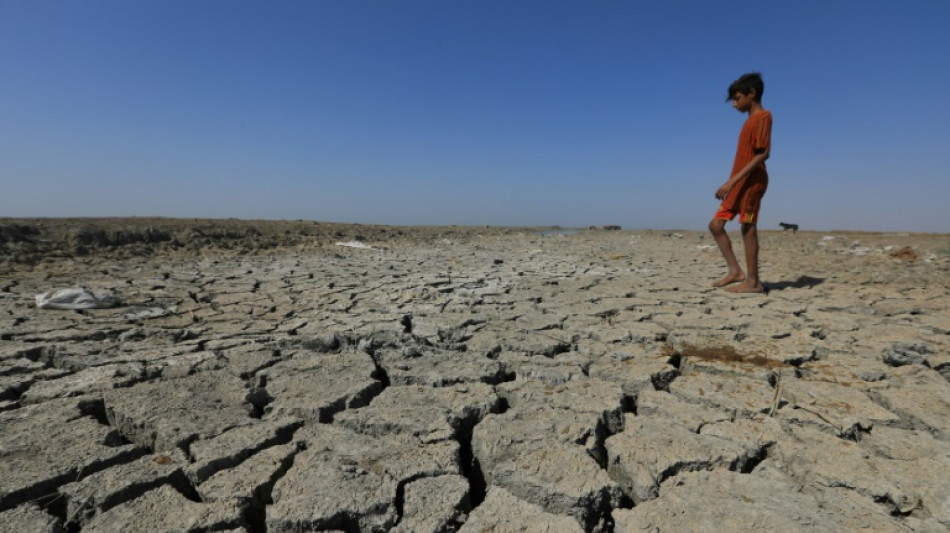
World warming at record 0.2C per decade, scientists warn / Photo: © AFP/File

 Nagoya mayor says sorry for Asian Games 'inconveniences'

 G20 trade officials meet under shadow of tariffs, overcapacity

 India's fat dog vote goes viral

 Asian Games crowds in spotlight as 998 see hosts in 50,000 stadium

 The eight stadiums for the 2027 Rugby World Cup

 Thieves swipe drugs under nose of Fiji police, swap with flour

 South Korea demands North apologise for DMZ mine blasts

 In Nepal's flood zone, teachers mourn students who never returned

 US Supreme Court lifts limits on third-country deportations

 Antonelli eager to 're-establish order' as F1 returns to Malaysia

 Paw-fect candidate: Australia finds new koala rescue dog

 One third of world population exposed to harmful air pollution: monitor

 North Korea denies South's claim it was apparently behind DMZ mine blasts

 West Bank's violent settlers part of a new generation fuelled by ideology

 US-led coalition ends mission in Iraq
 Pope-backed White Sox join Braves with MLB playoff wins

 NBA close to picking new $12-13bn Vegas team owners: report
 LA28 Olympics torch relay to visit all 50 states

 Spain brush aside Croatia in Nations League, England down Czechs

 Trump hails 'morally binding' AI self-regulation pledge

 Yamal inspires Spain to Croatia romp on World Cup homecoming

 UN to hold fourth informal poll of secretary-general candidates

 Who are the Emiratis behind crisis-hit Manchester City?

 Singer Angelique Kidjo urges Africans to 'create together'

 Alleged Rihanna mansion shooter mentally fit for trial, says judge
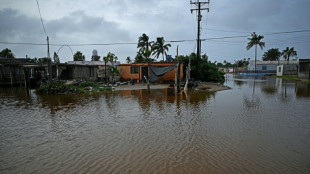
Record-high greenhouse gas emissions and diminishing air pollution have caused an unparalleled acceleration in global warming, 50 top scientists warned Thursday in a sweeping climate science update.
From 2013 to 2022, "human-induced warming has been increasing at an unprecedented rate of over 0.2 degrees Celsius per decade," they reported in a peer-reviewed study aimed at policymakers.
Average annual emissions over the same period hit an all-time high of 54 billion tonnes of CO2 or its equivalent in other gases -- about 1,700 tonnes every second.
World leaders will be confronted with the new data at the critical COP28 climate summit later this year in Dubai, where a "Global Stocktake" at the UN talks will assess progress toward the 2015 Paris Agreement's temperature goals.
The findings would appear to close the door on capping global warming under the Paris treaty's more ambitious 1.5C target, long identified as a guard rail for a relatively climate-safe world, albeit one still roiled by severe impacts.
"Even though we are not yet at 1.5C warming, the carbon budget" -- the amount of greenhouse gases humanity can emit without exceeding that limit -- "will likely be exhausted in only a few years," said lead author Piers Forster, a physics professor at the University of Leeds.
That budget has shrunk by half since the UN's climate science advisory body, the Intergovernmental Panel on Climate Change (IPCC), gathered data for its most recent benchmark report in 2021, according to the Forster and colleagues, many of whom were core IPCC contributors.
- Unintended consequences -
To have even a coin-toss chance of staying under the 1.5C threshold, emissions of carbon dioxide, methane and other drivers of warming generated mostly by burning fossil fuels must not exceed 250 billion tonnes (Gt), they reported.
Bettering the odds to two-thirds or four-fifths would reduce that carbon allowance to only 150 Gt and 100 Gt, respectively -- a two- or three-year lifeline at the current rate of emissions.
Keeping the Paris temperature targets in play would require slashing CO2 pollution at least 40 percent by 2030, and eliminating it entirely by mid-century, the IPCC has calculated.
Ironically, one of the big climate success stories of the last decade has inadvertently hastened the pace of global warming, the new data reveal.
A gradual drop in the use of coal -- significantly more carbon intensive than oil or gas -- to produce power has slowed the increase in carbon emissions.
But it has also reduced the air pollution that shields Earth from the full force of the Sun's rays.
Particle pollution from all sources dampens warming by about half-a-degree Celsius, which means -- at least in the short term -- more of that heat will reach the planet's surface as the air becomes cleaner.
Published in the peer-reviewed journal Earth System Science Data, the new study is the first in a series of periodic assessments that will help fill the gaps between IPCC reports, released on average every six years since 1988.
- Deadly heat -
"An annual update of key indicators of global change is critical in helping the international community and countries to keep the urgency of addressing the climate change crisis at the top of the agenda," said co-author and scientist Maisa Rojas Corradi, who is also the environment minister of Chile.
Co-author Valerie Masson-Delmotte, a co-chair of the 2021 IPCC report, said the new data should be a "wake-up call" ahead of the COP28 summit, even if there is evidence that the increase in greenhouse gases has slowed.
"The pace and scale of climate action is not sufficient to limit the escalation of climate related risks," she said.
Researchers also reported a startling rise in temperature increases over land areas -- excluding oceans -- since 2000.
"Land average annual maximum temperatures have warmed by more than half a degree Celsius in the last ten years (1.72C above preindustrial conditions) compared to the first decade of the millennium (1.22C)," the study reported.
Longer and more intense heat waves will pose a life-and-death threat in the coming decades across large swathes of South and Southeast Asia, along with areas straddling the equator in Africa and Latin America, recent research has shown.
G.Schulte--BTB