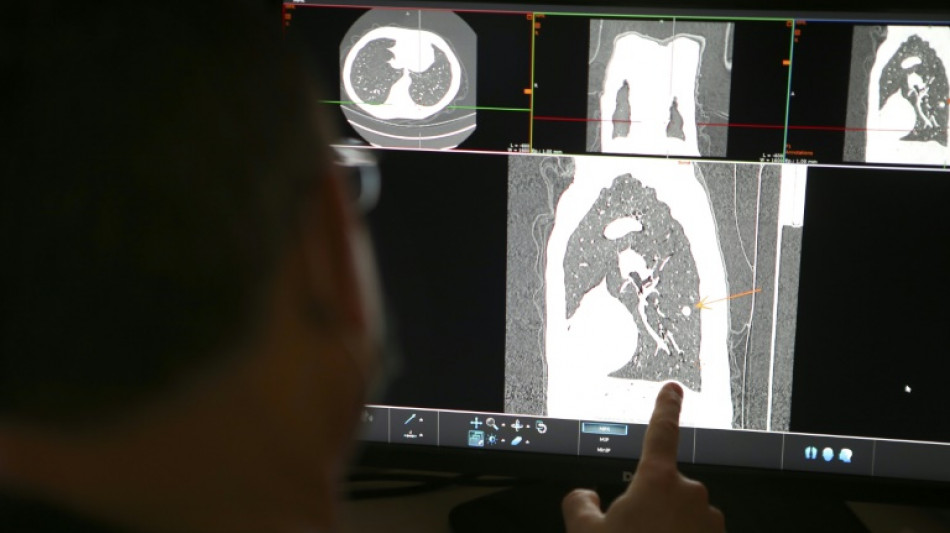
Pill halves risk of death in type of lung cancer / Photo: © AFP

 Nagoya mayor says sorry for Asian Games 'inconveniences'

 G20 trade officials meet under shadow of tariffs, overcapacity

 India's fat dog vote goes viral

 Asian Games crowds in spotlight as 998 see hosts in 50,000 stadium

 The eight stadiums for the 2027 Rugby World Cup

 Thieves swipe drugs under nose of Fiji police, swap with flour

 South Korea demands North apologise for DMZ mine blasts

 In Nepal's flood zone, teachers mourn students who never returned

 US Supreme Court lifts limits on third-country deportations

 Antonelli eager to 're-establish order' as F1 returns to Malaysia

 Paw-fect candidate: Australia finds new koala rescue dog

 One third of world population exposed to harmful air pollution: monitor

 North Korea denies South's claim it was apparently behind DMZ mine blasts

 West Bank's violent settlers part of a new generation fuelled by ideology

 US-led coalition ends mission in Iraq
 Pope-backed White Sox join Braves with MLB playoff wins

 NBA close to picking new $12-13bn Vegas team owners: report

 LA28 Olympics torch relay to visit all 50 states

 Spain brush aside Croatia in Nations League, England down Czechs

 Trump hails 'morally binding' AI self-regulation pledge

 Yamal inspires Spain to Croatia romp on World Cup homecoming

 UN to hold fourth informal poll of secretary-general candidates
 Who are the Emiratis behind crisis-hit Manchester City?

 Singer Angelique Kidjo urges Africans to 'create together'

 Alleged Rihanna mansion shooter mentally fit for trial, says judge

A pill has been shown to halve the risk of death from a certain type of lung cancer when taken daily after surgery to remove the tumor, according to clinical trial results presented on Sunday.
The results were unveiled in Chicago at the largest annual conference of cancer specialists, hosted by the American Society for Clinical Oncology (ASCO).
Lung cancer is the form of the disease that causes the most deaths, with approximately 1.8 million fatalities every year worldwide.
The treatment developed by the pharmaceutical group AstraZeneca is called osimertinib and is marketed under the name Tagrisso. It targets a particular type of lung cancer in patients suffering from so-called non-small cell cancer, the most common type, and showing a particular type of mutation.
These mutations, on what is called the epidermal growth factor receptor, or EGFR, affect 10 percent to 25 percent of lung cancer patients in the United States and Europe, and 30 to 40 percent in Asia.
The clinical trial included some 680 participants at an early stage of the disease (stages 1b to 3a), in more than 20 countries. They had to have been operated on first to remove the tumor, then half of the patients took the treatment daily, and the other a placebo.
The result showed that taking the tablet resulted in a 51 percent reduction in the risk of death for treated patients, compared to placebo.
After five years, 88 percent of patients who took the treatment were still alive, compared to 78 percent of patients who took the placebo.
These data are "impressive," said Roy Herbst of Yale University, who presented them in Chicago. The drug helps "prevent the cancer from spreading to the brain, to the liver, to the bones," he added at a press conference.
About a third of cases of non-small cell cancers can be operated on when detected, he said.
- Already on the market -
"It is hard for me to convey, I think, how important this finding is," said Nathan Pennell of the Cleveland Clinic Foundation at the press conference.
"We started entering the personalized therapy era for early stage patients," said Pennell, who did not take part in the trials, and noted that "we should firmly close the door on one-size-fits-all treatment for people with non- small cell lung cancer."
Osimertinib is already authorized in dozens of countries for various indications, and has already been given to some 700,000 people, according to a press release from AstraZeneca.
Its approval in the United States for early stages in 2020 was based on previous data that showed an improvement in patient disease-free survival, that is, the time a patient lives without a recurrence of cancer.
But not all doctors have adopted the treatment, and many were waiting for the data on overall survival that was presented on Sunday, said Herbst.
He stressed the need to screen patients to find out if they have the EGFR mutation. Otherwise, he said, "we cannot use this new treatment."
Osimertinib, which targets the receptor, causes side effects that include as severe fatigue, skin rashes or diarrhea.
O.Lorenz--BTB