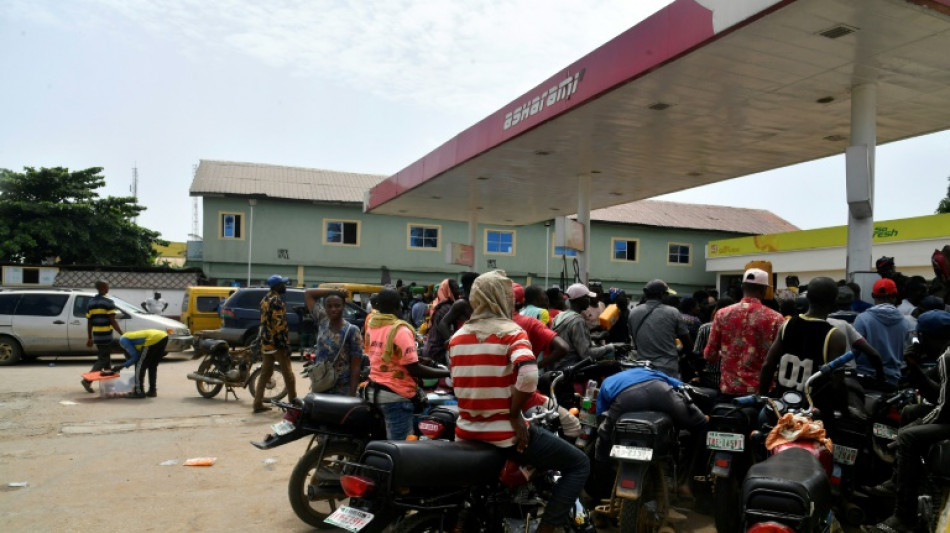
Nigeria grapples with end of fuel subsidy / Photo: © AFP

 'No limits': Marathon world record holder Sawe chasing history
 Countdown begins to biggest-ever Rugby World Cup
 Bangladesh women lose ground after quota reform
 Vietnam admits 'differing opinions' on Hanoi development

 Stocks temper gains as oil pares heavy losses, US data in focus
 New Zealand denies breaching climate commitments to EU
 Albert becomes youngest US scorer in 4-2 win over Chile

 Pirate island's plunging population shows Greece's demographic decline
 With elections ahead, Latvia's Russian-speakers reject Moscow's help
 Brazil football clubs face massive sponsorship blow from betting ban
 ChatGPT maker wants to be the App Store for AI as safety concerns grow
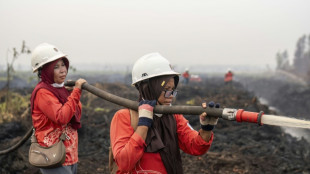 Women fight fires and sexism in Indonesian Borneo

 Forsling's OT blast lifts Florida over Carolina in NHL opener

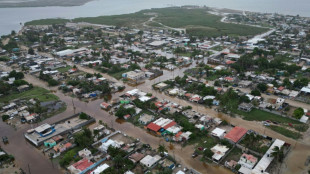 Hurricane Polo sweeps over Mexico's Pacific coast, heads inland
 Grynspan pulls ahead in race to lead UN: diplomat

 Trump touts AI boss pledge to self-regulate
 Oil down, but stocks lower as bond yields rise

 England break down stubborn Czechs to claim first Nations League win
 UN Security Council extends Haiti anti-gang force by 6 months

 Manchester City guilty of Premier League charges: What comes next?
 Man City chief Soriano slams Premier League 'conspiracy theory'

 Hurricane Polo sweeps over Mexico's Pacific coast

 Man City must be relegated after guilty verdict says club's former chairman

 German far-right aims to lead Saxony-Anhalt govt in December
 Little damage as Hurricane Polo sweeps over Mexico's Pacific coast
Nigerians are struggling with surging fuel prices after newly elected President Bola Tinubu declared an end to popular subsidies, a move analysts and experts said was long overdue.
On his first day in office, Tinubu kept to his campaign promise and announced an end to the long-running arrangement, which has given Nigerians access to cheap petrol.
The continent's biggest economy is oil-rich but has meagre refining capacity. For years, it has swapped crude for gasoline that it then subsidises for its domestic market, causing a huge drain on revenue, foreign exchange and contributing to ballooning debt.
None of Tinubu's predecessors had managed to scrap the hugely popular system, which has been a burden on public coffers for decades. Last year, the country spent more than 96 percent of its revenue on servicing its debt.
After his inauguration on Monday, Tinubu announced the "fuel subsidy is gone".
The price of petrol tripled to around 540 naira ($1.20) at government-run filling stations on Wednesday, effectively putting an end to subsidised fuel for Nigerians already battling inflation of over 20 percent.
But analysts believe Tinubu made a necessary political calculation to follow the lead of the previous administration and phase out the subsidy.
- 'Best timing' -
Tunde Ajileye of the Nigerian consultancy SBM said it was "only a matter of time before they stopped the subsidies".
"Economically, it was a sound and logical decision. Politically, it is a touchy decision," Ajileye said.
"But it was the best timing to do it. By the end of the administration, people are going to forget."
The president now has the chance to introduce reforms over the next four years to mitigate the effects, Ajileye added.
A key problem with the scheme was that it left ample room for embezzlement, with people falsifying documents to get hold of subsidies for products they never imported.
Others would buy cheap fuel in Nigeria and sell it at higher prices in neighbouring countries.
Ajileye said this "explains why daily consumption is so high in Nigeria."
Following the announcement, there was confusion over when the measure would come into force, and the apparently sudden change caused panic.
But in the long run, the move will save billions of dollars, encourage investment, and reduce pressure on the foreign exchange market, said Abayomi Adebayo, an economics professor at Obafemi Awolowo University in Ife, northeast of Lagos.
More than 80 million people live below the poverty line in Nigeria, according to the World Bank.
The country spends more on fuel subsidies than on failing sectors such as health and education, and the World Bank and the International Monetary Fund recommended ending the subsidies to boost development.
- 'Costly gamble' -
Adebayo said there would be a "short run inflation rise", but stressed it was important to see the bigger picture.
"It is tough because people are more concerned about immediate gain," Adebayo argued.
He also said the subsidies had done little to help the country's poorest.
The World Bank also said that in practice, "Nigeria's poor purchase only three percent of the total volume of subsidised petrol".
The scheme has mainly profited better-off Nigerians who own vehicles and can afford to use petrol every day.
Over the last decade, the authorities have tried to scrap the subsidies several times, but have been forced to back down in the face of public anger stoked by unions.
The army clashed with protesters demonstrating over fuel costs in 2012.
An umbrella group of trade unions, the Nigeria Labour Congress (NLC), has rejected the latest announcement and called for its withdrawal.
"We advise Tinubu to respect his own postulations and economic theories instead of daring the people," the NLC said.
"It could be a costly gamble".
K.Thomson--BTB