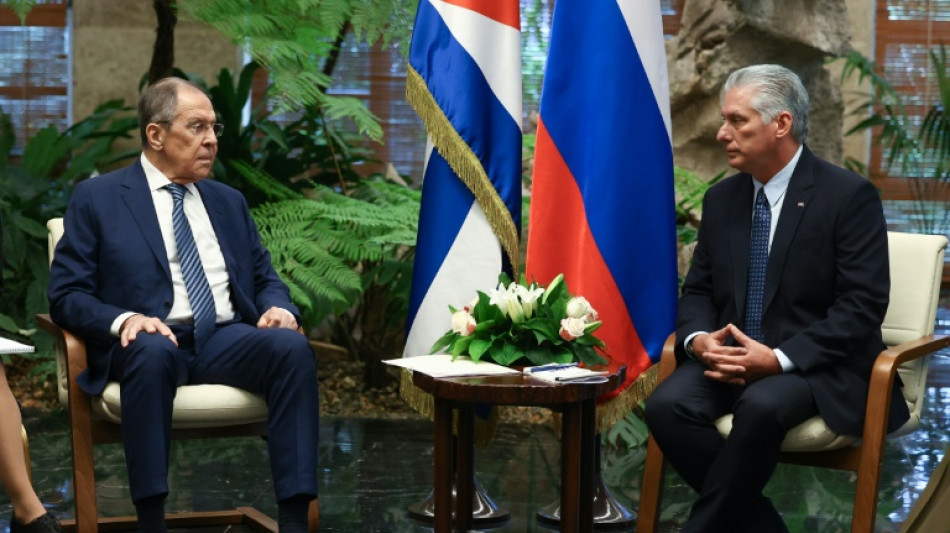
Difficult times bring Russia and Cuba closer together / Photo: © Ministerio Exteriores de Rusia/AFP

 Brazil football clubs face massive sponsorship blow from betting ban
 ChatGPT maker wants to be the App Store for AI as safety concerns grow

 Women fight fires and sexism in Indonesian Borneo

 Forsling's OT blast lifts Florida over Carolina in NHL opener

 Hurricane Polo sweeps over Mexico's Pacific coast, heads inland
 Grynspan pulls ahead in race to lead UN: diplomat

 Trump touts AI boss pledge to self-regulate
 Oil down, but stocks lower as bond yields rise
 England break down stubborn Czechs to claim first Nations League win
 UN Security Council extends Haiti anti-gang force by 6 months
 Manchester City guilty of Premier League charges: What comes next?

 Man City chief Soriano slams Premier League 'conspiracy theory'

 Hurricane Polo sweeps over Mexico's Pacific coast

 Man City must be relegated after guilty verdict says club's former chairman

 German far-right aims to lead Saxony-Anhalt govt in December
 Little damage as Hurricane Polo sweeps over Mexico's Pacific coast
 Manchester City guilty of breaking financial rules - Premier League

 FIFA boss Infantino blasted as would-be 'emperor' by UEFA's Ceferin

 Stocks move lower despite oil prices dropping

 AI driving up innovation investment: UN

 UN Security Council extends Haiti mission by 6 months

 Man Utd do not deserve medals if Man City stripped of titles: Rooney

 Vana Completes Expanded Staking as Part of the Vega Upgrade, Publishes Expanded VANA Token Economics
 Spain to cap gas price hikes, extend fuel discounts

 'We just need rain': Germany's Rhine river hits new low

For the first time since the breakup of the Soviet Union, Russia is taking an intense interest in Cuba as Moscow has become increasingly isolated over its invasion of Ukraine.
Top Russian officials have flocked to the island nation this year, starting in March with Nikolai Patrushev, Moscow's secretary of the Security Council, alongside the executive director of state oil company Rosneft, Igor Sechin.
A representative of Russian business owners, Boris Titov, also visited.
The most high-profile visit was from Foreign Minister Sergey Lavrov in April on a week-long trip to Latin American allies, including Venezuela and Nicaragua, which like Cuba and Russia are the subject of Western sanctions.
"Russia needs trading partners and political allies, with Latin America offering the possibility of both," Mervyn Bain, from Aberdeen University in Scotland, told AFP.
Last week, Russian Deputy Prime Minister Dmitry Chernyshenko drew up a road map to accelerate cooperation with Cuba, which is mired in its worst economic crisis in three decades, with chronic shortages of food, fuel and medicines.
The two countries have signed around a dozen agreements to relaunch trade relations in construction, information technology, banking, sugar, transport and tourism.
"But to what level" this cooperation can go "is unclear," said Bain, an expert in Russia's relationships with Latin America.
Chernyshenko's plan also referenced Cuba's need to change certain laws to loosen restrictions on private enterprise.
Communist Cuba had already been forced to open up its centralized economy to small and medium-sized private businesses due to its increasing economic woes.
Cuba has announced the reopening of direct flights between Moscow and the seaside resort of Varadero, and Russian tourists have been able to use the Russian Mir payment system in the country since March.
- 'Unconditional support' -
The Russian visits to the Caribbean island nation have come only months after Cuban President Miguel Diaz-Canel visited his Russian counterpart Vladimir Putin in Moscow.
The two communist entities were close allies during the Cold War, but that cooperation was abruptly halted in 1991 with the dissolution of the Soviet bloc.
Until then, 75 percent of Cuba's commercial exchanges were with its communist ally.
Having almost ended completely, relations started picking up again from 2005, with the current levels of exchange the highest since then.
According to Russian figures, commercial exchanges between the two countries reached $450 million in 2022, with 90 percent of that in sales of oil and soybean oil to the island nation.
The strengthening of ties is paying off for Russia in geopolitical ways.
Havana had maintained a position of neutrality over Russia's invasion of Ukraine, abstaining from United Nations votes on the issue.
But this week, Diaz-Canel assured Chernyshenko of "Cuba's unconditional support" in its "clash with the West" and on Wednesday, Havana voted against a World Health Organization resolution condemning Russian attacks on Ukrainian health systems.
The West has been taking note.
The EU's foreign policy chief Josep Borrell on Thursday urged cash-strapped Cuba to "reinforce the economic ties with the European Union," which is its main trade partner.
During a visit to meet private business leaders, Borrell reminded Cuba that it does twice as much business with the EU as it does with Russia and China combined.
Indeed, the aid that Russia can supply Cuba is limited and "nothing like" that which the Soviet Union furnished during the Cold War, according to Vladimir Rouvinski, an academic at the ICESI university in Cali, Colombia.
While Moscow may not be spending the big bucks any time soon, Rouvinski said that the West's unconditional support for Ukraine means "the attraction of Cuba for Putin's Russia is its geographic proximity to the United States."
"It's the logic of symbolic reciprocity," because "any mention of the possibility of having a Russian military presence on the island provokes great nervousness on the other side of the Florida Strait."
F.Pavlenko--BTB