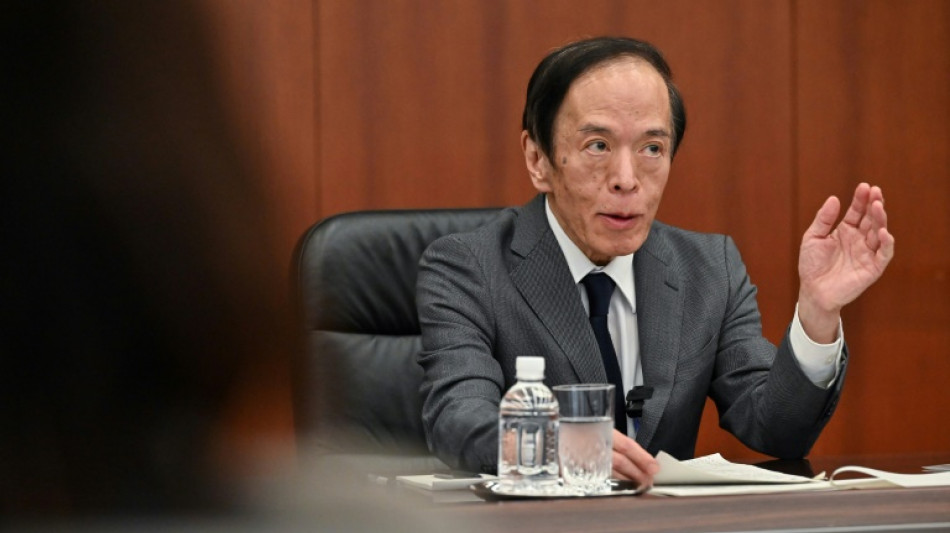
Japan central bank chief admits 'big gap' on women officials / Photo: © AFP

 Brazil football clubs face massive sponsorship blow from betting ban

 ChatGPT maker wants to be the App Store for AI as safety concerns grow

 Women fight fires and sexism in Indonesian Borneo

 Forsling's OT blast lifts Florida over Carolina in NHL opener

 Hurricane Polo sweeps over Mexico's Pacific coast, heads inland

 Grynspan pulls ahead in race to lead UN: diplomat

 Trump touts AI boss pledge to self-regulate

 Oil down, but stocks lower as bond yields rise

 England break down stubborn Czechs to claim first Nations League win

 UN Security Council extends Haiti anti-gang force by 6 months

 Manchester City guilty of Premier League charges: What comes next?
 Man City chief Soriano slams Premier League 'conspiracy theory'
 Hurricane Polo sweeps over Mexico's Pacific coast

 Man City must be relegated after guilty verdict says club's former chairman

 German far-right aims to lead Saxony-Anhalt govt in December

 Little damage as Hurricane Polo sweeps over Mexico's Pacific coast

 Manchester City guilty of breaking financial rules - Premier League

 FIFA boss Infantino blasted as would-be 'emperor' by UEFA's Ceferin

 Stocks move lower despite oil prices dropping

 AI driving up innovation investment: UN

 UN Security Council extends Haiti mission by 6 months

 Man Utd do not deserve medals if Man City stripped of titles: Rooney

 Vana Completes Expanded Staking as Part of the Vega Upgrade, Publishes Expanded VANA Token Economics

 Spain to cap gas price hikes, extend fuel discounts

 'We just need rain': Germany's Rhine river hits new low

A "big gap" exists between female representation at Japan's central bank and its overseas counterparts, the bank's new governor Kazuo Ueda acknowledged Thursday.
Ueda took office last month, with some analysts arguing it was time for Japan to join Europe and the United States by naming a woman governor to succeed long-time chief Haruhiko Kuroda.
The 71-year-old economics professor secured the top job instead, along with two male deputy governors.
Ueda, speaking to AFP in an interview with several other media outlets, conceded the bank was behind some counterparts on gender representation.
At international meetings such as the G7, G20 and IMF "there has been a high percentage of women at the table with me", he said.
"There are women like (BoJ) executive director (Tokiko) Shimizu, but the number is still very low compared with foreign countries. There is a big gap."
The problem, however, extended far beyond the central bank.
"This is a reflection of Japanese society as a whole, not just the Bank of Japan. It cannot be changed by the Bank of Japan by itself overnight," Ueda said.
The bank was working to address the issue, including through recruiting, he said.
Its fiscal 2022 annual review said women were being targeted as recruits and made up more than 30 percent of new hires who will be candidates for senior jobs in the future.
Japan has a highly educated female labour force but women occupy few top jobs in business and politics.
The US Federal Reserve and the European Central Bank have both had female chiefs, although they remain relative outliers globally.
- Room for caution -
Ueda took office after a decade of ultra-loose monetary policy championed by Kuroda and is being closely watched for any sign he might move to finally raise rates in line with other central banks.
Kuroda argued Japan has yet to achieve its long-sought goal of sustained two percent inflation, seen as key to turbocharging the world's third-largest economy.
Inflation has hit double that figure this year but the bank argues that is the result of temporary factors such as the war in Ukraine, and the figure is likely to drop back below two percent in coming months.
Ueda has squelched any talk of sudden policy shifts, although he said there are signs of a shift in longstanding wage stagnation and past reluctance by companies to pass higher costs on to customers.
"Until recently, the feeling was that if others were not raising their prices and wages, you would not raise them either," he said.
"Now it has changed to I can raise mine and others are also doing the same. In the case of wages, we now see people having to increase because other companies are raising their wages."
He said there was still room for caution and the bank was waiting to see if the shifts will "continue in the future, and will they will spread and be sustained".
The bank announced last month a "broad-perspective" review of its easing, with a timeframe of 12-18 months.
There has been criticism of the market distortions created by the BoJ's policy, and also a perception that it has worked hand-in-glove with a government that has an interest in keeping rates low given its astronomical debt-to-GDP ratio.
But Ueda insisted the bank's policies were not driven by the government's spending plans or its finances.
I.Meyer--BTB