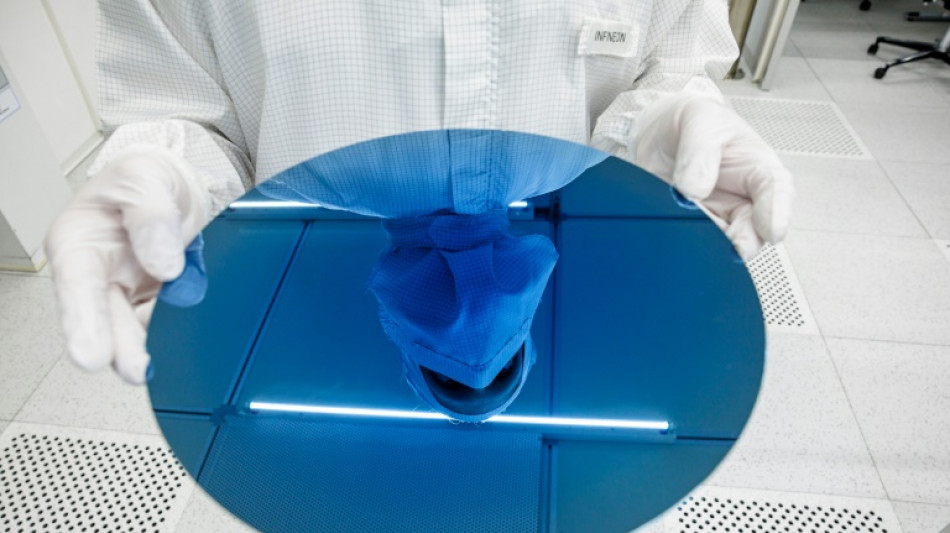
German chip charge could short-circuit on myriad challenges / Photo: © AFP

 NBA close to picking new $12-13bn Vegas team owners: report

 LA28 Olympics torch relay to visit all 50 states
 Spain brush aside Croatia in Nations League, England down Czechs
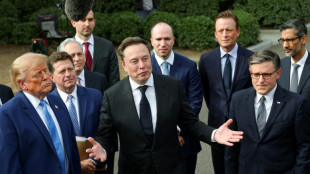 Trump hails 'morally binding' AI self-regulation pledge
 Yamal inspires Spain to Croatia romp on World Cup homecoming

 UN to hold fourth informal poll of secretary-general candidates

 Who are the Emiratis behind crisis-hit Manchester City?

 Singer Angelique Kidjo urges Africans to 'create together'

 Alleged Rihanna mansion shooter mentally fit for trial, says judge
 Mystery over UK airbase scare as police find petrol not explosives

 OpenAI unveils low-cost AI model, a day after shelving Astra upgrade
 Premier League confirms Man City guilty of serious financial breaches
 Brazil's Lula turns to Bad Bunny tune to criticise Trump ahead of polls

 Nigerian dancer eyes world record after seven-day marathon
 Swiss regulator concludes Julius Baer bank probe

 Brazil's patron saint pulled into latest election scrap

 Football overload leaves players near 'breaking point', warns Tebas

 Paris Eiffel Tower says chief to step down after uproar over removing women staff
 Amaze Holdings (NYSE: AMZE) Executes Binding LOI to Acquire BullionFX | Alchemy, a Decentralized Gold-Backed Financial Ecosystem for Valued at US$155 Million
 Clashes between French teens, police as school blockades intensify
 Stocks move sideways despite oil moving lower

 African leaders to gather in Egypt for business summit

 UK decides against charging foreign visitors for museums

 Dallaglio to sell England World Cup winners' medal

 Brazil come from behind to beat Australia 4-2 in friendly

Germany is seeking to lead a European charge to boost chip production with a series of mega-investments but the drive faces challenges ranging from high energy prices to subsidy rows and worker shortages.
When the pandemic sent semiconductor demand surging and snarled global supply chains, Western nations long reliant on Asia to produce their chips cheaply got a nasty shock as they faced sudden shortages.
The European Union was jolted into action, and is rolling out a plan to double the bloc's share of global chip production to 20 percent by 2030, and mobilise billions of euros in investment.
Industrial powerhouse Germany -- whose carmakers were among firms hit hard by the shortages -- is hoping to lead the European renaissance, with major investments announced in recent times, including from Intel, Infineon, Bosch and Wolfspeed.
Taiwanese tech giant TSMC, one of the world's leading chip companies, is also considering to build its first European plant in the eastern city of Dresden.
At the groundbreaking this month for a new Infineon chip factory in Dresden, Chancellor Olaf Scholz said semiconductors were "often referred to as the petroleum of the 21st century".
Chips, used to power everything from smartphones to fighter jets, were the one component "on which almost everything else depends," he added.
Infineon plans to invest about five billion euros ($5.4 billion) in the plant. It is due to open in 2026, and create up to 1,000 jobs in Dresden, the state capital of Saxony, already home to a dense network of chip companies.
- Soaring costs -
Not every project has been running so smoothly, however.
Intel announced with great fanfare in March last year plans to build a massive chip plant in the city of Magdeburg, with initial investment of 17 billion euros, the centrepiece of the US firm's European investment drive.
But after inflation surged following Russia's invasion of Ukraine, the project has been delayed, with construction -- originally supposed to start in the first half of 2023 -- not yet under way.
The company is reportedly pushing for higher government subsidies to cover the impact of higher costs.
Asked about the reports, Intel said that "much has changed" since the project was announced.
"Geopolitical challenges have become greater, semiconductor demand has declined, and disruptions in the global economy have resulted in increased costs, from construction materials to energy," the company said in a statement.
Germany's economy ministry said the government was currently discussing measures to "close the cost gap of the planned project, which has increased significantly in recent months".
For Germany's chip ecosystem, another major challenge is finding enough workers.
In occupations that are particularly key for the chip industry, there is currently a shortage of 62,000 skilled workers, according to a study from the German Economic Institute in December.
Europe's "Chips Act", agreed on by the European Parliament and EU member states last month, aims to mobilise more than 43 billion euros in public and private investments.
As well as Germany, investments have been announced elsewhere in the bloc, including a new plant in France built by French-Italian chipmaker STMicroelectronics and US-based GlobalFoundries.
- 'No self-sufficiency' -
The continent has much lost ground to make up -- its share of global chip manufacturing capacity fell from 44 percent in 1990 to nine percent in 2020, according to a study from the US-based Semiconductor Industry Association and Boston Consulting Group.
Europe also faces competition from the United States, which is shelling out large sums to promote domestic production, while Japan and South Korea have vowed to spend billions on developing production.
However, some fear that spending billions of euros in public money on chip production is misguided, given Europe is likely to remain heavily dependent on semiconductors produced elsewhere.
"If we enter into a subsidy race, then we end up paying a lot of money and are not necessarily any safer," Clemens Fuest, president of Germany's Ifo institute, recently said on broadcaster ARD.
And industry players believe the semiconductor supply chain -- which involves many different companies, providing different services -- is destined to remain globalised.
"All big economies are trying to strengthen the semiconductor industry in their territories," Infineon CEO Jochen Hanebeck told reporters on an earnings call this month.
While dependencies can be dialled back, there will be "no self-sufficiency for any countries or regions," he added.
E.Schubert--BTB