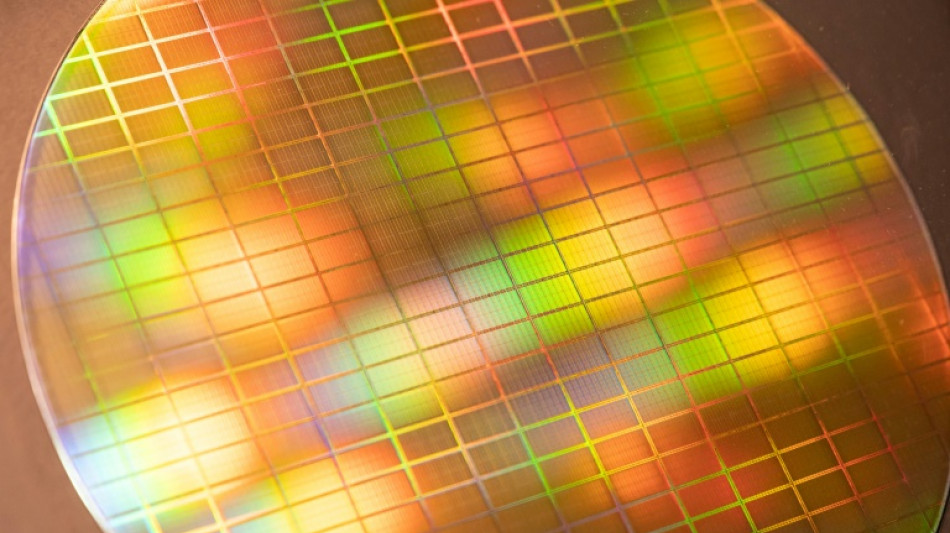
China says US chipmaker Micron failed national security review / Photo: © AFP/File

 NBA close to picking new $12-13bn Vegas team owners: report

 LA28 Olympics torch relay to visit all 50 states

 Spain brush aside Croatia in Nations League, England down Czechs

 Trump hails 'morally binding' AI self-regulation pledge

 Yamal inspires Spain to Croatia romp on World Cup homecoming

 UN to hold fourth informal poll of secretary-general candidates

 Who are the Emiratis behind crisis-hit Manchester City?

 Singer Angelique Kidjo urges Africans to 'create together'

 Alleged Rihanna mansion shooter mentally fit for trial, says judge

 Mystery over UK airbase scare as police find petrol not explosives

 OpenAI unveils low-cost AI model, a day after shelving Astra upgrade

 Premier League confirms Man City guilty of serious financial breaches

 Brazil's Lula turns to Bad Bunny tune to criticise Trump ahead of polls

 Nigerian dancer eyes world record after seven-day marathon

 Swiss regulator concludes Julius Baer bank probe

 Brazil's patron saint pulled into latest election scrap

 Football overload leaves players near 'breaking point', warns Tebas

 Paris Eiffel Tower says chief to step down after uproar over removing women staff

 Amaze Holdings (NYSE: AMZE) Executes Binding LOI to Acquire BullionFX | Alchemy, a Decentralized Gold-Backed Financial Ecosystem for Valued at US$155 Million
 Clashes between French teens, police as school blockades intensify

 Stocks move sideways despite oil moving lower

 African leaders to gather in Egypt for business summit

 UK decides against charging foreign visitors for museums

 Dallaglio to sell England World Cup winners' medal

 Brazil come from behind to beat Australia 4-2 in friendly

US semiconductor giant Micron has failed a national security review, China's cybersecurity watchdog said Sunday, telling operators of "critical information infrastructure" to stop buying its products.
It marked the latest escalation in the bitter chip war between the United States and China, with Washington looking to cut off Beijing's access to cutting-edge semiconductors.
Chinese authorities had launched a review in March of products sold in the country by Micron, one of the world's major chip manufacturers.
Micron's products "have relatively serious potential network security issues, which pose a major security risk to China's critical information infrastructure supply chain and affect China's national security", the cybersecurity administration said in a statement.
"Operators of critical information infrastructure in China should stop purchasing Micron products."
China's broad definition of critical information infrastructure includes sectors ranging from transport to healthcare.
About 10 percent of Micron's $30.8 billion annual revenue last year came from China, according to company data.
But a large portion of Micron products sold in the country were bought by foreign manufacturers, analysts had said earlier, and it was not clear if the cybersecurity watchdog's decision affects sales to foreign buyers.
AFP has reached out to Micron for comment on the cybersecurity administration's announcement.
China in 2021 announced rules to protect critical information infrastructure with stricter requirements over data security.
It has recently also strengthened the enforcement of its data security and anti-espionage laws.
- 'Bullying tactics' -
The chip war between Beijing and Washington escalated last year when the United States imposed restrictions on China's access to high-end chips, chipmaking equipment and software used to design semiconductors.
Washington also blacklisted Chinese firms, including Micron rival Yangtze Memory Technologies Co Ltd.
Washington cited national security concerns, and said it wanted to prevent tech that could help develop advanced military equipment from being acquired by China's armed forces and intelligence services.
The United States imposed targeted controls on the ability of domestic industry leaders to sell their products overseas.
It has also sought to persuade key allies to follow suit.
The Netherlands and Japan -- both leading manufacturers of specialised semiconductor technology equipment -- have recently announced new restrictions on exporting certain products, but without naming China.
Beijing has slammed the moves as "US bullying tactics" and accused Washington of "technological terrorism", vowing that such controls will only strengthen its resolve to achieve self-reliance in the sector.
The development of a robust domestic semiconductor industry has been a longstanding goal of the Chinese government, which has invested billions of dollars in domestic chip firms.
Chips are the lifeblood of the modern global economy, powering everything from cars to smartphones, and they are forecast to become a $1 trillion industry globally by 2030.
Nowhere is their essential nature more visible than in China, the world's second-largest economy, which relies on a steady supply of foreign chips for its huge electronics manufacturing base.
In 2021, China imported semiconductors worth $430 billion, more than it spent on oil.
E.Schubert--BTB