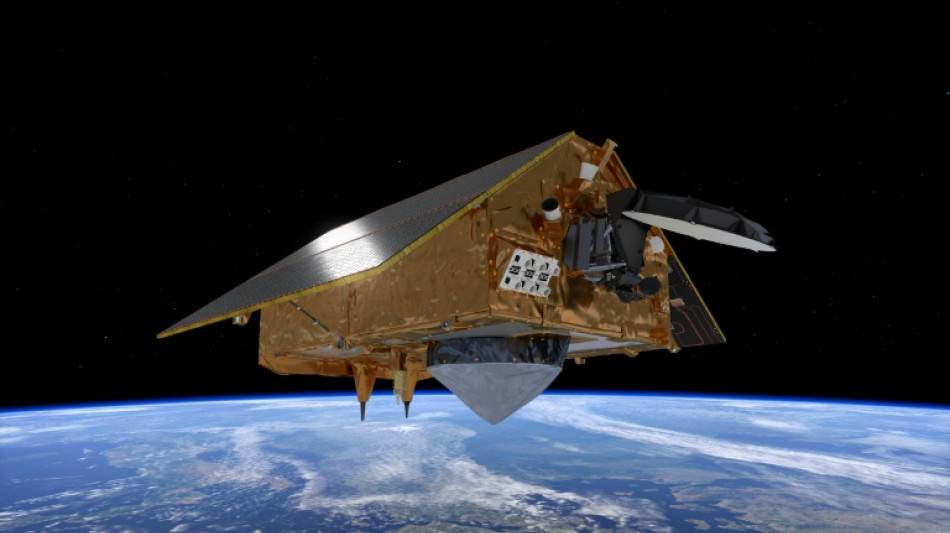
Private satellites give boost to public sector in climate fight / Photo: © EUROPEAN SPACE AGENCY/AFP/File

 Spain brush aside Croatia in Nations League, England down Czechs

 Trump hails 'morally binding' AI self-regulation pledge

 Yamal inspires Spain to Croatia romp on World Cup homecoming

 UN to hold fourth informal poll of secretary-general candidates

 Who are the Emiratis behind crisis-hit Manchester City?

 Singer Angelique Kidjo urges Africans to 'create together'

 Alleged Rihanna mansion shooter mentally fit for trial, says judge
 Mystery over UK airbase scare as police find petrol not explosives

 OpenAI unveils low-cost AI model, a day after shelving Astra upgrade
 Premier League confirms Man City guilty of serious financial breaches
 Brazil's Lula turns to Bad Bunny tune to criticise Trump ahead of polls

 Nigerian dancer eyes world record after seven-day marathon

 Swiss regulator concludes Julius Baer bank probe
 Brazil's patron saint pulled into latest election scrap

 Football overload leaves players near 'breaking point', warns Tebas

 Paris Eiffel Tower says chief to step down after uproar over removing women staff

 Amaze Holdings (NYSE: AMZE) Executes Binding LOI to Acquire BullionFX | Alchemy, a Decentralized Gold-Backed Financial Ecosystem for Valued at US$155 Million
 Clashes between French teens, police as school blockades intensify
 Stocks move sideways despite oil moving lower
 African leaders to gather in Egypt for business summit

 UK decides against charging foreign visitors for museums

 Dallaglio to sell England World Cup winners' medal

 Brazil come from behind to beat Australia 4-2 in friendly

 Ruthless An retains Asian Games badminton crown as Kunlavut triumphs

 Alonso to stay with F1 team Aston Martin in 2027
From satellites that can pinpoint the sources of industrial pollution, to others that track hurricane movements by the hour, space has emerged as a key front in the fight against climate change.
New launches are -- literally and metaphorically -- skyrocketing, and giving rise to increased cooperation between space agencies and private companies.
Among the most fruitful areas of collaboration: tracking greenhouse gas emissions.
The potent planet heating gas methane is regularly measured in the atmosphere by one of the satellites of the European Union Space Programme's Copernicus mission.
The spacecraft scans the entire globe, but its resolution is in the order of several kilometers, making it hard to zero in on the exact source.
That's where private companies can step in.
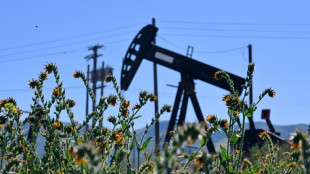
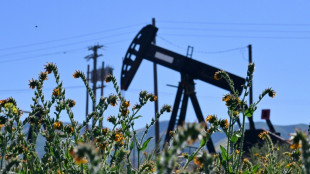
One of them, the Canadian GHGSat, currently has nine small satellites in orbit, each the size of a microwave. Their mission: to fly over oil and gas sites, looking for methane leaks. By orbiting at a lower altitude, they can take a detailed look at each site.
"Think of it as the wide angle lens camera, versus the telephoto lens camera," Stephane Germain, the company's founder, told AFP. The Copernicus team is in constant touch with GHGSat, telling them where to point their cameras.
GHGSat then sells its information to oil companies, such as Total, Chevron, ExxonMobil, and Shell.
"More and more companies are interested in that because they're realizing they have to better understand their own carbon footprints," said Germain, especially since their customers are insisting on better accounting of emissions' life cycles.
A common source of methane emissions are unlit flares, which are meant to burn off the gas.
GHGSat estimates it has prevented the equivalent of 10 megatons of carbon dioxide entering the atmosphere, equivalent to 1.3 million homes' energy use for a year.
Other companies plan to enter the sector, including France's Absolut Sensing. Another company, Kayrros, has no satellites of its own but is analyzing Copernicus data to track down the biggest leaks.
- Technological advances -
"The big picture shows you that there is a problem. And the small one then focuses in higher resolution and sells information to somebody. So this works very well together," European Space Agency director Josef Aschbacher said of such public-private partnerships to AFP.
But government agency constellations -- comprised of mostly large, very expensive satellites -- remain the backbone of the Earth observation system.
Copernicus will soon enter a new era, with new missions such as CO2M measuring the carbon dioxide released specifically by human activities. NASA has about thirty Earth observation missions.
In the last six months alone, the US space agency has launched the SWOT mission to survey the Earth's surface water in unprecedented detail, TEMPO to measure pollutants in the troposphere above North America, and TROPICS, to track tropical weather systems, including hurricanes, hour by hour.
Advances in technology make it possible to measure today what was thought impossible just five or 10 years ago, said Aschbacher.
- Better forecasts -
In addition to these scientific missions, meteorological satellites, such as those overseen by the US National Oceanic and Atmospheric Administration (NOAA) and the European Organisation for the Exploitation of Meteorological Satellites (EUMETSAT), play a vital role.
Their data, collected over decades, have revealed stark shifts to global climate systems: from warming sea and land temperatures to receding Antarctic ice sheets, helping feed the models climate science relies on today.
But increasingly, they can also help play a major role in adapting to a heating world. To mitigate the impact of increasingly frequent natural disasters, "you've got to provide better forecasts," NOAA's chief scientist Mitch Goldberg told AFP.
The agency has been increasing its partnerships with the private sector. For example, it has teamed up with the company GeoOptics to collect information on the humidity or the temperature of the atmosphere.
According to a report by Inmarsat and Globant, if current satellite technologies were universally adopted, they could reduce carbon emissions by 5.5 gigatons -- quadrupling current reductions of 1.5 gigatons enabled by the sector.
These savings could be achieved by, for example, helping the aviation and maritime sectors decarbonize through voyage optimization, weather routing and air traffic control management.
K.Thomson--BTB