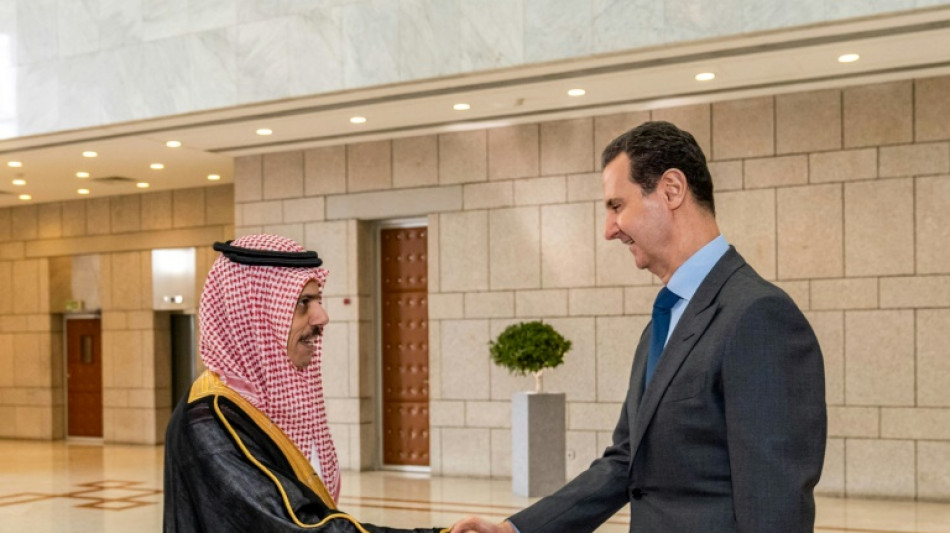
Syria's Assad to emerge from the cold at Arab League summit / Photo: © Syrian Presidency Facebook page/AFP

 Spain brush aside Croatia in Nations League, England down Czechs
 Trump hails 'morally binding' AI self-regulation pledge
 Yamal inspires Spain to Croatia romp on World Cup homecoming

 UN to hold fourth informal poll of secretary-general candidates
 Who are the Emiratis behind crisis-hit Manchester City?

 Singer Angelique Kidjo urges Africans to 'create together'
 Alleged Rihanna mansion shooter mentally fit for trial, says judge
 Mystery over UK airbase scare as police find petrol not explosives

 OpenAI unveils low-cost AI model, a day after shelving Astra upgrade
 Premier League confirms Man City guilty of serious financial breaches
 Brazil's Lula turns to Bad Bunny tune to criticise Trump ahead of polls

 Nigerian dancer eyes world record after seven-day marathon
 Swiss regulator concludes Julius Baer bank probe
 Brazil's patron saint pulled into latest election scrap

 Football overload leaves players near 'breaking point', warns Tebas
 Paris Eiffel Tower says chief to step down after uproar over removing women staff

 Amaze Holdings (NYSE: AMZE) Executes Binding LOI to Acquire BullionFX | Alchemy, a Decentralized Gold-Backed Financial Ecosystem for Valued at US$155 Million

 Clashes between French teens, police as school blockades intensify
 Stocks move sideways despite oil moving lower
 African leaders to gather in Egypt for business summit
 UK decides against charging foreign visitors for museums

 Dallaglio to sell England World Cup winners' medal

 Brazil come from behind to beat Australia 4-2 in friendly

 Ruthless An retains Asian Games badminton crown as Kunlavut triumphs

 Alonso to stay with F1 team Aston Martin in 2027

Syrian President Bashar al-Assad will attend this week his first Arab League summit in 13 years, his foreign minister said Wednesday, signalling regional reintegration after more than a decade of war.
The host of Friday's summit, Saudi Arabia, has championed Assad's return to the pan-Arab body and invited the Syrian leader over the objection of other regional leaders.
The Syrian government had been isolated in the region for years since its brutal crackdown on pro-democracy protests in 2011 triggered a war that has killed more than 500,000 people.
Analysts say Assad's invitation also shows the clout of Saudi Arabia, which is casting itself as a peacemaker and asserting itself in multiple crises across the Middle East.
Following a preparatory meeting on Wednesday, Syrian Foreign Minister Faisal Mekdad told reporters Assad would attend Friday's event in Jeddah in person.
Washington, however, said it did "not believe that Syria merits readmission to the Arab League".
"We are not going to normalise relations with the Assad regime and we certainly don't support others doing that as well," State Department spokesman Vedant Patel told reporters in Washington.
Beyond rekindling ties with the Assad government, the summit is expected to devote energy to two conflicts: a month-long war between two generals in Sudan and the eight-year civil war in Yemen.
It is taking place in the same city where representatives of the two Sudanese camps have been locked in negotiations for a week and a half brokered by Saudi and US officials.
An envoy of Sudan's army chief Abdel Fattah al-Burhan would represent him at the summit, the Arab League's deputy head Hossam Zaki said.
In Yemen, Saudi Arabia is pushing for a peace deal with Iran-backed Huthi rebels after eight years at the helm of a military coalition that failed to defeat them on the battlefield.
- Wave of reconciliation -
Recent diplomatic shifts were accelerated by a surprise Chinese-brokered normalisation deal with Iran announced on March 10.
Less than two weeks later, Saudi Arabia announced it had begun talks on resuming consular services with Iran ally Syria, the first public step in a rapprochement that has since seen the countries' foreign ministers exchange visits.
Yet Assad's presence in Jeddah on Friday does not guarantee progress on resolving Syria's brutal war.
In areas of northwestern Syria that remain under rebel control, there have been repeated mass protests against Assad's return to the Arab fold.
Nor is it clear that the pan-Arab body can extract concessions on issues like the fate of Syrian refugees or surging trade in the drug captagon.
"It's important to remember that Assad's return to the Arab League is a symbolic measure to begin the process of ending his regional isolation," said Anna Jacobs, senior Gulf analyst with the International Crisis Group.
"In many ways it is the start of political normalisation, but it will be even more important to watch if economic normalisation comes with it, especially from Gulf Arab states."
Assad's stay in Jeddah will be followed across the region, perhaps nowhere more closely than in Damascus.
"This is the first time in many years that my family and I have been interested in political news because we had lost hope," said Haidar Hamdan, a 44-year-old geography teacher in the Syrian capital.
His country's reintegration into the Arab League represents a "return to the world order", he said, adding that he expected shuttered embassies and companies to reopen, and "movement and life (to) return to the country".
Other Damascus residents have more subdued expectations.
"We are optimistic, but we know that the Arab summit is not a magic wand that can be waved to solve all of Syria's problems," said Sawsan, a 29-year-old who works at a car dealership.
- 'Jury still out' -
The same could be said of the Sudan and Yemen files.
Last week in Jeddah, Sudan's warring parties agreed to respect humanitarian principles, but they have made no breakthrough on a truce in talks that one US official called "very tough".
Separately, the Saudi ambassador to Yemen said the next steps towards a peace deal with the Huthis were unclear, though he said he believed all sides were serious about ending the war.
Regardless of what happens, there is little doubt about Saudi Arabia's approach, both for the summit and beyond, said Torbjorn Soltvedt of the risk intelligence firm Verisk Maplecroft.
"There are clear signs that Saudi Arabia is shifting away from its previously adventurist foreign policy and seeking to reinvent itself as the region's main diplomatic broker," Soltvedt said.
He added, though, that "the jury is still very much out" on whether this mission will succeed.
J.Horn--BTB