Coming years 'critical' to slash plastic pollution: UN / Photo: © AFP

 UN to hold fourth informal poll of secretary-general candidates

 Who are the Emiratis behind crisis-hit Manchester City?

 Singer Angelique Kidjo urges Africans to 'create together'

 Alleged Rihanna mansion shooter mentally fit for trial, says judge
 Mystery over UK airbase scare as police find petrol not explosives

 OpenAI unveils low-cost AI model, a day after shelving Astra upgrade
 Premier League confirms Man City guilty of serious financial breaches
 Brazil's Lula turns to Bad Bunny tune to criticise Trump ahead of polls

 Nigerian dancer eyes world record after seven-day marathon

 Swiss regulator concludes Julius Baer bank probe
 Brazil's patron saint pulled into latest election scrap

 Football overload leaves players near 'breaking point', warns Tebas

 Paris Eiffel Tower says chief to step down after uproar over removing women staff

 Amaze Holdings (NYSE: AMZE) Executes Binding LOI to Acquire BullionFX | Alchemy, a Decentralized Gold-Backed Financial Ecosystem for Valued at US$155 Million
 Clashes between French teens, police as school blockades intensify
 Stocks move sideways despite oil moving lower

 African leaders to gather in Egypt for business summit

 UK decides against charging foreign visitors for museums

 Dallaglio to sell England World Cup winners' medal

 Brazil come from behind to beat Australia 4-2 in friendly

 Ruthless An retains Asian Games badminton crown as Kunlavut triumphs

 Alonso to stay with F1 team Aston Martin in 2027

 China badminton 'still strong' despite Asian Games slump
 'Exceptional' Turner painting shown in Rome before sale

 European stocks climb as oil dips

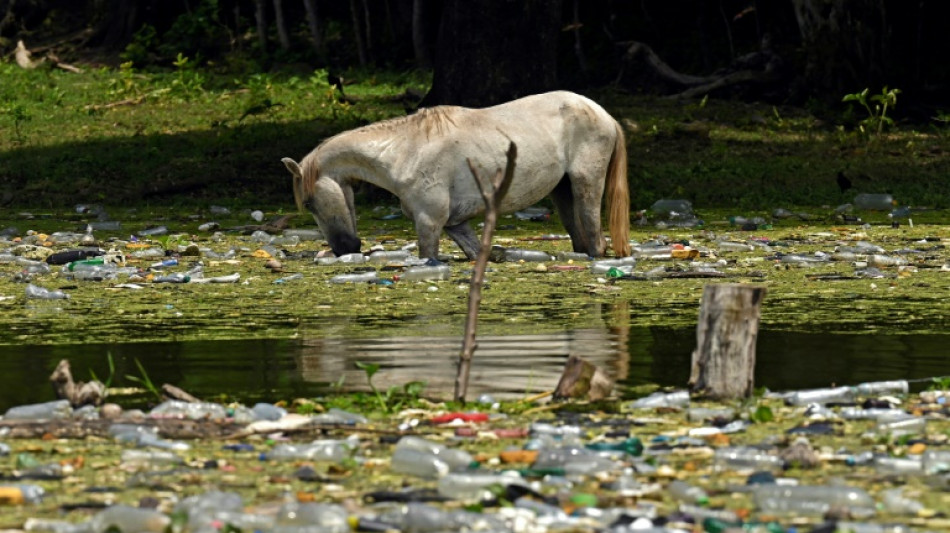
The world must halve single-use plastics and slash throwaway consumption to stem the tide of environmental pollution, according to a UN report on Tuesday that warns the next few years are critical.
Concern is growing about the impacts of microplastics -- produced when plastic products break down in the environment -- which have been found from the deepest oceans trenches to top of Mount Everest.
In humans, they have been detected in blood, breast milk and placentas.
The report by the United Nations Environment Programme (UNEP) comes two weeks before negotiators from nearly 200 countries meet in Paris for a new round of negotiations aimed at reaching a legal agreement next year to end plastic pollution.
It lays out a three-pronged plan based on reuse, recycling and diversifying the materials used -- to help slash plastic pollution 80 percent by 2040 overall and cut single-use plastic production by half.
The report cited research estimating plastic could emit 19 percent of global greenhouse gas emissions by 2040.
That would essentially prevent the world from meeting its Paris Agreement commitment to limit the rise in the planet's average temperature to 1.5 degrees Celsius above the pre-industrial level.
"The way we produce, use and dispose of plastics is polluting ecosystems, creating risks for human health and destabilising the climate," said Inger Andersen, UNEP executive director.
She said the roadmap laid out in the report "dramatically reduces these risks, through adopting a circular approach that keeps plastics out of ecosystems, out of our bodies and in the economy".
- Reuse, recycle, replace -
In 2020, approximately 238 million metric tonnes (mmt) of waste from short-lived plastics -- like packaging that ends up in municipal waste -- was generated worldwide.
Roughly half of that was mismanaged -- for example dumped in the environment or burned.
Without significant changes, UNEP expects annual plastic waste to reach 408 mmt by 2040, including 380 mmt of new fossil-fuel-based plastics. That would mean some 227 mmt of plastics would end up in the environment.
The report estimates that with a range of "systems change" solutions, that pollution figure could be reduced to 41 mmt.
But the report says there is no time to waste.
"The next three to five years present a critical window for action to set the world on the path towards implementing the systems change scenario by 2040," it warned.
Reuse in particular was identified as the most effective measure -- cutting plastic pollution up to 30 percent by 2040 -- with the introduction of things like refillable water bottles, packaging take-back schemes and "reverse vending machines".
While governments have to incentivise the shift, consumers will have to "forego convenience of disposable and get used to products looking less shiny".
Better recycling could cut pollution by a fifth, the report found, while replacing plastics with alternatives, like paper or other compostable materials, could help cut waste another 17 percent.
K.Thomson--BTB