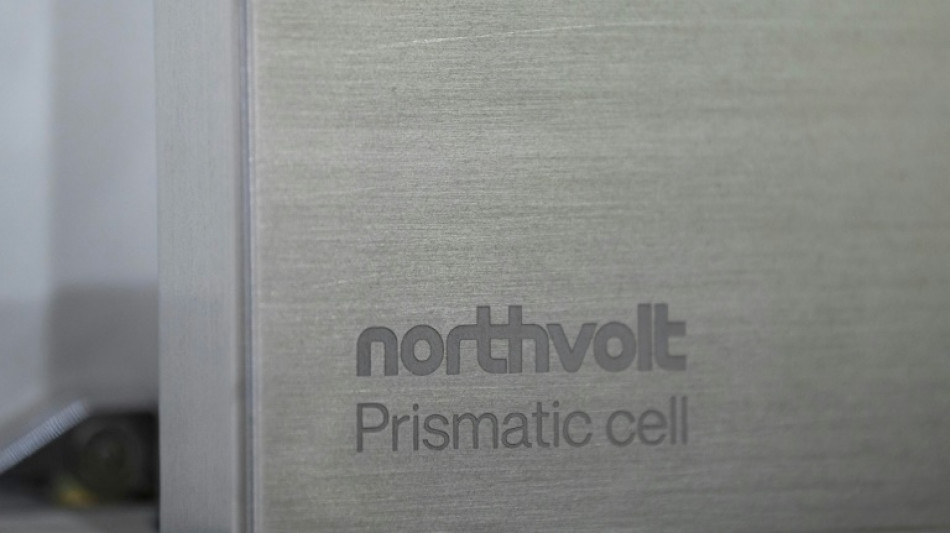
Europe charges up car battery drive with new plants / Photo: © AFP

 Strengthening El Nino likely to 'rank among largest' on record: US agency

 Jorge Jesus to take over as Portugal coach after World Cup exit

 Ebola outbreak is 'fastest growing ever' as 600 die

 Stocks shrug off tensions to rise on renewed tech interest
 Hong Kong welcomes dogs into restaurants, to pet owners' delight
 England recall Slade for Fiji as pressure mounts on Borthwick

 Lock Petti to become latest Argentina centurion in Nations Championship Test
 EU parliament greenlights digital euro

 Two thirds of EU faced harmful ozone levels during heatwave: report

 Russia to take on World Athletics at CAS over ban
 600 dead in DR Congo Ebola outbreak
 'Total Eclipse' singer Bonnie Tyler, queen of the 80s power ballad, dies at 75

 Myanmar names Norwegian Andersen as head of national team

 Russell back as Scotland tackle world champions South Africa

 Tour de France yellow jersey protocol: 90 minutes of 'stress'

 Crude stabilises after US-Iran flare-up rocked peace hopes

 Playmaker Jalibert moves to fullback as France swing axe for Australia clash

 Australian sprint star Gout out of U20 worlds with hamstring tear

 Unions to protest as Volkswagen thrashes out job cut plans

 Teeth bared in Greece's bear-human showdown

 Alpacas, mini pigs on the loose after floods hit south China zoo
 All Blacks make five changes for Italy Nations Championship clash

 Western Europe records its hottest June as heatwaves surge: EU monitor

 Fashion's mystery man Margiela sells off his archives
 Nuclear test-scarred Marshall Islands criticises China missile

Europe's efforts to build up its battery-making capacity got a major boost Friday as Sweden's Northvolt and Taiwan's ProLogium announced projects to build factories in Germany and France.
The continent has been racing to produce more electric vehicles as part of its green transition, with the clock ticking down on an EU deadline of 2035 to phase out the sale of cars using fossil fuels.
A flurry of new battery plant projects are in the pipeline in Europe, but it is still playing catch up and faces tough competition from both the United States and China.
So the announcement by battery-maker Northvolt on Friday that it would go ahead with building a multi-billion-euro plant in northern Germany, after months of uncertainty, came as a major boost.
"Germany can look forward to one of the most significant... projects of the energy and transport transition, which will create thousands of green tech jobs," said German Economy Minister Robert Habeck.
The so-called gigafactory will be able to supply around one million electric vehicles with batteries a year, and will create 3,000 jobs in Heide, in Schleswig-Holstein state, Northvolt and Berlin said in a statement.
Construction is expected to start this year, with deliveries of batteries from the plant to begin in 2026.
After initially announcing the project in early 2022, Northvolt boss Peter Carlsson had warned recently it could be postponed due to surging energy costs in Germany following Russia's invasion of Ukraine.
He also noted that the United States was offering enticing subsidies, as part of a huge programme to accelerate the country's transition to a low-carbon future.
But Northvolt ultimately decided to push on with the project in Germany, home to leading carmakers including Volkswagen -- whose 10 brands include Audi, Porsche and Skoda -- BMW and Mercedes-Benz.
The German economy ministry said the federal government and Schleswig-Holstein state will provide subsidies for the project.
Subsidies will be provided in part under a EU scheme that was recently introduced as the bloc raced to come up with response to the generous funding on offer from Washington.
The European Commission has to approve the funding, but if it does it will be the first time the scheme has been used in Germany, the economy ministry said.
- US subsidy threat -
Shortly after confirming it would go ahead with the German project, Northvolt also said it was considering a new factory in Canada or the United States, with a decision expected in the coming months.
Canada is also covered by Washington's vast subsidy scheme.
Northvolt already has one battery plant in Sweden, and is building a second.
In France meanwhile, Taiwanese battery maker ProLogium announced it will invest 5.2 billion euros ($5.7 billion) in building a new factory in Dunkirk.
Its first European plant, the group hopes it will start production at the end of 2026, and ramp up over several years until it has some 3,000 employees.
The factory will produce batteries for hundreds of thousands of cars once at full capacity.
The group specialises in the development of "solid-state" batteries which are considered more powerful, safer and quicker to charge than the lithium-ion cells often used in electric vehicles.
The Taiwanese company said it decided on Dunkirk because it allows proximity to its customers, with many electric vehicle factories located in northern Europe.
About 50 lithium-ion battery factories are planned to be built in Europe by 2030.
Germany is furthest ahead, with 498 gigawatt hours of projects in the pipeline, followed by Hungary, Norway and France, according to NGO Transport and Environment.
But the NGO says some of these projects could be scaled back or delayed, mainly due to competition from the United State's subsidies.
The US scheme was introduced in part to counter the might of China, which has traditionally been dominant in a range of green tech industries, including making electric batteries.
O.Lorenz--BTB