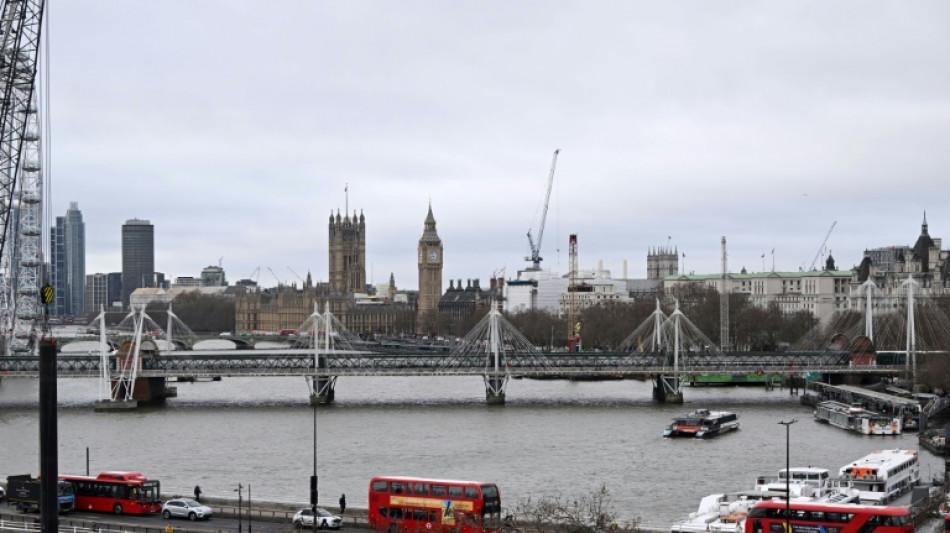
UK economy ekes out growth in first quarter / Photo: © AFP/File

 Man City must be relegated after guilty verdict says club's former chairman

 German far-right aims to lead Saxony-Anhalt govt in December

 Little damage as Hurricane Polo sweeps over Mexico's Pacific coast

 Manchester City guilty of breaking financial rules - Premier League

 FIFA boss Infantino blasted as would-be 'emperor' by UEFA's Ceferin
 Stocks move lower despite oil prices dropping

 AI driving up innovation investment: UN

 UN Security Council extends Haiti mission by 6 months

 Man Utd do not deserve medals if Man City stripped of titles: Rooney

 Vana Completes Expanded Staking as Part of the Vega Upgrade, Publishes Expanded VANA Token Economics

 Spain to cap gas price hikes, extend fuel discounts

 'We just need rain': Germany's Rhine river hits new low

 Yemen health system at 'breaking point': WHO

 Ireland undecided on second Israel match: coach

 France's Le Pen defiant after top ally hit by antisemitism claims

 Tom Cruise trades stunts for satire as toxic tycoon 'Digger'

 MEXC Unveils "WE SEE YOU" Brand Visual Refresh, Putting People Behind Every Trade in Focus

 Thai capital cleans up after deadly floods

 NATO, EU allies rally to Estonia after 'sabotage' blamed on Russia

 Families demand justice for Cameroon's 'nightmare' wave of murdered women

 Tebas says Man City should face 'most severe' sanctions if guilty of rule breaches

 Pochettino calls Man City success 'a period of deception'

 Settler attack on West Bank village injures Israeli forces, drawing rare rebuke

 Mystery over UK airbase scare after reports no explosives found

 Spanish govt races to adopt housing law under protest pressure

Britain's economy grew 0.1 percent over the first quarter despite weakening in March, official data revealed Friday, as output continues to be hit by high inflation and strikes.
After narrowly avoiding recession last year, the economy advanced 0.5 percent in January before flattening in February and sliding 0.3 percent in March, the Office for National Statistics said in a statement.
"The fall in March was driven by widespread decreases across the services sector," noted ONS director of economic statistics, Darren Morgan.
"Despite the launch of new number plates, cars sales were low by historic standards -- continuing the trend seen since the start of the pandemic -- with warehousing, distribution and retail also having a poor month," he added.
The data comes one day after the Bank of England forecast that the UK economy would avoid recession this year despite the country's annual inflation stuck above 10 percent.
With consumer prices continuing to rise at a fast pace, the BoE on Thursday hiked its key interest rate by a further quarter-point to 4.5 percent.
It was the central bank's 12th increase in a row, putting the rate at the highest level since the global financial crisis in 2008.
Elevated inflation is eroding the value of workers' wages, causing mass strikes across Britain, the latest being stoppages on the railway network Friday.
- 'Fragile economy' -
"A weaker economy in March underscores its fragility despite a fall in wholesale energy prices, improving supply chain conditions, and consumer confidence that has... recovered from multi-year lows," noted Yael Selfin, chief economist at KPMG UK.
"While recession is probably no longer on the cards, vulnerabilities resulting from higher borrowing costs and tighter credit are likely to dampen business and household activity this year," she added.
The latest BoE hike is set to deepen the crunch in living standards as retail banks pass on the increase, resulting in higher repayments on loans, including mortgages.
At the same time, those who can afford to save will benefit for increased fixed returns on investments.
UK annual inflation stood at 10.1 percent in March, the highest level in the Group of Seven richest nations.
British Prime Minister Rishi Sunak and the BoE blame the high level partly on rises to pay and have urged employers to show restraint.
Sunak's Conservative government last week suffered a drubbing in local elections, as voters gave their verdict over a cost-of-living crisis despite government efforts to partly subsidise energy bills.
K.Brown--BTB