Dead rivers, flaming lakes: India's sewage failure / Photo: © AFP

 Spain to cap gas price hikes, extend fuel discounts
 'We just need rain': Germany's Rhine river hits new low
 Yemen health system at 'breaking point': WHO

 Ireland undecided on second Israel match: coach

 France's Le Pen defiant after top ally hit by antisemitism claims

 Tom Cruise trades stunts for satire as toxic tycoon 'Digger'

 MEXC Unveils "WE SEE YOU" Brand Visual Refresh, Putting People Behind Every Trade in Focus
 Thai capital cleans up after deadly floods

 NATO, EU allies rally to Estonia after 'sabotage' blamed on Russia

 Families demand justice for Cameroon's 'nightmare' wave of murdered women
 Tebas says Man City should face 'most severe' sanctions if guilty of rule breaches

 Pochettino calls Man City success 'a period of deception'

 Settler attack on West Bank village injures Israeli forces, drawing rare rebuke

 Mystery over UK airbase scare after reports no explosives found
 Spanish govt races to adopt housing law under protest pressure

 Estonia slams Russian 'sabotage' after arson attack on defence company
 Slovenia sees surge in '.si' sites after Trump hypes 'super intelligence'

 'Like a dream' for An as Games organisers 'sorry' for latest mix-up
 Tokyo suffers longest streak of rainy days on record

 Indonesia charges train driver over crash that killed 16 women
 Ruthless An makes history to retain Asian Games badminton crown

 Australian central bank lifts key interest rate to 15-year high
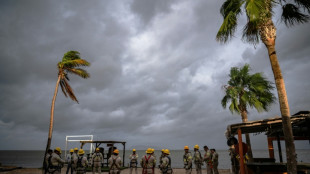 Polo makes landfall in Mexico as Category 3 hurricane
 South Korea team latest to be bussed to wrong Asian Games venue

 Bears thrash Eagles 27-7 as third-string QB Keenum shines
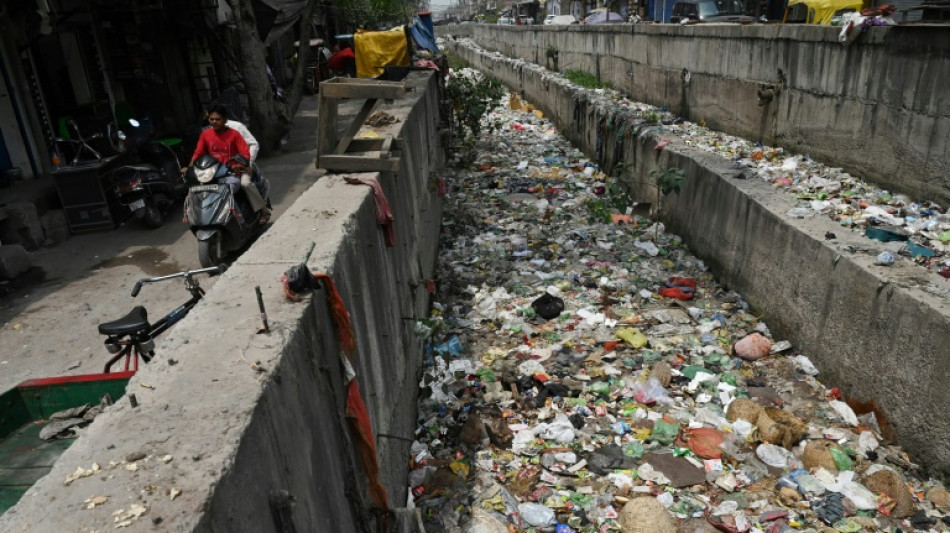
Mohammed Azhar holds his baby niece next to a storm drain full of plastic and stinking black sludge, testament to India's failure to treat nearly two-thirds of its urban sewage.
"We stay inside our homes. We fall sick if we go out," the 21-year-old told AFP in the Delhi neighbourhood of Seelampur, where open gutters packed with plastic and sickly greyish water flow alongside the narrow lanes.
"It stinks. It attracts mosquitoes. We catch diseases and the kids keep falling sick," he added. "There is no one to clean the filth."
India at the end of April was projected to have overtaken China as the world's most populous country, according to the United Nations, with almost 1.43 billion people.
Its urban population is predicted to explode in the coming decades, with over 270 million more people forecast to live in its cities by 2040.
But of the 72 billion litres of sewage currently generated in urban centres every day, 45 billion litres -- enough to fill 18,000 Olympic-sized swimming pools -- aren't treated, according to government figures for 2020-21.
India's sewerage system does not connect to about two-thirds of its urban homes, according to the National Faecal Sludge and Septage Management Alliance (NFSSM).
Many of the sewage treatment plants in operation don't comply with standards -- including 26 out of Delhi's 35 facilities, according to media reports.
Coupled with huge volumes of industrial effluent, the sewage is causing disease, polluting India's waterways, killing wildlife and seeping into groundwater.
- Ecologically dead -
Although India has made major progress in reducing child mortality, diarrhoea -- caused mostly by contaminated water and food -- remains a leading killer.
More than 55,000 children under five died of diarrhoea across India in 2019, according to a study published last year in the scientific journal BMC Public Health.
The Yamuna in Delhi is one of the world's filthiest rivers and is considered ecologically dead in places, although people still wash clothes and take ritual baths in it.
It often billows with white foam, and facilities processing drinking water from the river for Delhi's 20 million people regularly shut down because of dangerous ammonia levels.
Despite some bright spots, as well as efforts to plant more trees alongside rivers, the situation elsewhere is often no better in big cities including Mumbai and Chennai.
In Bengaluru, massive Bellandur Lake has on occasion caught fire when methane, generated by bacteria feasting on sewage in the oxygen-depleted water, ignited.
- 'Water crisis' -
Mridula Ramesh, author of a book about India's water woes who lives in a "nearly" net-zero-waste home, said properly treating sewage into useable water would help solve the crisis.
According to the World Bank, India is one of the most "water-stressed" countries in the world, with plummeting water tables and increasingly erratic monsoon rains.
Chennai nearly ran out of water briefly in 2019, and other cities may see similar calamities in the coming years due to excessive groundwater pumping and rainfall volatility.
"India is headed for a water crisis. Sewage can so easily be co-opted to fight that and help us to a very large extent solve the problem in our cities," Ramesh told AFP.
This could be achieved with decentralised treatment plants partially funded by the private sector or non-governmental organisations, with some of the fully treated sewage reused or released into local lakes.
"India's water is so seasonal. Many cities in India get 50 rain days... but sewage is available every day because you go to the bathroom every day... It's such a powerful weapon," she said.
For Khalil Ahmad, standing by the revolting open drain in Seelampur as flies buzz around, a solution can't come soon enough.
"Children keep falling sick... If they don't get treatment and medicine, the children will die," he told AFP.
O.Lorenz--BTB