Giant SpaceX rocket leaves crater, serious damage at Texas base / Photo: © AFP/File

 Ruthless An makes history to retain Asian Games badminton crown

 Australian central bank lifts key interest rate to 15-year high

 Polo makes landfall in Mexico as Category 3 hurricane

 South Korea team latest to be bussed to wrong Asian Games venue

 Bears thrash Eagles 27-7 as third-string QB Keenum shines

 All Blacks name veteran Taylor captain as Mo'unga seizes 10 jersey

 Race against time as Asian Games cricket quarter-finals washed out

 India turns to corals and seagrass to shield against rising seas

 Manchester City's Premier League charges: What comes next?

 Brazil's cellphone crime: a security nightmare in every pocket

 Russia pummels Kyiv in latest deadly attack
 NFL Giants obtain QB McCarthy from Vikings

 Deal for evicted Spanish pensioner as PM seeks new housing law

 Clippers apologize, warn fans of 'challenges' after Leonard scandal

 Turkish comedian convicted for Erdogan 'insult' freed pending appeal

 Trump announces 'biggest' US steel plant in battleground Iowa

 Olise wonder strike gives Zidane's France win in Belgium

 US stocks fall, bond yields rise as Middle East war drags on

 Trump denies offering to sell arms to China's Xi

 Wemby ready for NBA Spurs to move rivals in climb to top

 Ukraine to postpone some spending amid delays in aid: PM

 Tuchel says Czech Republic game 'not yet a must-win'

 MaXhosa puts South Africa on the Paris fashion map
 Rose, Scott among 2027 World Golf Hall of Fame finalists

 Brunson says NBA champion Knicks can't get satisfaction

Flying chunks of concrete, twisted metal sheets, craters blasted deep into the ground: the thunderous power of SpaceX's first test flight of Starship -- the biggest and most powerful rocket ever built -- inflicted serious damage on its Texas launch site.
Repairing the damage from Thursday's unmanned test flight is expected to take months, potentially delaying further launch attempts and slowing the development of a rocket NASA plans to use on its upcoming Moon missions.
SpaceX boss Elon Musk had said before the test that just getting Starship in the air without destroying its launch pad would be "a win."
Luckily for Musk, the 390-foot-tall (120-meter) rocket successfully lifted off, climbing for about four minutes until it tumbled and exploded, well over the Gulf of Mexico.
But SpaceX engineers may have underestimated the damage that Starship's 33 first-stage rocket engines would do.
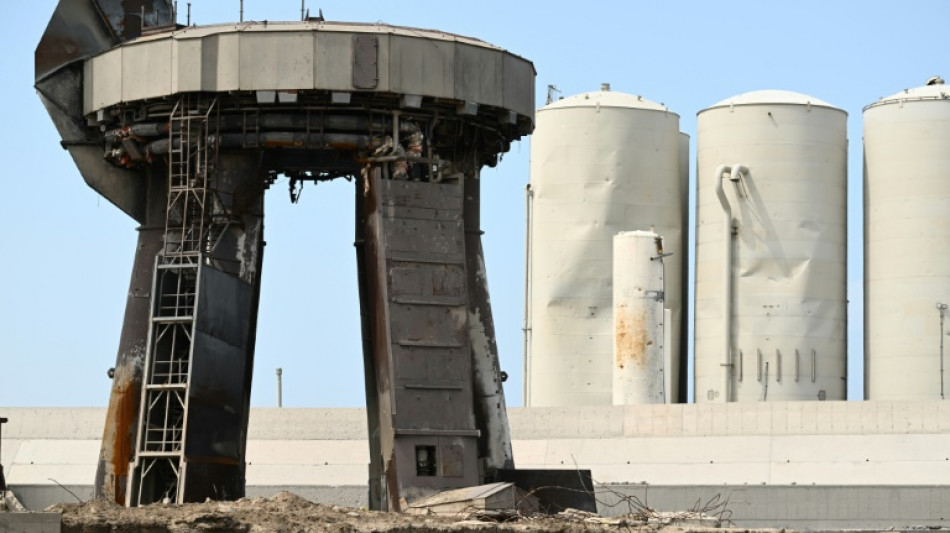
A few days later, the scene around the launch pad is one of desolation, an AFP photographer saw.
During takeoff, SpaceX video showed a hail of debris being blasted as far as the Gulf of Mexico, over 1,400 feet (420 meters) away. According to local press reports, a cloud of dust floated over a small town several miles (kilometers) away.
Photos of the launch site show the gigantic launch tower still standing while the rocket mount, which supports Starship before liftoff, damaged but still intact.
Beneath it, however, lies a huge crater, images posted on social media showed.
"The force of the engines when they throttled up may have shattered the concrete, rather than simply eroding it," Musk conceded Saturday on Twitter -- another company in his portfolio.
- A delay of months -
Olivier de Weck, a professor of astronautics and engineering at MIT, told AFP that "the radius of debris and disturbance was probably bigger than anybody anticipated."
"The main damage to the launch pad is underneath, where the flames impinge on the ground," he told AFP, adding that repairing the crater "will take several months."
De Weck said that Starship's launch site, unlike others used for such large rockets, lacked a "water deluge system."
Those are used to flood the pad with water, cooling it and absorbing shock and sound waves.
The Texas site also lacks what is known as a flame trench -- tunnels which channel hot exhaust away from the pad.
Such features come at a high price though, particularly when they have to stand up to the earth-shaking power of Starship.
After Thursday's test, Musk said that SpaceX had begun building "a massive water-cooled steel plate to go under the launch mount."
But it "wasn't ready in time," and engineers "wrongly" calculated that the pad could still withstand the test.
Known for audacious goal-setting, Musk estimates that a next launch attempt could be carried out as soon as "one to two months."
- Melting steel -
Scientist Philip Metzger, who previously worked for NASA on launch pad physics, said he thought the steel plate plan could have been "a good solution."
"The problem," he added, "is that this is such a large rocket and it takes so long to get off the pad," that the heat from the rocket's 33 engines "possibly could melt the steel."
That could be solved by pumping water through channels in the steel, "so long as they have a high enough flow rate," said Metzger, now a professor at the University of Central Florida.
He said the approach would not entirely solve the problem of shock waves, but he believes it's possible Starship has been designed to be solid enough to survive.
Designing a launch pad, Metzger told AFP, can be just as complicated as developing a rocket.
The maiden launch in November of NASA's new mega-rocket, the SLS, also caused damage to its launch pad in Florida, notably knocking launch-tower elevators out of service.
Before its next test flight, SpaceX will need to determine the exact problems behind Thursday's test.
In video broadcast by the company, several of Starship's 33 engines appeared to malfunction.
The rocket's two stages also did not separate as planned, forcing SpaceX to trigger a self-destruct mechanism.
The private aerospace firm will also have to persuade the Federal Aviation Administration (FAA) to authorize a new flight, noted de Weck.
The US agency, which is leading an investigation into the explosion, has confirmed that no injuries resulted from Thursday's test. It has said that no new tests will be approved if there is any threat to public safety.
De Weck echoed Musk's evaluation of the trial, calling it "more a success than a failure."
"The reason they're achieving these incredible capabilities," the MIT professor continued, "is because they are willing to take risks and break things.
"But they learn from it, and improve very, very quickly."
M.Odermatt--BTB