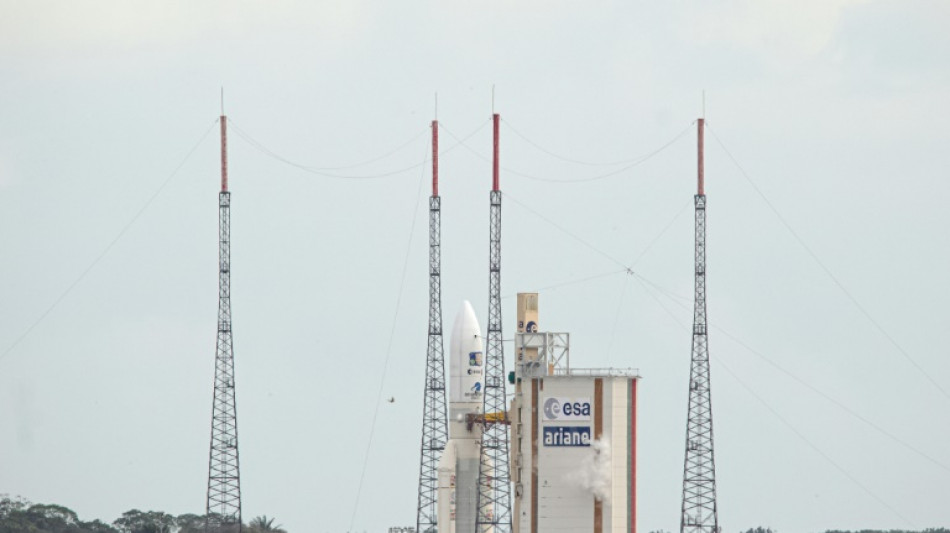
Europe's Jupiter moons mission launches on second attempt / Photo: © AFP

 South Korea volleyball team latest to be bussed to wrong Games venue

 Malaysia starts sending Myanmar migrants home

 8.3 mn refugees at risk due to 'severe' funding cuts: UN

 Stocks drop and oil rises as Hormuz hopes fade

 OpenAI cancels release of newest model due to safety concerns

 AI bosses head to White House as safety pressure builds

 Batista sacked as Costa Rica coach after six months

 Flooding, power cuts and evacuations as Hurricane Polo slams Mexico

 Dodgers eye three-peat, Red Sox face Yankees as MLB playoffs begin

 Certification of Boeing 737 MAX delayed by software bug

 Celine Dion wows Paris Fashion Week with surprise gig

 AMD buys firm founded by AI 'godmother' Fei-Fei Li

 Italy rebound in Turkey as France win late in Belgium

 Pope says concerns about AI 'should be taken seriously'

 Hurricanes to hoist title banner as NHL season begins

 Justice Alito steps aside from major US climate case

 Willis happy with England exile after retains Top 14 player award

 Spain housing protests keep heat on government as PM seeks new law

 Wissa spoils Zimbabwe homecoming as DR Congo win AFCON qualifier

 UK police release on bail five men held over airbase incident

 Ex-All Black Plummer 'sure' New Zealand will find Super Rugby solution

 Shein sees 1% revenue growth in first half of 2026

 Netherlands regrets Israel retaliation in settlements row

 Moscow seizes Russian assets of German food retailer Metro

 Bulgarian spirits inflamed by new rakia rules

The European Space Agency's JUICE space probe blasted off Friday on a mission to discover whether Jupiter's icy moons are capable of hosting extraterrestrial life in their vast, hidden oceans.
The launch on an Ariane 5 rocket from Europe's spaceport in Kourou, French Guiana came after a previous attempt on Thursday was called off due to the risk of lightning.
Despite cloudy skies, the rocket took off as planned at 09:14 am local time (1214 GMT), with teams on site saying it was on the correct trajectory.
A little under half an hour after lift-off, the uncrewed six-tonne spacecraft is scheduled to separate from the rocket at an altitude of 1,500 kilometres (930 miles). Only then can the launch be declared successful.
The Jupiter Icy Moons Explorer (JUICE) plans to take a long and winding path to the gas giant, which is 628 million kilometres (390 million miles) from Earth.
It will use several gravitational boosts along the way, first by doing a fly-by of Earth and the Moon, then by slingshotting around Venus in 2025 before swinging past Earth again in 2029.
When the probe finally enters Jupiter's orbit in July 2031, its 10 scientific instruments will analyse the Solar System's largest planet as well as its three icy moons Europa, Ganymede and Callisto.
- Liquid water -
The moons were first discovered by astronomer Galileo Galilei more than 400 years ago, but were long ignored as potential candidates for hosting life.
However, the discovery of huge oceans of liquid water -- the main ingredient for life as we know it -- kilometres beneath their icy shells has made Ganymede and Europa prime candidates to potentially host life in our celestial backyard.
JUICE will focus on Ganymede, the Solar System's largest moon and the only one that has its own magnetic field, which protects it from radiation.
In 2034, JUICE will slide into Ganymede's orbit, the first time a spacecraft will have done so around a moon other than our own.
NASA's Europa Clipper mission, which is scheduled to launch in October 2024, will focus on Ganymede's sibling Europa.
Neither mission will be able to directly detect the existence of alien life, but instead hope to establish whether the moons have the right conditions to harbour life.
Only a future mission which would land on -- and possibly drill into -- the surface could confirm whether life exists below.
- 'Extraordinary mission' -
If life is there, scientists theorise it would likely be primitive microbes like bacteria, which are capable of surviving on Earth in such extreme environments.
JUICE has 10 scientific instruments -- including an optical camera, ice-penetrating radar, spectrometer and magnetometer -- which will analyse the local weather, magnetic field, gravitational pull and other elements.
It also has a record 85 square metres of solar panels to collect as much energy as possible near Jupiter, where sunlight is 25 times weaker than on Earth.
The 1.6-billion-euro ($1.7 billion) mission will mark the first time Europe has sent a spacecraft into the outer Solar System, beyond Mars.
"This is an extraordinary mission that shows what Europe is capable of," said Philippe Baptiste, head of France's CNES space agency which manages the Guiana Space Centre.
Friday marked the second-last launch for the Ariane 5 rocket, before it is replaced by the next-generation Ariane 6.
Repeated delays for the Ariane 6, as well as Russia pulling its Soyuz rockets in response to sanctions over the war in Ukraine, have left Europe struggling to find launch its mission into space.
L.Janezki--BTB