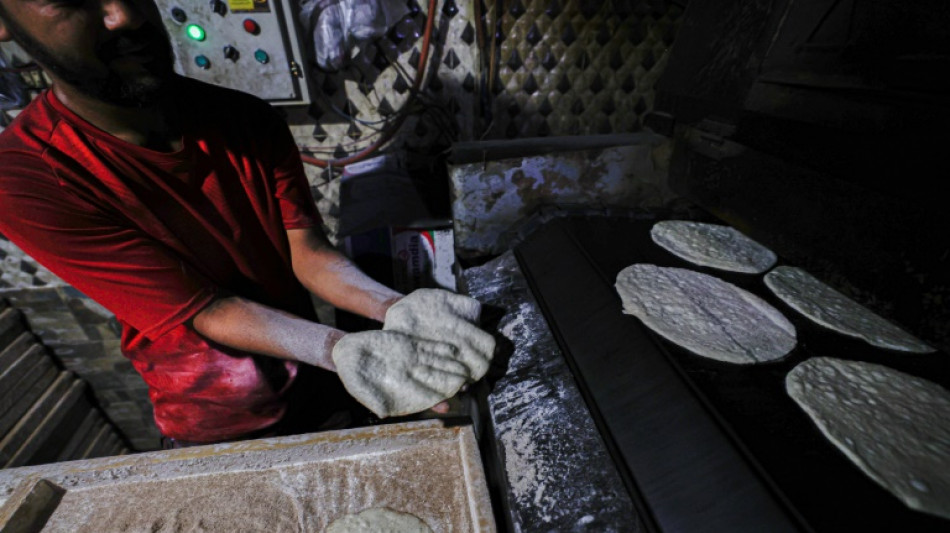
Rising costs spell doom for Egypt's village traditions / Photo: © AFP

 Table for one: how Japan's 'Solitary Gourmet' became a TV hit
 Australia's Big Bash League to open season in India

 Disappointment at Morocco's World Cup exit cannot mask pride
 In gas-rich Kazakhstan, many rely on lethal cylinders

 Chip titan SK hynix raises $26.5 bn in blockbuster US listing

 Venezuela quake tragedy threatens to set back democratic transition

 Yamal's best 'yet to come,' warns Spain coach

 'Up to him' - Curry on chance that LeBron lands with Warriors

 Revamped Ireland wary of 'bang in form' Japan

 Morocco coach Ouahbi vows team will come back stronger after World Cup exit
 Rennie says Italy won't catch All Blacks off guard

 McIlroy encouraged by 'great start' to Scottish Open

 England chase World Cup glory as Haaland allows Norway to dream
 'When it's Kylian, there's no problem': Deschamps after France into semis

 Mbappe strikes again as France beat Morocco to reach World Cup semi-finals

 Sick Olympic champion McKeown pulls out of Commonwealth Games, PanPacs

 Traeen out of Tour de France after losing yellow jersey

 Ukrainian sports minister slams IOC's 'cynical' Russia decision

 Leonard return to Raptors on hold pending Clippers probe

 US pushes for weaker truck pollution rules

 Black and cream and very Roman at Fendi haute couture show

 Spain keeping opposition far from goal at World Cup, says 'keeper Garcia

 Czech mates Muchova and Noskova to clash in Wimbledon final
 Bayeux Tapestry begins epic journey from France to London: source

 King in shades braves heat to visit London zoo

Multi-day weddings, feeding the bereaved and homemade bread are all becoming things of the past in rural Egypt, as centuries-old traditions are steadily squeezed by a punishing economic crisis.
From the south to the north of their country, more and more Egyptians -- crushed under the weight of 33.9 percent annual inflation, as of March -- are having to abandon once-cherished rituals of celebration and mourning.
In the Nile Delta, grooms once threw elaborate bachelor parties before their weddings, erecting large traditional tents, hiring bands and butchering cattle to feed guests from far and wide.
"Hardly anyone does it anymore," 33-year-old engineer Mohamed Shedid told AFP from his home town of Quweisna in Menoufia, 70 kilometres (43 miles) north of Cairo.
"We used to blame it on Covid, but then immediately afterwards everyone was hit by the economic crisis," which has pushed the price of meat beyond the reach of most families.
Even before the current crisis -- worsened by Russia's invasion of Ukraine last year, which destabilised crucial food imports -- 30 percent of Egyptians were living under the poverty line and the same number were vulnerable to doing so, according to the World Bank.
- Not in a party mood -
At the other end of the country, in the Nubian south where tourists flock to see ancient pharaonic temples by the Nile River, "soaring costs mean our weddings and funerals aren't what they once were", said Omar Maghrabi, a 43-year-old Nubian language teacher.
"Things are really hard: families need the money we once spent on these events just to keep households running."
In a year, the Egyptian pound has lost nearly half of its value, pushing consumer prices to more than double in the import-dependent country.
Weddings in Nubian villages -- renowned for their long extravagant parties -- are no longer three-day, nine-meal affairs to which the entire town is invited.
"A few months ago, there was a kind of agreement among the villages to make weddings more affordable," Maghrabi told AFP.
"Now the hosts only have to offer a light dinner" instead of the old festivities, which used to last "up to a week for the richest families".
With everyone keeping an iron grip on their purse strings, brides have also grown less discerning when it comes to wedding rings.
"Rings had to be a certain weight of gold before," the teacher said, but they have now grown finer and lighter.
With newlyweds unable to keep up with skyrocketing gold prices, the highest Muslim authority in Egypt said in March there was no religious objection to swapping gold for cheaper alternatives, namely silver.
- Communal grief, downsized -
In the tightly-knit agricultural villages of Upper Egypt, which extend southwards from Cairo along the narrow green strip of the Nile Valley, funerals are a communal affair.
With each death, families rush to bring convoys of food trays to the deceased's relatives, who quickly run out of storage space and call on neighbours and guests to help rid them of the feasts.
But now, "it's agreed that only the immediate family will cook for the bereaved", former parliamentarian Mohamed Refaat Abdel Aal, 68, told AFP from his village of Al-Adadiya in Qena, 500 kilometres south of Cairo.
"Some families are also suggesting that we limit ourselves to just the funeral, and forgo the wake," which at the bare minimum means serving drinks to guests offering condolences.
No commodity has been left undisturbed by price hikes, including simple beverages, coffee and -- catastrophically for rural households that once cherished their baking skills -- flour.
Traditional flatbread is a staple on every table in every Egyptian village, town and megacity. But in Upper Egypt, it was a source of pride for families always to make their own.
"It used to be shameful for families in villages to go and buy bread from a bakery. It would mean the house had grown lazy and complacent," Abdel Aal said.
But with the cost of grain rising 70 percent in a year, he added that "everyone is lining up outside bakeries" run by the government.
At least they can get subsidised bread there -- even if it tastes nothing like what they would make at home.
H.Seidel--BTB