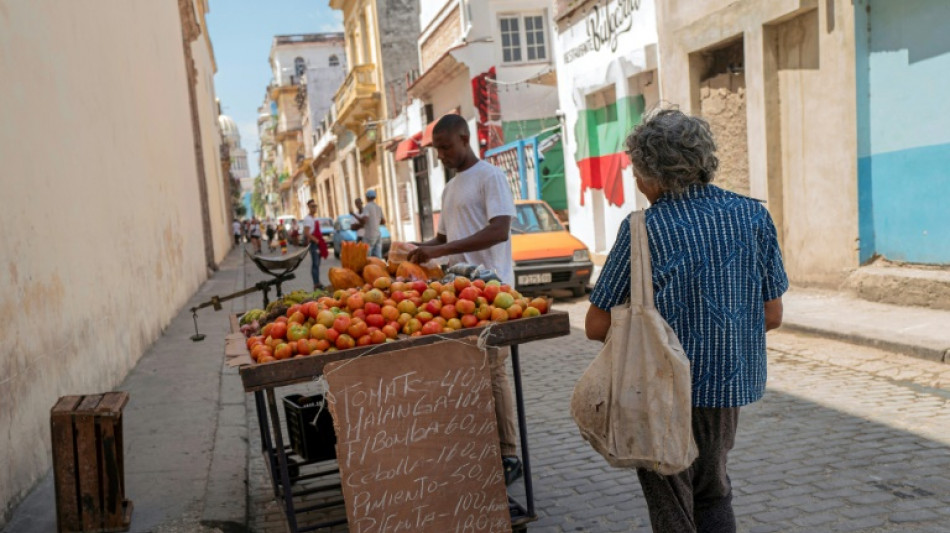
Soaring inflation wallops Cubans already battling shortages / Photo: © AFP

 NFL Giants obtain QB McCarthy from Vikings

 Deal for evicted Spanish pensioner as PM seeks new housing law

 Clippers apologize, warn fans of 'challenges' after Leonard scandal

 Turkish comedian convicted for Erdogan 'insult' freed pending appeal

 Trump announces 'biggest' US steel plant in battleground Iowa

 Olise wonder strike gives Zidane's France win in Belgium

 US stocks fall, bond yields rise as Middle East war drags on

 Trump denies offering to sell arms to China's Xi

 Wemby ready for NBA Spurs to move rivals in climb to top

 Ukraine to postpone some spending amid delays in aid: PM

 Tuchel says Czech Republic game 'not yet a must-win'

 MaXhosa puts South Africa on the Paris fashion map

 Rose, Scott among 2027 World Golf Hall of Fame finalists

 Brunson says NBA champion Knicks can't get satisfaction

 France puts out largest wildfire since 1949

 Real Madrid's Perez summoned over Barcelona referee payments comments

 Oil takes off again, Wall Street dips after Trump rejects Iran truce offer
 AlgoQuant Asset Management Selects Liquid Mercury to Enhance Digital Asset Trading Infrastructure

 UK to reopen refugee resettlement scheme to push 'safe' migration

 Pope urges Europe to help combat 'lies and deceit' in world affairs

 Iranian lawyer Nasrin Sotoudeh wins Council of Europe's rights prize

 French far-right's Bardella denies alleged 2013 antisemitic comments

 Oil up, Wall Street dips after Trump rejects Iran truce offer

 Gakpo withdraws from Netherlands squad

 SpaceX puts Starship megarocket in orbit for first time

Cuban retiree Xiomara Castellanos gets a monthly pension equivalent to $13.80. A carton of 30 eggs in the inflation-battered country costs $14.10 -- almost four times more than two years ago.
"It is hitting us hard, very hard," the 80-year-old told AFP of inflation that officially reached 39 percent last year, but is likely much, much higher.
In 2021, the one-party communist government moved to end parallel currencies in Cuba, phasing out a convertible peso that was pegged to the dollar, leaving only the regular, weaker peso, or CUP.
Since then, the currency has fallen from 24 to an official rate of 120 to the dollar. On the black market the rate is 180.
To compensate for the currency devaluation, the government two years ago raised all salaries and pensions by 450 percent.
But then, "prices... exploded and salaries did not follow," Castellanos told AFP.
- Reality is worse -
According to official figures, inflation -- which has several countries in Latin America and elsewhere in its grips -- reached 70 percent in import-dependent Cuba in 2021 and 39 percent in 2022.
But Pavel Vidal, a Cuban economist with the Javeriana University of Cali in Colombia, said real inflation was five to six times higher.
"Real inflation in 2022 exceeded 200 percent, one of the highest in the world," Vidal said, citing his own calculations.
Before 2021, said Vidal, there was no such thing as a consumer price index in Cuba, making comparisons difficult.
But from GDP figures one could infer inflation was the highest in Cuban history, he said.
Like many Cubans, Castellanos depends heavily on the "libreta" -- a ration book with which one can buy basics like rice, beans and bread at subsidized price.
You buy what you get; the choice is severely limited.
For the equivalent of $1.42 in CUP, Castellanos can get 3.1 kilograms (seven pounds) of rice, a half-liter of oil, seven eggs, 1.3 kg of black beans, 2.7 kg of chicken and a packet of coffee for the month at a dedicated subsidized store.
If you want anything else, the next point of call is a state-run supermarket, where they charge much higher prices and in dollars much-needed for the public coffers.
The last resort are the many small privately-owned stores that have popped up since the government in 2021 authorized small and medium businesses.
At one of these in Havana, a kilogram of milk powder costs about $14.
Cubans can withdraw dollars from the bank but in limited quantities, meaning that black market dealers can charge a premium.
And while for consumers the exchange rate is 120 to 180, state enterprises which make up 85 percent of the economy get a rate of 24 -- a measure to ease the pain of high import prices.
Cuban economist Omar Everleny Perez has worked out that a couple needs $113 per month to cover basic food requirements on top of what can be obtained with the "libreta."
But the average salary on the island of 11.1 million people is about $33, and a large part of the population relies on remittances sent from family abroad in those most coveted of currencies: the US dollar.
"What concerns me is that the world in which Cubans live is becoming more and more unequal," said Perez, who has observed an increase in poverty.
On Tuesday, President Miguel Diaz-Canel will take part in a virtual meeting with his leftist counterparts from Mexico, Colombia, Brazil and Argentina to discuss ways to deal with inflation.
A.Gasser--BTB